 9 min read
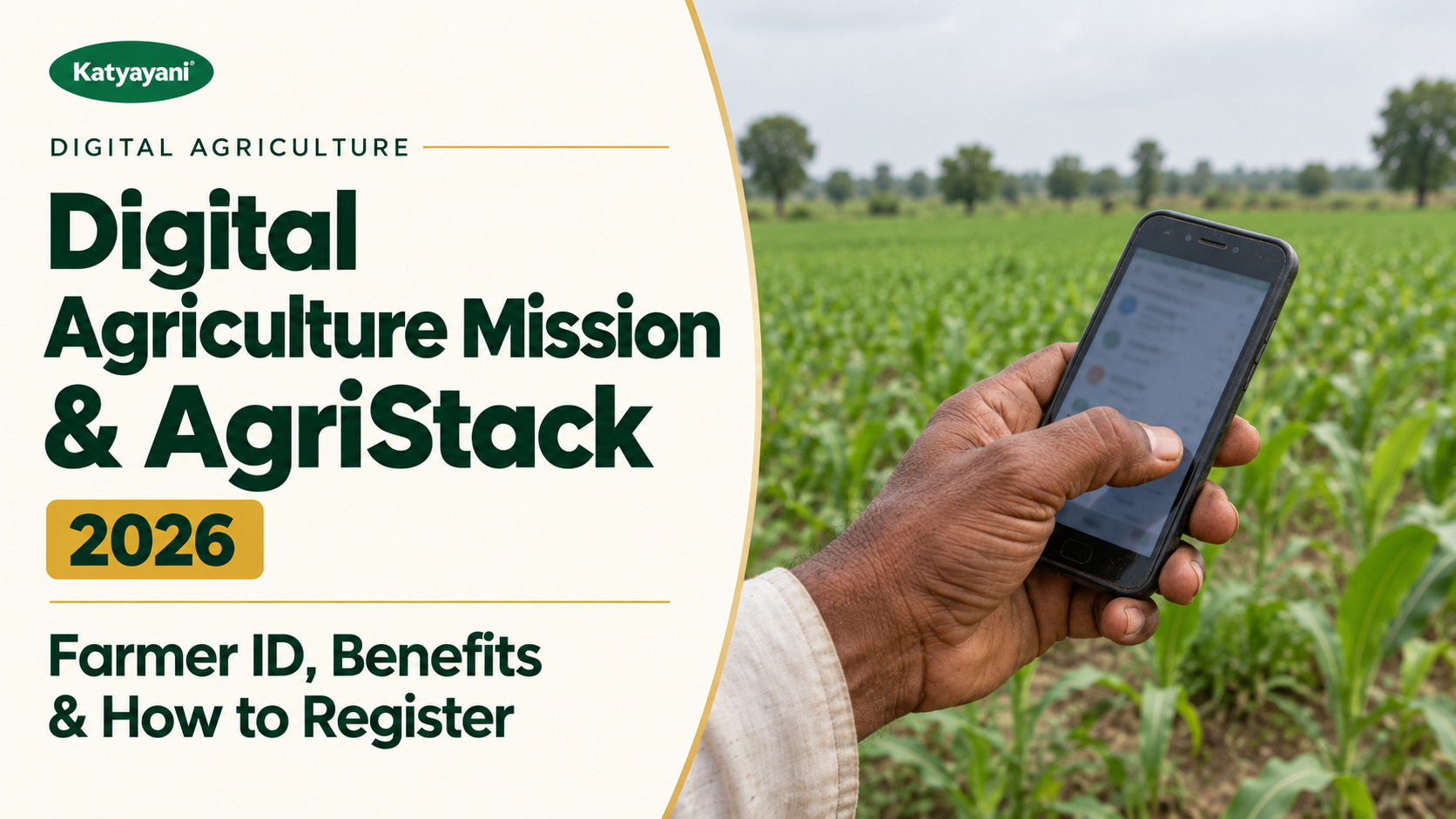
The Digital Agriculture Mission is a Rs 2,817 crore central scheme, approved in September 2024, that builds India's farm data system. Its core is AgriStack, which gives each farmer a free digital Farmer ID (Kisan Pehchaan Patra) linked to Aadhaar and land records. You register on your state AgriStack portal or at a CSC.
What is the Digital Agriculture Mission?
The Digital Agriculture Mission (DAM) is a central government scheme to put Indian farming on a shared digital base. The Union Cabinet approved it in September 2024 with a budget of Rs 2,817 crore, of which the central share is Rs 1,940 crore, as MediaNama explains. States and other partners are meant to add the rest. Think of it as one big plan that pays for several digital tools for farmers.
In simple words, the government wants to know who each farmer is, what land they farm, what crop they sowed and what help they already got. This makes crop loans, crop insurance and government crop purchase (MSP) easier. The national portal is agristack.gov.in.
What are the main parts of the mission?
| Part | What it does | What it means for a farmer |
|---|---|---|
| AgriStack | Three lists: a list of farmers, village maps with exact plot locations, and a list of crops sown | One digital ID and record, so you do not submit the same papers again and again |
| Krishi Decision Support System (Krishi DSS) | A map-based system that brings together satellite pictures and data on crops, soil, weather and water | Officers can plan schemes and give advice better. Tools for farmers will be added later |
| Soil Profile Mapping | Detailed soil maps. About 142 million hectares are planned. About 29 million hectares were already done when the mission was approved (MediaNama) | Over time, fertiliser advice based on your actual soil. See our soil health card guide for what you can read today |
| Digital Crop Survey | A mobile-based survey that records which crop is sown on which plot each season | Fills the list of crops sown. It is meant to help with insurance, crop purchase and loans |
Right now, the Farmer ID is the part that matters most to farmers. So the rest of this guide is about it.
What is a Farmer ID?
A Farmer ID (Kisan Pehchaan Patra) is a unique digital ID for a farmer. It is linked to your Aadhaar and to your state land records. It works like Aadhaar, but for farming. It helps you prove that you are a farmer. Officers can also check your land details without asking for photocopies each time.
Many people get confused here. The Farmer ID is not a bank account. It does not give you money by itself. It only helps schemes find your checked details quickly.
How many Farmer IDs have been made so far?
According to a PIB release of 24 March 2026, more than 9.20 crore Farmer IDs had been generated across the country by 19 March 2026, with Uttar Pradesh the highest at about 2 crore. The original target at approval was digital identities for 11 crore farmers by 2026-27, phased as 6 crore, 3 crore and 2 crore over three years. Numbers rise every week, so check the portal for the latest count.
Is Farmer ID compulsory?
No single law says every farmer must have it. But in practice, more schemes are asking for it. News reports in 2026 say new PM-Kisan applicants need one in states where the list is live. Existing beneficiaries are also being asked to get it. Our PM-Kisan instalment guide tracks the latest instalment and the e-KYC steps. Some states also use it for crop loans, MSP procurement and crop insurance.
Check Your State: Rules differ by state. If your bank, CSC or agriculture office asks for a Farmer ID, ask for the written notice or scheme order. If your state has not started the registry yet, you do not need the ID yet.
What benefits does a Farmer ID give?
| Use | How the ID helps | Status |
|---|---|---|
| PM-Kisan | Your land and identity are checked, so wrong or duplicate entries can be removed | Reported to be required for new applicants in many states |
| Crop loans and KCC | Banks can see your land and crop details in one place. See our KCC scheme guide | Rolling out by state |
| Crop insurance | The crop record can make it easier to check a claim. See PMFBY Rabi registration | Gradual |
| MSP procurement | Your sale to the government can be matched with the crop you really grew | State-wise |
| One-time documents | Fewer repeat visits with the same land papers | Depends on the scheme |
How to register for Farmer ID: step by step
Every state has its own website for this. The screens look different, but the steps are almost the same. Start from the national website and pick your state.
- Keep documents ready. Aadhaar card, mobile number linked to Aadhaar, and your land record (khatauni, khasra or 7/12 extract). Many states also ask for a bank passbook.
- Open your state registry. From agristack.gov.in, choose your state. Some states take applications through an app, others through a CSC.
- Verify with Aadhaar OTP. The OTP goes to the mobile linked with Aadhaar.
- Check your land details. The system loads your plots from state land records. Check your name, survey numbers and area.
- Agree and submit. You allow your details to be shared with government schemes.
- Save the Farmer ID. Keep the number and the acknowledgement. Ask the CSC to print it free of cost.
Fraud Warning: Registration is free. No one can sell you a "faster Farmer ID". Do not share your Aadhaar OTP with anyone who is not sitting in front of you at a CSC or camp.
What if my land record is wrong or my name is missing?
This is the most common problem. Your land may still be in the name of a late parent. The area may be wrong. A plot may show a government name. In such cases, the system cannot match your Aadhaar. So first fix the record at the revenue office (tehsil). Farmers in Maharashtra have been stuck for exactly this reason. Fixing the record first saves many wasted trips.
Can tenant farmers and sharecroppers get a Farmer ID?
Not clearly yet. The list is built on land records, so someone who farms rented land may not appear. Experts quoted by Down To Earth warn that women, labourers, tenants and sharecroppers could be excluded. Some states ask only for cultivable land, owned or leased, while others do not allow landless farmers. The Centre has asked states to make rules for tenant farmers, but these are not ready everywhere. Until then, ask your block agriculture office what your state accepts as proof of lease.
What is the Digital Crop Survey and how does it affect you?
Every season, trained surveyors note on a mobile app which crop is sown on each plot. It was tried first in 11 states in 2023-24. The plan is to cover all districts within two years of approval. You may be asked to confirm what you grew. Please be accurate, because the record can later be matched with insurance claims and crop sales.
What is Krishi DSS?
The Krishi Decision Support System is a map-based data system. It puts satellite pictures together with soil, weather and water information. This helps officers plan better. You will not use it directly yet. But over time you may get better alerts and advice made for your village or plot.
Privacy and data: what should you know?
- Registration needs your permission. Read what you are agreeing to.
- Share OTPs only at official counters, CSCs or camps.
- Check the details printed on your ID. Report mistakes at the same place you registered.
- Farmer unions in some states have raised worries about data safety. Ask the officer how your data will be shared.
For the wider list of schemes the ID connects to, see our agriculture subsidy schemes guide and the agri schemes calendar.
Common mistakes that delay your Farmer ID
- Aadhaar mobile number is old or switched off, so the OTP never arrives.
- Name spelling differs between Aadhaar and the land record.
- Land is in the name of a deceased family member and the record is not yet updated (mutation).
- Going to a private "agent" who charges money.
- Not saving the acknowledgement and Farmer ID number.
Conclusion
The Digital Agriculture Mission will shape how farmers get loans, insurance and subsidy over the next few years, and the Farmer ID is the first thing you can act on. Make it free, make it early, and keep the acknowledgement safe. If your land record or name is wrong, fix that first. Then check your state portal for what it requires, so you do not lose an instalment or a scheme window.
Why trust this guide
Written by Team Katyayani, Editorial Team at Katyayani Organics. Cross-checked against published research and university extension programs.

Leave a Comment