 9 min read
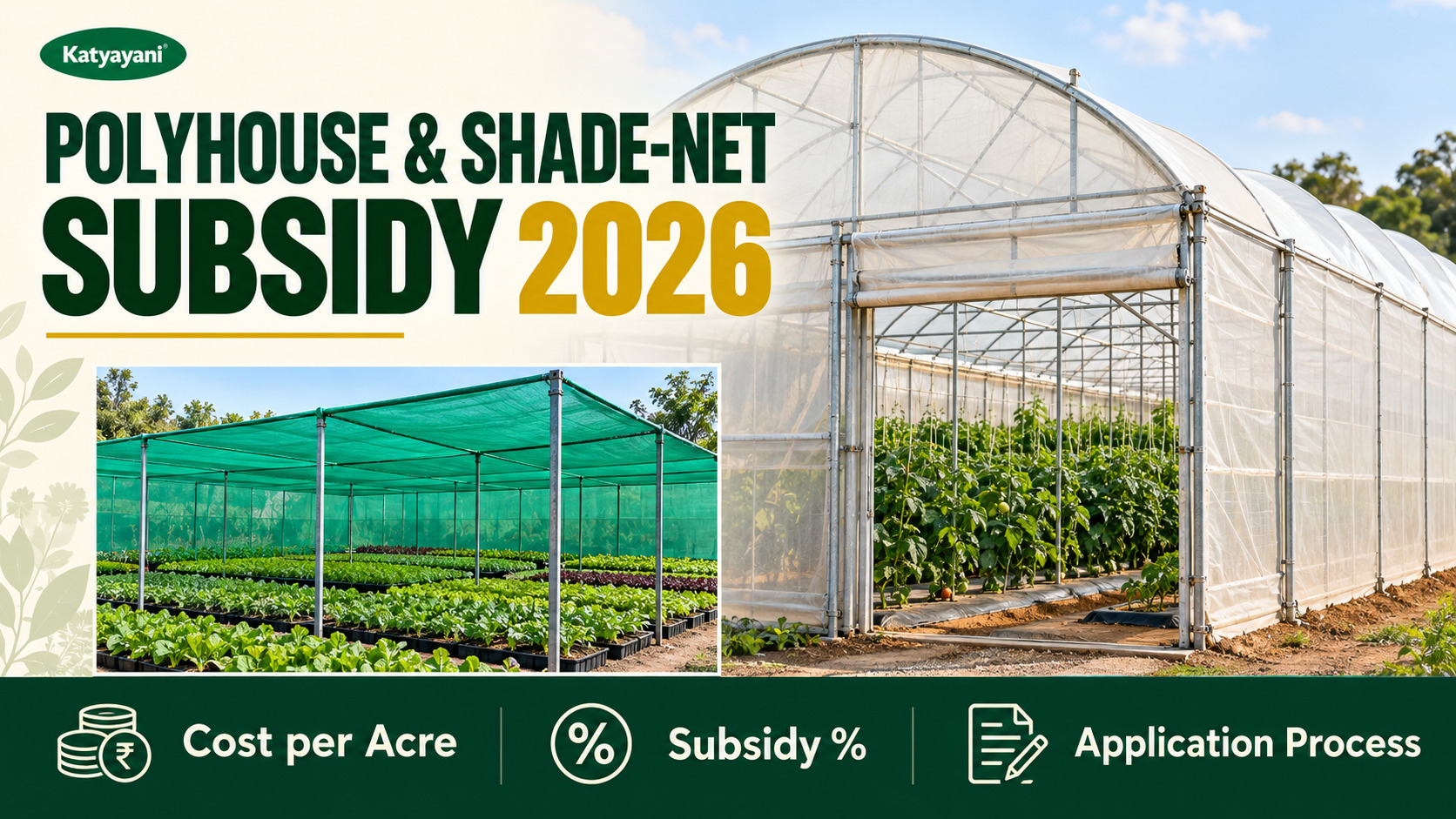
Polyhouse and shade-net houses get about 50% subsidy on the cost norm under NHB and MIDH. Commonly cited norms are Rs 1,000 per sq m for a naturally ventilated polyhouse, Rs 1,600 for fan-and-pad and Rs 710 for shade net. One acre is about 4,047 sq m, so a naturally ventilated polyhouse works out to roughly Rs 40 lakh at the norm, and about Rs 20 lakh of that is subsidy.
Is there any subsidy for polyhouse farming?
Yes. Protected cultivation is supported under the Mission for Integrated Development of Horticulture (MIDH) and through the National Horticulture Board (NHB). For polyhouse and shade net, the rate commonly quoted is 50% of the admissible cost, calculated on a fixed cost norm per square metre, not on the actual bill. If your contractor charges more than the norm, you carry the extra. Other MIDH items such as new orchards are typically 40% in general areas, as in our agriculture subsidy schemes guide.
States can also run their own top-up or special rates for SC/ST, hill and North-East regions, so the number on your sanction letter may differ from the headline. The official sites for the national schemes are NHB and MIDH.
Polyhouse vs shade net: which one fits your crop?
| Structure | Cost norm per sq m (commonly cited) | Best for | Main limit |
|---|---|---|---|
| Naturally ventilated polyhouse | Rs 1,000 | Vegetables, flowers, nursery in mild climates | Gets hot in peak summer without cooling |
| Fan-and-pad greenhouse | Rs 1,600 | High-value crops needing tight climate control | Highest cost and electricity use |
| Shade net house | Rs 710 | Nursery, leafy and heat-sensitive crops; cuts sun and heat | Does not protect from rain or cold like a polyhouse |
Note On Numbers: Published guides differ on these norms (for example Rs 935 or 844 for naturally ventilated, and Rs 1,290 or 1,465 for fan-and-pad). The table uses figures from an NHB-based guide dated Nov 2025. Always confirm against the current NHB/MIDH or State Horticulture Mission circular.
What is the cost of 1 acre polyhouse? Worked out
One acre is about 4,047 square metres. Multiply by the cost norm and you get the table below. These are my calculations from the norms, not market quotes. Real contractor prices vary by region, design and steel price.
| Structure | Cost at norm for 1 acre | Subsidy at 50% | You fund (before loan) |
|---|---|---|---|
| Shade net house (Rs 710/sq m) | about Rs 28.7 lakh | about Rs 14.4 lakh | about Rs 14.4 lakh |
| Naturally ventilated polyhouse (Rs 1,000/sq m) | about Rs 40.5 lakh | about Rs 20.2 lakh | about Rs 20.2 lakh |
| Fan-and-pad greenhouse (Rs 1,600/sq m) | about Rs 64.8 lakh | about Rs 32.4 lakh | about Rs 32.4 lakh |
Add land preparation, drip, fertigation, planting material, electricity and working capital. Those are separate. A first-time grower should also budget for one weak crop cycle while learning. For loan options, read our Kisan Credit Card guide.
Who can apply and how much area is allowed?
- Individual farmers and growers who own land, or lease it with a registered lease of at least 12 years.
- Companies, partnership firms, societies and trusts engaged in horticulture.
- Project size under the NHB route is commonly cited as a minimum of 4,000 sq m and a maximum of 16,000 sq m in general areas, with a lower minimum in the North-East.
- State horticulture mission schemes may limit area per beneficiary (one state guideline caps it at 4,000 sq m). Check yours.
- Subsidy under NHB is commonly cited as capped at Rs 1 crore per project.
Polyhouse subsidy process step by step
The subsidy is back-ended. It is released after the structure is built and inspected, and it is credited to your loan account. So you need a bank loan or own funds to start.
- Prepare a Detailed Project Report (DPR) with crop plan, structure, cost and market plan.
- Collect documents: ID, land proof or lease, project papers, and entity papers if you are a company or society.
- Apply to a bank for an agri term loan and get the sanction letter.
- Apply to NHB (or your State Horticulture Mission) and pay the processing fee. Appraisal is commonly reported to take around 6 to 8 weeks.
- Receive the Grant of Consent (GOC) and submit it to the bank.
- The bank pays the vendor. Construction typically takes around 45 days.
- Plant the approved crop and update the government portal.
- A joint inspection by NHB and the bank verifies the work.
- The subsidy is released and adjusted against your loan. You repay the reduced amount.
Best crops for a polyhouse
Choose a crop with a reliable buyer within a day's transport. Common choices are cucumber, capsicum (including coloured), tomato, and cut flowers such as rose or gerbera. Nursery raising and leafy crops suit shade net. If flowers interest you, our marigold flower farming guide shows the crop side. For other protected, high-value enterprises compare our indoor saffron farming setup cost and dragon fruit farming guides. Do not pick a crop only because it sounds profitable. Talk to two growers within 100 km who have run it for more than one season.
How much cucumber you get from an acre polyhouse depends on the hybrid, season, climate control and your skill. I did not find an official yield benchmark, so ask nearby operating units for three seasons of records before you build your numbers.
Disadvantages of polyhouse farming
- High up-front cost and slow payback if the first crops fail.
- Soil-borne diseases build up when you grow the same crop repeatedly.
- Pests such as whitefly, thrips and mites multiply fast in warm, closed air.
- Needs skilled day-to-day management of irrigation, nutrition and ventilation.
- Heat stress in peak summer without cooling.
Crop protection and nutrition inside a polyhouse
Closed air means problems spread quickly, so prevention beats cure. Here is how Katyayani inputs fit common polyhouse steps. These are guidelines, not a fixed label dose. Always follow the dose on the pack and match it to your soil test.
| Need | What the input does | Katyayani option |
|---|---|---|
| Soil-borne fungal diseases in repeat crops | Bio-fungicide applied to soil and root zone | Trichoderma harzianum bio-fungicide |
| Soft-bodied sucking pests (whitefly, mites) | Plant-based first step; check dilution and timing | Activated neem oil |
| Drip fertigation | Water-soluble balanced feed | NPK 19:19:19 water soluble |
| Fruiting vegetables | Calcium and nitrate nitrogen through fertigation | Calcium nitrate |
Compare forms in our water-soluble vs granular fertiliser guide, check why nutrients sometimes fail in soil pH and nutrient lock, and read how to use bio-agents in Trichoderma and Beauveria for gardeners. Browse the full NPK fertilizer collection and bio-fungicides collection.
Conclusion
A polyhouse can be a good business, but only with the right crop, buyer and plan. Use the subsidy maths above to size your budget, confirm the norm with NHB or your state mission, and talk to two operating growers before signing any contract.
Why trust this guide
Written by Team Katyayani, Editorial Team at Katyayani Organics. Cross-checked against published research and university extension programs.




Leave a Comment