 11 min read
The two linkages people confuse
A group opens a
savings account in month two and thinks it is linked. Then nothing happens for
a year and members lose interest.
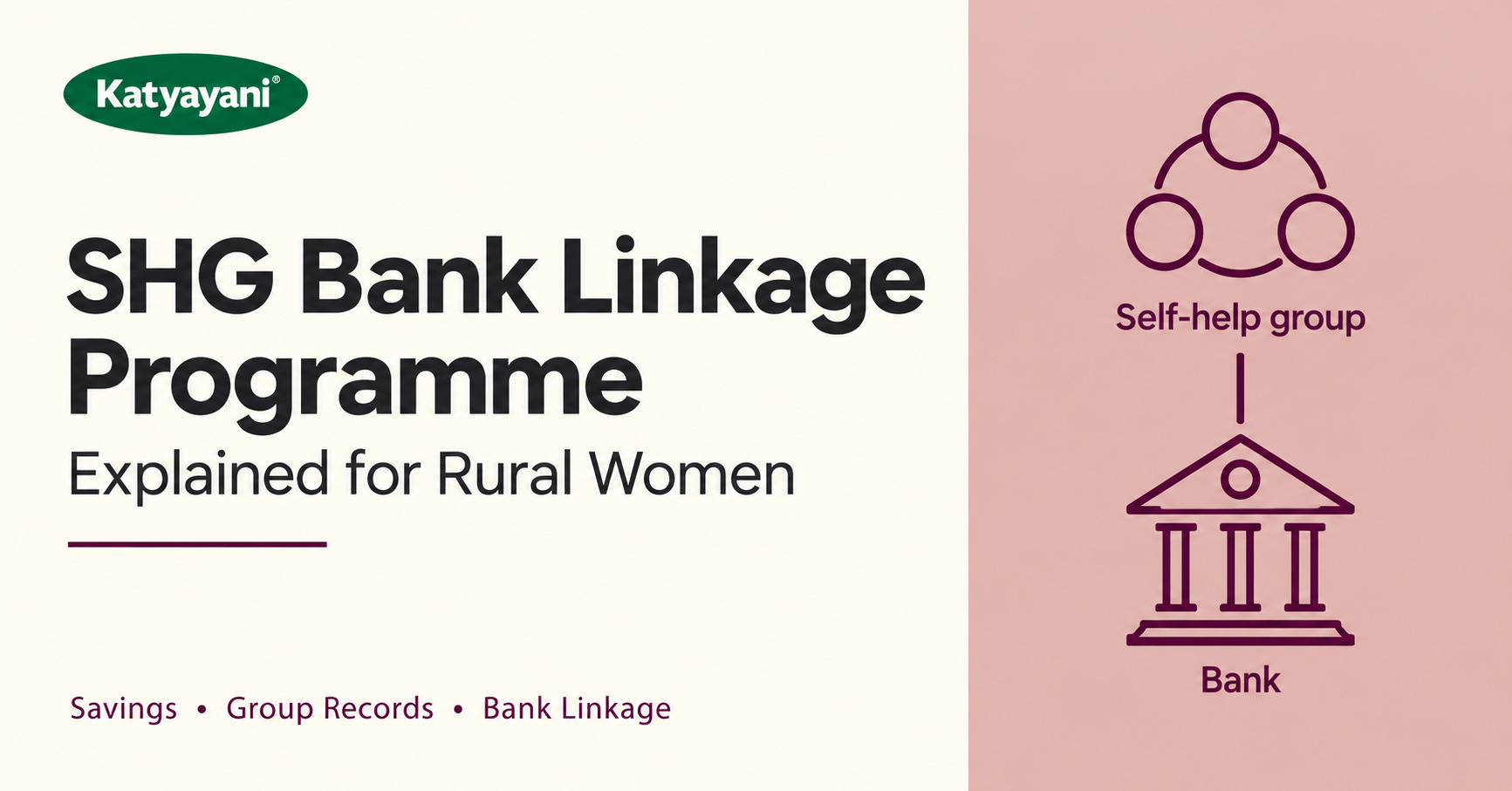
Savings linkage
means the group has a bank account in the group's name, and the group's savings
sit in it. This should happen within about two months of forming.
Credit linkage
means the bank has sanctioned a loan to the group. This comes later, after the
group has proved it can handle money.
Both are
needed. As on 31 March 2024, 144.22 lakh SHGs were savings-linked with Rs
65,089 crore in savings, but only 77.42 lakh had loans outstanding. So roughly
half the groups with bank accounts had not reached credit linkage. Knowing
which stage you are at, and what closes the gap, is the practical value of
understanding this programme.
The steps, in the order they actually happen
Form the group.
Ten to twenty women from similar economic backgrounds. In difficult areas,
remote tribal areas, and groups including women with disabilities, five members
is enough. Members from very different income levels tend to want very
different loan sizes, which strains the group later.
Agree the rules
in the first meeting. How much each member saves, which day the meeting is
held, what the fine is for missing it, and who keeps the register. Write it
down.
Save without
breaking the rhythm. Regularity matters more than the amount. Rs 20 a week
saved for a year is worth more to your grading than Rs 500 saved twice.
Start internal
lending. Lend the group's own money to members who need it, charge the interest
the group agreed, and record every transaction. This is the single strongest
piece of evidence a bank looks at, because it shows the group can assess and
recover a loan.
Open the
group's savings account within about two months. Take the group's resolution,
the members' KYC documents and the register. Under RBI rules a group can open
this account whether or not it is registered.
Follow the
Panchasutras. These five are the whole grading test: regular meetings, regular
savings, internal lending on demand, timely repayment, and proper books of
account. Nothing else weighs as much.
Get graded
after six months of active existence. Grading is done against NABARD's
parameters, usually by the bank or by the institution that promoted the group.
Apply for
credit linkage. Take the Micro Credit Plan showing what each member wants the
money for.
Realistically
this takes six to nine months from formation to first loan. A group that is
told it will get a loan in two months has been told wrong.
What grading checks
Grading is not
a written exam and there is no secret score. The person doing it opens your
registers and looks for the same things every time.
Are meetings
held on the fixed day, and do most members attend. Does the savings entry
appear for every member for every period, or are there gaps. Has the group lent
internally, and has it recovered what it lent. Are the loans recorded with
dates, amounts and repayments. Is the cash in hand equal to what the register
says it should be. Do the members know how much the group has, or does only the
leader know.
That last one
matters more than groups expect. A group where only one woman understands the
accounts is treated as a weak group, because it collapses when she moves away.
How much your group can get
The bank
sanctions a cash credit limit to the group, and the drawing power is reset each
year against the group's corpus, which is savings plus interest earned on
internal lending.
|
Year |
Drawing power |
|
First year |
Six times the corpus,
or Rs 1.5 lakh, whichever is higher |
|
Second year |
Eight times the corpus,
or Rs 3 lakh, whichever is higher |
|
Third year onward |
Minimum Rs 6 lakh,
based on the Micro Credit Plan |
Under DAY-NRLM
the cash credit limit itself is sanctioned for three years with a minimum of Rs
6 lakh, and reviewed annually.
The collateral
position has two levels, and both numbers are correct.
Up to Rs 10
lakh there is no collateral and no margin, and the bank cannot mark a lien on
the group's savings account. Between Rs 10 lakh and Rs 20 lakh there is still
no collateral, but the bank may take a margin of up to 10 per cent of the
amount above Rs 10 lakh.
So Rs 20 lakh
is the collateral-free ceiling, and Rs 10 lakh is the
no-collateral-and-no-margin ceiling. Individual banks may set lower internal
caps than the RBI ceiling, so ask your branch what their limit is.
Under DAY-NRLM
a women's SHG pays 7 per cent a year on loans up to Rs 3 lakh, and between Rs 3
lakh and Rs 5 lakh the bank's one year MCLR or 10 per cent, whichever is lower.
The subvention scope covers public sector banks, private sector banks and small
finance banks. Regional rural banks and cooperative banks are not on that list
in the current circular, so if your group banks with an RRB, ask what rate you
will be charged.
Additional
loans can be sanctioned even while a previous loan is outstanding, based on
repayment record. Groups often do not know this and wait unnecessarily.
Money that arrives before the bank loan
Revolving Fund
of Rs 20,000 to Rs 30,000 comes to the group after three to six months of good
functioning, provided it has not received it before. Community Investment Fund
of up to Rs 2.5 lakh per SHG is routed through the Cluster Level Federation.
Every member with a Jan Dhan account can get an overdraft of Rs 5,000, and one
woman per SHG can take a Mudra loan of up to Rs 1 lakh.
Cumulative
capitalisation support released under DAY-NRLM reached Rs 62,340 crore, with Rs
12,670 crore released during 2025.
What to do if the branch refuses
This is the
most common real problem and no page addresses it, so here is what actually
works.
Ask what
specifically is missing. Refusals are usually about a document or a form, not
about the group. Get the reason named.
Take your
promoting institution with you. The NGO, the block mission staff, or the bank
sakhi attached to your area. As of December 2025 there were 50,548 bank sakhis
deployed, and their job is exactly this.
Ask the branch
manager, not the counter clerk. Account opening for an unregistered group is a
decision many clerks are unsure about, and RBI's position allows it.
Go to the
district level. Every district has a Lead District Manager and a district level
bankers' committee where SHG linkage targets are reviewed. Your block mission
office knows how to raise it there.
Try another
branch. Branches differ enormously in how much SHG work they do. A branch with
an existing SHG portfolio will process your file in a fraction of the time.
What the programme looks like today
As on 31 March
2024, NABARD recorded 144.22 lakh SHGs savings-linked with Rs 65,089 crore in
savings, and 77.42 lakh groups with loans outstanding of Rs 2.6 lakh crore.
Exclusive women's groups were 83.5 per cent of savings-linked SHGs. Average
loan outstanding per group was Rs 3.82 lakh, and the programme covered 17.75
crore households.
On the DAY-NRLM
side, 10.05 crore rural households have been mobilised into 90.90 lakh SHGs,
and Rs 12.18 lakh crore of institutional credit has been accessed since
2013-14, with a repayment rate above 98 per cent and non-performing assets
around 1.8 per cent.
That repayment
rate is worth reading twice. It is the reason banks lend to groups without
collateral at all.
Where to go from here
If you are in a
new group, the priority is the register and the rhythm, not the loan. The loan
follows the record.
If your group
is already linked and you want to use the credit for farming, what is allowed
and how repayment fits a harvest cycle is set out in self help group loan for agriculture activities.
If you are a
woman farming without land in your name, SHG
loan for women farmers covers how much one member actually receives
and why land papers are not required.
If your group
has outgrown what group credit can do and the real problem is the price you get
for your produce, read SHG vs FPO: which is
better for farmers before registering anything.
Why trust this guide
Written by Team Katyayani, Editorial Team at Katyayani Organics. Cross-checked against published research and university extension programs.


Leave a Comment