 17 min read
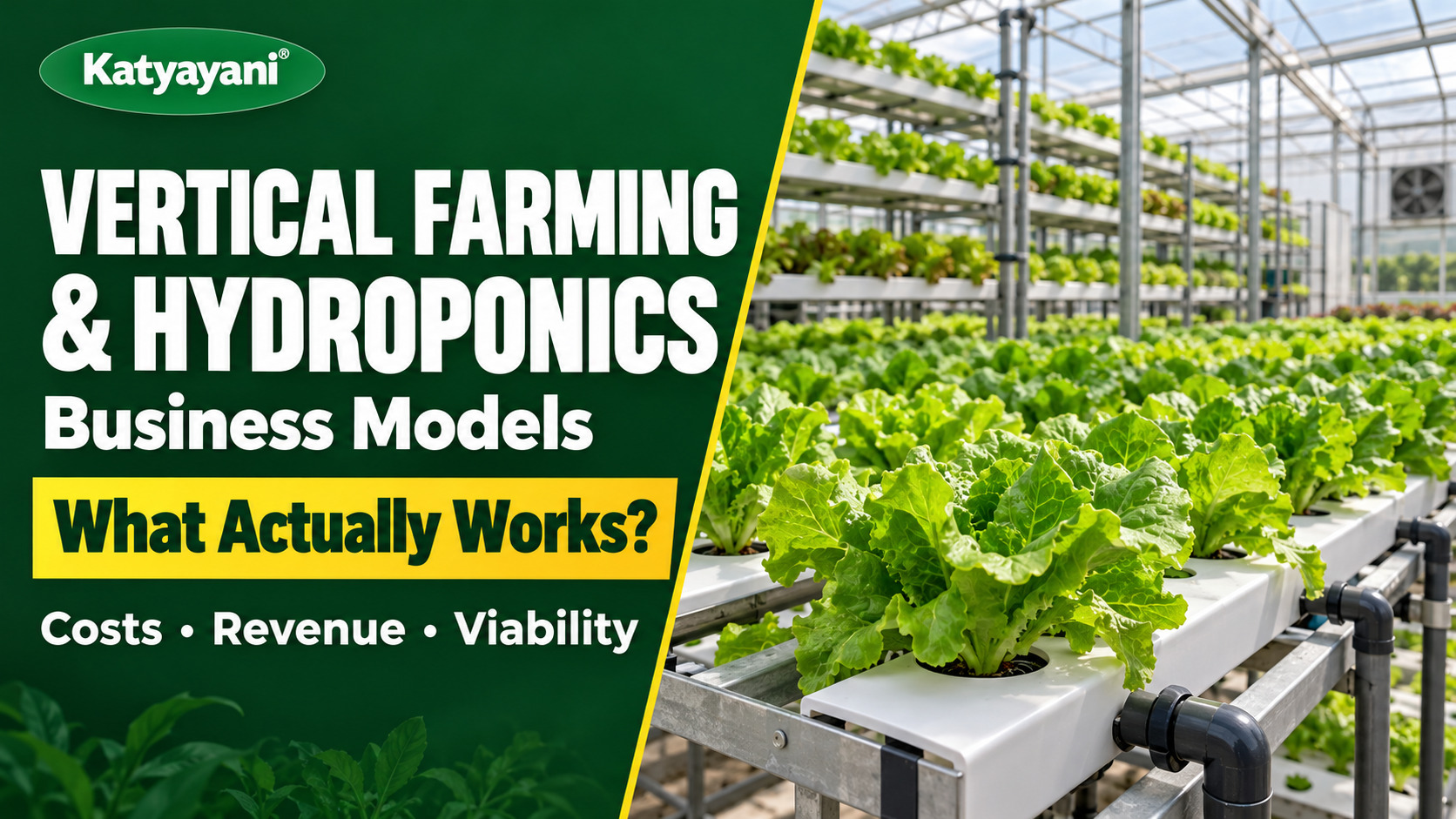
Vertical farming grows crops in stacked layers under artificial light, usually in water-based systems called hydroponics. It can give many times the yield per square metre, but it uses far more electricity per kilogram than field or greenhouse growing. Several heavily funded companies, including Plenty, Bowery and AeroFarms, went bankrupt or shut down. An Indian study of 23 polyhouse hydroponic farms found profit on paper, but its price data conflict, so no income figure is safe to promise.
What is the difference between vertical farming, hydroponics, aeroponics, aquaponics and a greenhouse?
They answer different questions. A greenhouse and a vertical farm describe the building and layout. Hydroponics, aeroponics and aquaponics describe how roots are fed. One farm can combine them, for example a vertical farm that uses hydroponics under LED lights.
| Term | Plain meaning | Light source | Typical crops | Main business risk |
|---|---|---|---|---|
| Greenhouse / polyhouse | A covered structure on one level, growing in soil or without soil | Mostly sunlight | Tomato, capsicum, cucumber, flowers | Structure cost; heat in Indian summer |
| Hydroponics | Roots sit in or are fed a nutrient solution; no soil | Sunlight or LED | Lettuce, basil, spinach, celery, strawberries | Pump or power failure; nutrient errors |
| Aeroponics | Roots hang in air and are misted with nutrient solution | Sunlight or LED | Leafy greens, seed potato, herbs | Clogged nozzles; very little buffer if misting stops |
| Aquaponics | Fish waste feeds plants; plants clean the water for fish | Sunlight or LED | Lettuce, herbs, fish such as catfish | Two businesses to manage: fish and plants |
| Vertical farming | Crops grown in stacked layers, usually indoors | Almost always LED | Leafy greens, microgreens, herbs, strawberries | Electricity bill; building and equipment cost |
The comparison that matters for money is plant factory versus greenhouse. A Wageningen-led study modelled lettuce in three climates and found a closed plant factory needed about 247 kWh of electricity per kg of dry lettuce. The greenhouses needed about 70 kWh in the Netherlands, 111 in the United Arab Emirates and 182 to 211 in Sweden. The plant factory did better on land, water and CO2 per unit. It lost on purchased electricity, because the greenhouse uses free sunlight (Graamans et al. 2018). In India, where sunlight is plentiful, that gap is the main reason a polyhouse hydroponic farm is easier to make pay than a fully indoor LED farm.
Is vertical farming successful? What the failures and survivors show
The sector has real technology and a poor financial record. Several of the best-funded companies failed, and the stated reasons point to cost and sales, not to plants refusing to grow. The table lists what the sources I opened say, with dates.
| Company | What happened | Money raised (as reported) | Reasons stated by the source |
|---|---|---|---|
| AeroFarms (US) | Filed Chapter 11 in June 2023 and focused on its Danville, Virginia farm. In Dec 2025 it said it would cease operations, got emergency funding a week later, and Palm Ventures announced its acquisition in June 2026 | $238 million (Crunchbase, per Food Dive 2023) | Industry headwinds and less investor interest; a planned $1.2 billion SPAC listing was called off in late 2021 |
| AppHarvest (US) | Chapter 11 in July 2023, with plans to sell its Kentucky farms; Berea leafy greens paused earlier in 2023 after Listeria monocytogenes was detected | Net loss $176.6 million in 2022 (AgFunder News) | Cash shortfall; strategy reset called Project New Leaf |
| Bowery Farming (US) | Reported by PitchBook in Nov 2024 to be shutting down after layoff rounds in 2023 | More than $700 million; valued above $2 billion in 2021 (TechCrunch) | No official reason in the article |
| Plenty (US) | Filed for bankruptcy on 24 Mar 2025 with $20.7 million in debtor-in-possession financing, kept its Virginia strawberry farm and emerged from Chapter 11 by June 2025 with a strawberry-only focus | Nearly $1 billion; last valuation $1.9 billion in Jan 2022 (TechCrunch) | The article does not state the reasons |
| Jones Food Company (UK) | Closed in May 2025 | Not stated | Failed to secure new investment |
| 80 Acres Farms (US) | Announced in Aug 2026 that it would wind down | Raised $115 million about 18 months earlier | Could not raise the capital needed |
A trade feature republished on 12 Oct 2026 sums up the causes it names: companies expanded before they had proved unit economics, crop-market fit and reliability, and then higher energy prices and tighter fundraising exposed the gaps (VerticalFarmDaily). I did not find a government or academic count of closures. One aggregator says 14 controlled-environment bankruptcies happened in 2025, but I could not trace that to a primary source, so I have left it out of the numbers.
What has worked
The same feature lists what reportedly works: high-value crops, crops already grown in greenhouses (strawberries, lettuce, tomatoes, peppers), staged funding against proof of performance, and sites with cheap renewable power, waste heat or industrial CO2. It names Oishii, a premium strawberry grower, as raising $150 million in Series C funding. That is a company claim of progress, not an audited profit. Staple grains do not work: the feature cites a Plant Physiology analysis at about $10 per kg of dry matter for vertical production against under $1 for field production.
Smaller operations can also work. Two microgreens vertical farms in northern Italy were both profitable in 2023 on their own books, with operating margins of about 20% and 35%, though the authors warn that two farms in one country cannot be generalised (Amici et al. 2025). The details are in the models table below.
What business models do vertical and hydroponic farms actually use?
There are nine models in use worldwide. They differ in who pays you, how much capital you need and how much evidence exists that they make money. For several of them I found no sourced economics, and the table says so instead of guessing.
| Model | How money is made | What the evidence shows |
|---|---|---|
| 1. Wholesale leafy greens to retail chains | Sell lettuce, baby greens or herbs to supermarkets at a premium | Where most of the large failures sat (AeroFarms, Bowery). Agritecture notes that commodity lettuce competes with $1.99 clamshells in California |
| 2. Restaurant and hotel supply | Sell direct to chefs, premium grocers and hospitals | Agritecture (11 May 2026) names direct-to-buyer sales as a core route and advises securing offtake agreements before building. No margin data given |
| 3. Subscription or home delivery | Weekly box or app orders to households | No sourced unit economics found. Delivery cost and churn are the usual limits, but I have no study to quote |
| 4. Microgreens | Short cycle crop sold by the tray or gram to restaurants and shops | Best documented small model: two Italian farms profitable, payback 2.5 and 5.5 years, labour 41% to 46% of cost |
| 5. High-value crops (strawberries, saffron, herbs) | Grow a crop whose price covers high running cost | Strawberries are the main bet of Plenty and Oishii. For India, see our indoor saffron setup cost guide |
| 6. Container farms and farm-as-a-service | Buy a ready container system, or pay a provider to run one | Agritecture says off-the-shelf systems have "wildly different cost structures and timelines". Vendor payback claims of 1.27 to 1.64 years (Dutch Lion, 2026) are the vendor's own |
| 7. Technology and equipment supplier | Sell racks, lights, controls or whole farms | Plenty says it will sell vertical strawberry farms using its technology. This moves capital risk to the buyer |
| 8. Plant factory for seedlings, tissue culture, pharma crops | Sell uniform young plants or high-value plant material | I found no sourced economics. The Indian polyhouse study lists planting material as 5% to 12% of running cost, which is a buyer-side clue only |
| 9. Training and franchise | Sell courses, kits or a franchise licence | No independent evidence of income found. Treat claims of guaranteed buy-back or fixed returns with caution |
Read the table this way. Models 1 and 3 need scale and a lot of money before they pay. Models 4, 2 and 5 can start small. Models 6 to 9 earn money from other people's capital, which is why the person selling the system often makes money even when the farmer does not.
How much does it cost to set up a vertical farm or hydroponic unit?
The best Indian number is Rs 200 to Rs 368 per sq ft for polyhouse hydroponics, from a study of 23 farms in Bengaluru. Fully indoor LED farms abroad are quoted in euros per square metre of growing area by vendors, so they are not a like-for-like comparison.
The Bengaluru study surveyed 23 farms in 2022-23, grouped by land size. The farms grew lettuce, spinach, celery, basil and amaranthus under polyhouses with NFT, deep water culture and similar systems (Chaithra et al. 2024). Setup cost covers the polyhouse, the growing system, drip lines and equipment.
| Farm size (land) | Setup cost (Rs lakh) | Setup cost per sq ft (Rs) | Polyhouse share of setup | Growing system share |
|---|---|---|---|---|
| 5,000 sq ft | 18.4 | 368 | 56.9% | 32.0% |
| 10,700 sq ft | 32.2 | 301 | 52.3% | 32.7% |
| 21,780 sq ft | 50.3 | 232 | 45.8% | 37.6% |
| 43,560 sq ft (1 acre) | 87.1 | 200 | 41.4% | 37.7% |
| About 83,000 sq ft (2 acres) | 180.0 | 217 | 40.7% | 37.4% |
Size matters: the cost per sq ft fell by almost half between the smallest and the 1-acre farm. For comparison, MIDH sets the cost norm for a fan-and-pad polyhouse at Rs 1,800 per sq m up to 500 sq m, and a naturally ventilated tubular polyhouse at Rs 1,200 per sq m up to 500 sq m (MIDH Operational Guidelines, April 2025). Rs 1,200 per sq m is about Rs 111 per sq ft (my calculation), so the structure alone is around half of the Bengaluru figure.
Abroad, the figures are for indoor LED farms and come from companies. Dutch Lion Agtech Solutions reported in June 2026 a capex under 1,000 euros per sq m of growing area at small scale, 730 at medium and 650 at large scale, with a 1.27 to 1.64 year payback. Those use assumed lettuce at 7 euros per kg and power at 0.11 euro per kWh, and they leave out sales costs. They are vendor numbers. The two Italian microgreens farms in the peer-reviewed study cost 320,000 and 300,000 euros to build, for cultivation areas of 150 and 64 sq m, and paid back in about 2.5 and 5.5 years (Amici et al. 2025).
What To Trust: Lender and franchise blogs quote a few lakh to over a crore for one acre, with no survey behind it. The Bengaluru study is the only peer-reviewed Indian cost table I found. Use it as a reference and get written vendor quotes.
How much more does hydroponics yield, and how much electricity does it use?
Yield per square metre can rise about 11 times, but electricity per kg rises far more. The numbers come from a model, not a measured farm, so they show direction rather than your result.
| Measure (lettuce, Yuma, Arizona model) | Conventional field | Hydroponic greenhouse |
|---|---|---|
| Yield (kg per sq m per year) | 3.9 | 41 |
| Water (litres per kg) | 250 | 20 |
| Energy (kJ per kg per year) | 1,100 | 90,000 |
Source: Barbosa et al. 2015. The hydroponic figures come from engineering equations for a hypothetical 815 sq m greenhouse with a 24-hour photoperiod. 90,000 kJ is 25 kWh per kg (my calculation). Most of the energy was heating and cooling in a hot desert climate, so the authors say a milder climate would need less. Their conclusion: hydroponic lettuce cannot yet be called more sustainable overall.
Real farms report very different yields. The Bengaluru farms produced 4,100 kg a year from 5,000 sq ft, and 19,000 kg from one acre. That is about 8.8 and 4.7 kg per sq m of land per year (my calculation), far below the 41 kg modelled for growing area. Land area includes paths, tanks and sheds, and the paper does not say how much of it was under crop, so the gap is not a fair test of either number.
For microgreens, the Italian farms made 300,000 trays a year from 150 sq m at one farm and 46,000 trays from 64 sq m at the other, with about 35 g of edible portion per tray. Energy cost was 0.06 to 0.07 euro per tray, only 3% to 4% of total cost, because the crop grows quickly. The authors cite literature of about 17 kWh/kg for soilless systems, 3 for greenhouses and 1 for open field (Amici et al. 2025).
What does the running cost look like: labour, nutrients and power?
In the Bengaluru polyhouse farms the biggest costs were labour, nutrient solution and plant protection chemicals, and electricity was small. In fully indoor farms the order changes, and power can become the largest bill.
| Running cost item (1-acre farm, Bengaluru) | Rs per year | Share of variable cost |
|---|---|---|
| Labour | 6,98,080 | 26.3% |
| Nutrient solution | 4,50,940 | 17.0% |
| Plant protection chemicals | 4,00,160 | 15.0% |
| Planting material | 3,15,670 | 11.9% |
| Transport | 1,55,176 | 5.8% |
| Electricity | 1,08,100 | 4.0% |
| Other items (repairs, maintenance, packing, marketing, interest) | 5,27,202 | 20.0% |
| Total variable cost | 26,55,328 | 100% |
The table is from the same study. Total annual cost, including fixed items such as depreciation, was Rs 35.85 lakh for the 1-acre farm. Dividing by its 19,000 kg yield gives about Rs 189 per kg (my calculation). Across all five farm sizes the all-in cost came to about Rs 159 to Rs 243 per kg (my calculation). Note that plant protection chemicals took 13% to 25% of variable cost on these farms, so hydroponics under a polyhouse does not remove pest management.
Power is where farms differ most. A Punjab hydroponic farm on 2.5 acres, growing baby spinach, lettuce, basil, microgreens and Swiss chard, reported electricity above 60% of its monthly expenses. It installed a 15 kW solar system for about Rs 7.5 lakh, with no subsidy, and says the cost came back in about three years (Mercom India, March 2025). That is one farm describing itself. The Italian microgreens farms put energy at 3% to 4% of cost. So energy can be anywhere from a few percent to over half of the bill, depending on lights, cooling, crop and cycle length.
Is hydroponics a profitable business? Can you earn Rs 1 lakh a month from 1 acre?
Nobody can promise that figure. The one peer-reviewed Indian study shows profit on paper, but its own price data conflict, and at the lower price the same farms lose money.
The Bengaluru study found positive returns for all 23 farms. Its returns table uses an average selling price of Rs 400 per kg for the 1-acre group and gives net returns of Rs 40.1 lakh a year for that group, or about Rs 3.3 lakh a month (my calculation). It reports an internal rate of return of 30% for that group, the best of the five sizes. For the smallest group, the table shows 16% (the abstract says 17%).
But the same paper says, in its text, that basil sold at Rs 110 per kg, lettuce at Rs 110 to 130, celery and spinach at Rs 90 to 120, and amaranthus and kale at Rs 130 to 160. At Rs 130 per kg, the 1-acre farm's 19,000 kg would bring Rs 24.7 lakh against a total cost of Rs 35.85 lakh. That is a loss of about Rs 11 lakh a year (my calculation). The authors do not explain the difference between Rs 130 and Rs 400. It may be a mix of products sold at different prices, or an error.
| Case for the 1-acre farm in the Bengaluru study | Revenue (Rs lakh a year) | Total cost (Rs lakh a year) | Result |
|---|---|---|---|
| Returns table (average Rs 400 per kg) | 76.0 | 35.85 | +40.1, about Rs 3.3 lakh a month |
| Text prices (assume Rs 130 per kg) | 24.7 | 35.85 | -11.1 (my calculation) |
So the honest answer to "Rs 1 lakh a month from 1 acre" is: possible in one reading of one study, a loss in another reading of the same study, and unproven for a new entrant. Prices, buyers and your ability to sell 19,000 kg of fresh greens a year decide it, not the system.
How do power price and selling price change break-even?
For an indoor LED farm, the electricity price and the selling price move profit more than almost anything else. The table below is an illustration with assumed inputs, not a forecast and not real income.
Illustration With Assumed Inputs: Assumed: an indoor LED farm using 15 kWh of electricity per kg of lettuce (the study range for indoor lettuce is wide; this is my assumption). Non-electricity cost of Rs 165 per kg, borrowed from the lowest all-in cost per kg in the Bengaluru study (my calculation), which includes only about 4% electricity. Building and LED capex are NOT included, so real indoor results would be worse. Power tariffs of Rs 6, 8 and 10 per unit are assumed. For reference, Himachal Pradesh set 2025-26 commercial tariffs at Rs 6.21 to Rs 6.40 per unit and agriculture at Rs 5.04 (The Week, 28 Mar 2025).
| Selling price per kg | Power Rs 6 per unit (cost Rs 255 per kg) | Power Rs 8 per unit (cost Rs 285 per kg) | Power Rs 10 per unit (cost Rs 315 per kg) |
|---|---|---|---|
| Rs 200 | -55 | -85 | -115 |
| Rs 300 | +45 | +15 | -15 |
| Rs 400 | +145 | +115 | +85 |
Margin per kg in rupees, before capex. Break-even selling prices are Rs 255, Rs 285 and Rs 315 per kg. At the Rs 110 to 130 per kg lettuce prices quoted in the Bengaluru text, an indoor LED farm at these assumptions loses Rs 125 to Rs 205 per kg (my calculation). If the electricity use is 20 kWh per kg instead, energy alone at Rs 6.40 per unit is Rs 128 per kg (my calculation), the whole selling price of ordinary lettuce.
This is why the survivors target premium crops, why polyhouses with sunlight are cheaper to run in India, and why a solar plant on the roof, as the Punjab farm did, is not optional but part of the model.
What support and costs apply in India: MIDH, power, water and loans?
The central horticulture mission lists 50% assistance on a hydroponics add-on, as part of a polyhouse project. Rules differ by state. Check your state horticulture office before you buy anything.
The Mission for Integrated Development of Horticulture (MIDH) Operational Guidelines of April 2025 list, under protected cultivation, an add-on "Hydroponics and Aeroponics" at a cost norm of Rs 350 per sq m, with assistance at 50% for a maximum of 1,000 sq m per beneficiary. The rate is 15% higher for the North East, Himalayan states and some other areas. The same table supports poly-house crops such as capsicum, cucumber, tomato, broccoli, parsley and celery at Rs 150 per sq m. At Rs 350 per sq m and 50%, the support is Rs 175 per sq m, or Rs 1.75 lakh for the full 1,000 sq m (my calculation). That is small compared with the Rs 200 to Rs 368 per sq ft (Rs 2,150 to Rs 3,970 per sq m, my calculation) full setup cost.
Two cautions. First, I found only older news, from October 2024, that said the Centre planned to add hydroponics, aquaponics and vertical farming to MIDH, and I did not find an official line for vertical farming itself in the April 2025 text. Second, state schemes differ, and the way and timing of payment can differ, so ask before you build. Our polyhouse and shade net subsidy guide explains the process.
- Power tariff: I found no state tariff order with a hydroponics or vertical farm category. Ask your electricity board whether a unit counts as agriculture or commercial. Himachal Pradesh in 2025-26 charges Rs 5.04 for agriculture and Rs 6.21 to Rs 6.40 for commercial use, so the category can change your bill by a fifth or more.
- Loans: A hydroponic unit is an agri-enterprise, so credit guarantee and subsidy-linked loans may apply. See our guides to CGTMSE loans for agri MSMEs and PMEGP loans for agriculture business. Eligibility depends on the bank and scheme rules at the time.
- Water: Systems recirculate water, which is why the Barbosa model uses 20 litres per kg against 250. Your source water still needs testing: the Missouri nutrient guide gives optimum source water as pH 5.5 to 7, EC 0.2 to 0.8 dS/m and alkalinity 40 to 160 ppm.
What food safety rules and markets apply to hydroponic produce in India?
Fresh produce sold in India needs food business registration or licence with FSSAI, and buyers such as hotels and chains will ask for it. I could not open the FSSAI direction PDF, so confirm the category and slab on the FSSAI licensing portal.
FSSAI issued a direction under section 16(5) of the Food Safety and Standards Act dated 17 August 2021. From search excerpts, it made categories on its licensing portal available for businesses that manufacture or repack untreated and surface-treated fresh fruits and vegetables and minimally processed (peeled, cut or shredded) ones. I could not read the full text. It does not mention hydroponics. Whether your unit needs a registration or a licence depends on your turnover and activity, so ask a food safety officer.
AppHarvest paused leafy greens production at one site in 2023 after Listeria monocytogenes was detected.
Which crops and buyers are realistic in India?
In the Bengaluru study the farms grew lettuce, spinach, celery, basil and amaranthus, and sold in a metro market, at Rs 90 to 160 per kg in the text. Buyers named in the paper's background include hotels, restaurants and quick-service chains. Microgreens, herbs and exotic salad leaves are the usual first crops because they are small, fast, and priced by the gram. For other controlled-environment crops, see our guide to oyster mushroom farming, which also runs indoors, and indoor saffron farming. I found no verified Indian price data for strawberries from hydroponic systems, so I have not given one.
Market access is the tough part. A farm making 19,000 kg a year of fresh leaves needs about 52 kg sold every day, every day of the year (my calculation). Fix your buyers first.
What are the disadvantages of hydroponics?
The main disadvantages are high set-up cost, high energy use, constant monitoring, and market risk. All of these are supported by the sources above.
- High setup cost: Rs 200 to Rs 368 per sq ft in Bengaluru, and the study itself notes that hydroponics needs a high initial investment.
- Energy: about 82 times field energy per kg in the Arizona model, and 247 kWh per kg of dry lettuce in a plant factory against 70 to 211 in greenhouses.
- Nutrient waste and error: In a University of Florida test, more than half of most added elements stayed in the water, and 61% of the iron added was lost. The fix is careful dosing. See the nutrient section below (UF/IFAS AE610).
- Salt stress is fast: In a vertical-rack trial, lettuce at EC 4.5 to 6.0 gave 77% less yield than lettuce at EC 1.5 to 2.0 under the same light (Akter et al., Scientific Reports 2026).
- Pests and disease still happen: plant protection chemicals were 13% to 25% of variable cost in Bengaluru.
- Market and price risk: the failure table above.
- Skill and labour: labour was 41% to 46% of cost in the Italian microgreens farms and 20% to 27% in Bengaluru.
How is the nutrient solution managed: EC, pH and water-soluble fertiliser?
EC tells you how much dissolved fertiliser is in the water. pH tells you how acidic the water is, which controls whether roots can take up what is there. You check both daily and top up as the crop grows.
| What you measure | Plain meaning | Lettuce guide from the sources I opened |
|---|---|---|
| EC (electrical conductivity, dS/m) | Total dissolved salts. High EC means strong feed; very high EC stresses roots | UF/IFAS: 1.2 at germination and 1.5 to 1.8 in production. Their trial found 1.2 grew lettuce as well as 1.6 |
| pH | Acidity of the solution | Missouri nutrient guide: adjust to 5.5 to 6.0 for lettuce. Trial cited there: pH 6.0 gave 106 g a head against 132 g at 5.4 |
| Alkalinity | How strongly the water resists pH change (bicarbonates, "dissolved limestone") | Source water ideal 40 to 160 ppm. High alkalinity needs more acid to bring pH down |
These come from a University of Missouri teaching deck on nutrient solutions and the UF/IFAS fact sheet. Universities give different ranges, so treat them as starting points and follow the guide from your system maker.
Fertiliser choice: UF/IFAS says growers commonly use a premixed soluble fertiliser, plus calcium nitrate and magnesium sulphate, dissolved in clean water and dosed to hold the target EC. The same sheet suggests using single-element fertilisers mixed to the crop stage, because fixed premixes waste nutrients. The Missouri deck gives a lettuce recipe built from two soluble fertilisers per 10 gallons, with N 150 ppm and Ca 90 ppm required.
In India, water-soluble products are sold for drip irrigation, and some are used in hydroponics. Check the label for full water solubility, no insoluble residue, and the calcium and magnesium you need, and ask the supplier whether the batch suits recirculating systems. Examples: calcium nitrate and mono potassium phosphate, and the wider NPK fertiliser range. They are not hydroponic recipes; a nutrient plan must be built for your crop and system. Our water-soluble fertiliser bulk guide explains how to check solubility and buy in bulk.
Who should start a vertical or hydroponic farm, and who should not?
Start only if you have a buyer, a power plan and money to survive the learning period. Agritecture's May 2026 guide says steady-state profitability can take 18 to 36 months.
| Situation | Better choice | Why |
|---|---|---|
| Own a polyhouse, have sunlight and water, want to test salad crops | Small hydroponic section, apply for MIDH add-on | Sunlight cuts power cost; support is small but real |
| Have a signed buyer (hotel, chain, restaurant) and want to try microgreens | Microgreens room with racks | Documented small-model profit in Italy; short cycle; low energy share |
| Salaried, no buyer, hope for passive income | Do not start yet. Run a 100 sq ft pilot or visit three working farms | Sales and daily care are the business |
| Want to build a large indoor LED farm for lettuce | Not recommended without cheap power and an offtake deal | Biggest failures were in this model |
| Considering a franchise or turnkey system with promised returns | Ask for audited customer accounts and the buy-back contract in writing | No independent income evidence found |
If you are still choosing a direction, our guide on how to start an agriculture business in India compares many options, and what is commercial farming explains scale and risk in simpler terms.
What should you check before you launch? A pre-launch checklist
Answer these ten questions in writing before you pay for any system.
- Buyer: Do you have two or three buyers who will sign for weekly volume and price?
- Price: What is your lowest realistic selling price per kg, and is it above your break-even from a table like the one above?
- Power: What is the tariff category and unit price, and what happens in a power cut? Is backup in the budget?
- Water test: Have you tested source water for pH, EC and alkalinity?
- Quotes: Do you have at least three written vendor quotes including pumps, lights, sensors and spares?
- Support: Is your project eligible for MIDH or a state scheme, and do you know when the money arrives?
- Licence: Have you confirmed the FSSAI category with your state food safety office?
- Skills: Who will run the farm daily, and who will manage the nutrient solution?
- Pilot: Can you test one crop on a small area for 3 to 6 months before scaling?
- Cash: Can you fund 18 to 36 months of running costs without the farm paying you?
Conclusion
Hydroponics and vertical farming are real ways to grow food, and some small farms make money. But the record of the large players shows that technology does not fix a weak market or a high power bill. In India, polyhouse hydroponics with sunlight is easier to justify than a fully indoor LED farm. The Bengaluru study shows profit on paper, yet its own price data conflict, so treat any promise of fixed monthly income with caution. Test small, sign buyers first, price power honestly, and manage the nutrient solution with a meter, not a guess.
Why trust this guide
Written by Team Katyayani, Editorial Team at Katyayani Organics. Cross-checked against published research and university extension programs.



Leave a Comment