 14 min read
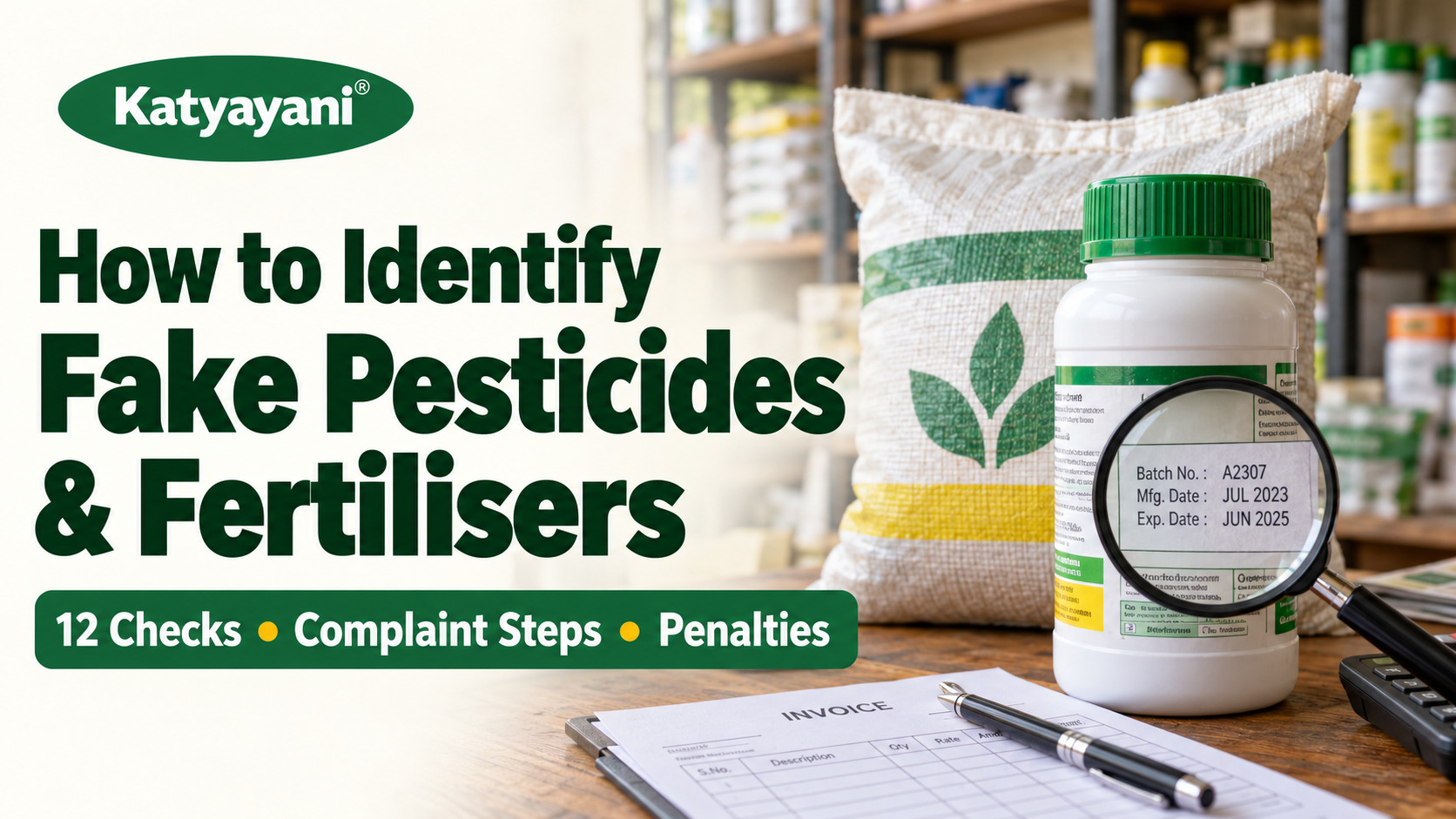
Check six things before you pay: a licensed seller, a printed bill, an intact seal, a full label (manufacturer, registration number, batch, expiry), a price near the usual rate, and a claim that sounds normal. For pesticides the law lets only registered products be sold, and a pack with a false label, an imitation name or no registration is "misbranded". Under the Insecticides Act the first-offence penalty is up to 2 years in jail or a fine of Rs 10,000 to Rs 50,000. To complain, call 1800-180-1551 or go to the district agriculture office. A new pesticide law is still a draft as of 19 Oct 2026.
What is a fake, spurious or misbranded pesticide and fertiliser in Indian law?
In plain terms, a fake input is one that is not what the pack says it is: wrong active ingredient, too little of it, an imitation of a known brand, or a product that was never registered. The law uses more exact words. The Insecticides Act 1968 says "misbranded", and I could not find the word "spurious" defined anywhere in the text of the Act (Insecticides Act 1968, section 3). Government replies in Parliament use "spurious" and "misbranded" loosely, so counts under the two words do not always match.
Under section 3(k), an insecticide is treated as misbranded in these cases:
- The label carries a false or misleading statement or picture, or the pack is otherwise deceptive.
- It imitates another insecticide or is sold under another product's name.
- The label lacks a warning or caution needed to prevent risk to people or animals.
- It is not packed or labelled as the Act and Rules require.
- It is not registered as the Act requires, or the label refers to some registration other than the registration number.
- Its toxicity is above the prescribed level, it is mixed or packed with a substance that changes its nature or quality, or it contains a substance not in its registration.
For fertilisers the rule is clause 19 of the Fertiliser (Control) Order 1985. No one may sell, stock or exhibit a fertiliser that is not of the prescribed standard, is an imitation or substitute for another fertiliser, or is adulterated (it contains something that lowers the nutrient content or pulls it below standard). The same clause bars a fertiliser whose label names a manufacturer that is fictitious or does not exist, one that makes a false or misleading claim, a substance sold as fertiliser that is not one, and any fertiliser without the minimum guaranteed percentage of nutrient shown (FCO 1985, clause 19).
One more FCO rule is useful for buyers. A fertiliser that is below standard but not adulterated can still be sold legally if the bag is marked "non-standard" in red with an "X" and is sold under the rules in clause 23. So a bag with that mark is not a scam, but you should know you are buying a lower grade.
How common are fake pesticides and fertilisers in India?
Nobody knows the exact share, because the figures that exist are from sample testing, not from a market survey. The best public numbers come from lab tests on samples drawn by state inspectors. They show a small share failing, but the samples are not random and the labs test a fraction of the market.
| Item | Figure | Source and limit |
|---|---|---|
| Pesticide samples drawn 2017-18 to 2020-21 | 2,51,728 samples; 5,890 sub-standard (about 2.3%) | Crop Care Federation of India, from an RTI reply, reported 17 Mar 2023. CCFI is an industry body. |
| Pesticide samples analysed 2023-24 | 80,789 analysed; 2,222 found spurious | Lok Sabha answer (Feb 2025), seen only in a search snippet. VERIFY. |
| Pesticide samples 2022-23 to 2024-25 | 2,21,253 tested; 5,723 reported misbranded | Lok Sabha answer (Aug 2025), search snippet only. VERIFY. |
| Fertiliser enforcement 2025-26 (to 5 Dec 2025) | 3,51,312 raids; 1,447 licences cancelled or suspended; 68 FIRs; 3 convictions | Parliament reply, search snippet only. VERIFY. |
| Share of the market said to be counterfeit or illegal | "Almost 25 percent" | CropLife International article. It names no source and shows no date, so treat it as an industry claim. |
A recent case shows how it plays out. In August 2025, farmers in Madhya Pradesh complained of damaged soybean after using the herbicide chlorimuron-ethyl. The Agriculture Minister said seized samples were substandard in the test, dealer licences were cancelled in the areas where it was sold, and sale of the remaining stock was banned in Vidisha, Dewas and Dhar districts (Outlook Business, 20 Aug 2025).
What did CropLife India warn about online sales and traceability?
On 21 January 2026, CropLife India said that unauthorised crop protection products sold online need stronger supervision, enforcement and accountability. It spoke at a New Delhi conference on online sale of these products. CropLife India is an association of 17 research-based crop protection companies (Agro Spectrum India report).
Its main points, as reported:
- Under the Insecticides Act and Rules, only licensed sellers can sell pesticides, only the products endorsed on their licence, in approved areas, backed by a valid Principal Certificate.
- Online platforms are not explicitly required to check whether a listed product is endorsed on the seller's licence or backed by a valid Principal Certificate. CropLife called this a regulatory gap.
- In the inventory model, pesticides may be stored and sent from warehouses that are not licensed under the Rules. That makes inspection, sampling and tracing harder.
- Rule 10E (2022), which allows online or doorstep delivery, does not remove the licence and Principal Certificate requirements, the association said, but some read it that way.
- It asked for "digital traceability across online supply chains" and said these risks should be written into the Draft Pesticides Management Bill 2025.
Two limits matter. CropLife's chairman said the industry is not against selling pesticides online. And the report does not mention any season or a bad crop year, so the idea that illicit products reach farmers more easily "in a hard season" is not in this statement. Agriculture Commissioner P. K. Singh said at the same event that checking a seller's GST papers may not be enough for hazardous farm inputs.
How to identify fake pesticides and fertilisers: 12 checks before you pay
Run these 12 checks in order. None needs a lab. Any "no" on checks 1 to 5 is a reason to walk away. Each check ties to a rule or a published warning sign, listed in the last column.
| # | Check | What a genuine product shows | Basis |
|---|---|---|---|
| 1 | Seller licence | Dealer displays a valid licence, and the product is endorsed on it. For pesticides, ask which Principal Certificate backs the product. | CropLife statement, 21 Jan 2026 |
| 2 | Printed bill | A cash or credit memo for every sale. For fertiliser it must be in Form M. Keep it. | FCO clause 5; FMC advice to keep the receipt |
| 3 | Seal and pack | Fertiliser bag: sealed so contents cannot be tampered with without breaking the seal (lead seal or machine stitching with no visible break). Pesticide: factory-sealed container, label stuck on firmly. | FCO clause 21(b); Rules 19(2) |
| 4 | Maker and address | Name of a real manufacturer. A label naming a firm that does not exist makes fertiliser illegal to sell. | FCO clause 19(c)(iv); Rules 19(1)(i) |
| 5 | Registration number (pesticide) | A registration number printed on the label. No number means it cannot be a registered product. | Rules 19(1)(iii); Act 3(k) |
| 6 | Batch number and expiry | Batch number and expiry date printed in indelible ink, the same on the pack and the outer carton. Never buy past expiry. | Rules 19(1)(vi), (vii); draft Bill row 2(f) |
| 7 | Ingredient and percentage | Active ingredient and its percentage (pesticide), or minimum guaranteed nutrient percentage (fertiliser). | Rules 19(1)(iv); FCO clause 19(c)(vii) |
| 8 | Warning diamond and leaflet | Pesticide has the coloured diamond with POISON, DANGER or CAUTION and a leaflet inside with dose, antidote and safety advice. | Rules 18, 19(3) to (4) |
| 9 | Price | Close to the usual retail rate and not above the MRP or fixed price. FMC lists prices at least twice normal as a counterfeit sign. A far lower price needs an explanation too. | FMC; FCO clause 3 |
| 10 | Claim | No "secret" imported booster sold in a second bottle, no effect lasting weeks longer than normal, no promotion for crops or pests the product is not known for. | FMC signs 1 to 9 |
| 11 | Weight and fill | Bag or bottle weight and net content match the label. Short fill is a common cheat. | Rules 19(1)(v); FCO clause 21(c) |
| 12 | Print quality and spelling | Clean printing, correct spelling, sharp logo. Blurry logos, wrong fonts and misspelt words are red flags listed by CropLife India in a farmer post (seen in search results, not opened). VERIFY. | CropLife India social post, VERIFY |
Checks 1, 2 and 3 matter most because they are what you can prove later. If a lab fails the product and you have the bill, the batch number and the sealed leftover, the authorities can trace it back to a seller and a batch. Without them it is your word against the shop.
How to read a pesticide label: what must be printed on a genuine pack
A genuine pesticide label carries eight printed items, set out in rule 19 of the Insecticides Rules. If one is missing, treat the pack as suspect (Insecticides Rules 1971, rules 16 to 19).
- Name of the manufacturer. If the maker is not the registration holder, the label must show the relationship between them.
- Brand name or trade mark.
- Registration number of the insecticide.
- Names and percentages of active and other ingredients, using the ISO common name where one exists.
- Net content by weight or volume, in metric units.
- Batch number.
- Expiry date, meaning the date up to which the product keeps its efficacy and safety.
- Antidote statement.
The label must be fixed so that it cannot ordinarily be removed. It must also carry a square set at 45 degrees (a diamond) covering at least one-sixteenth of the label face. The upper half holds the signal word: a skull and cross-bones with POISON in red for Category I (extremely toxic), POISON in red for Category II, DANGER for Category III and CAUTION for Category IV. The lower half holds the colour band for the toxicity class. Every pack must also hold a leaflet with directions, harmful chemicals, warnings, first-aid and antidote, and how to dispose of used containers.
Two rules protect you from loose sales. Rule 16 says no one may stock or sell an insecticide unless it is packed and labelled as the Rules require. Rule 17 says every batch must be analysed against its specification before it goes into the primary package, and the result recorded in a register. The draft Bill goes further on repacking: it would allow it only on licensed premises, and a repacked product must keep its original batch number, manufacturing and expiry dates on the new label. Loose "open" pesticide poured into a plain bottle is a red flag under both the current Rules and the draft.
How to check if a fertiliser (DAP, urea, NPK) is original or fake?
Start with the bag, the bill and the label, because the FCO makes these things legal duties and most counterfeit fertiliser fails here before any test is needed. Then, if you are still unsure, ask for a sealed sample to be drawn and tested.
| What to check | What the FCO says | What to do if it fails |
|---|---|---|
| Bag marking | The word "FERTILISER" must be printed across the container. Bio-fertilisers and organic fertilisers carry "BIO-FERTILISER" or "ORGANIC FERTILISER". Packs of 5 kg or less may use a separate securely fixed label. | Do not buy a bag with a plain or hand-written label. |
| Seal | Container must be sealed so it cannot be tampered with without breaking the seal. Hand-stitched bags need lead seals. Machine-stitched bags must show no visible break in the stitching. | A resewn or re-stitched bag is a red flag. Ask for another bag. |
| Open bags in the shop | A retail dealer may keep one open, unsealed bag of each variety for sale (clause 22). My reading: other bags on display should be sealed. | Ask to see a sealed bag from the stock. |
| Nutrient claim | The guaranteed minimum percentage of plant nutrient must be shown. Without it the fertiliser may not be sold. | Compare the label with the grade you asked for (for example 18-46-0 for DAP). |
| Maker | The named manufacturer must exist. | Search the maker's name and contact details before a large purchase. |
| Cash memo and price board | Dealers must issue a cash or credit memo in Form M, and display opening stock and the price list on the premises (clauses 4 and 5). | No bill and no price board is a reason to go elsewhere. |
| Weight | Bags must be of the weight and size the Central Government specifies. | A visibly short or soft bag, or one that rattles with different material, should be reported. |
If the check points to a problem, the lawful way to prove it is sampling by an inspector. The FCO says samples drawn by an inspector go to the government control laboratories at Faridabad, Mumbai, Chennai and Kalyani or to a laboratory notified by the State. A sample whose analysis is challenged can go to a referee laboratory other than the one that did the first test, and a person aggrieved by a central laboratory report can appeal for referee analysis within 30 days. A court case turns on whether the sampling followed the Order's procedure, so ask an inspector to draw it rather than testing a bag on your own.
After you buy, a soil test shows whether a field really received the nutrient it should have. Our guide to reading your Soil Health Card explains what the numbers mean. Note that this is a check on the field, not proof that a particular bag was fake.
Do home tests for fake DAP and urea work?
No home test has been shown to be reliable. I found no government or university protocol for any of them and no published accuracy data. They appear in farm-media articles, and they can be misleading both ways: a good product can fail a rough test, and a skilled mixer can pass one.
For example, a Global Agriculture article (12 Jun 2024) lists four checks for DAP:
- Nail test. Real DAP is described as hard, granular and brown, black or hazelnut in colour, and it should not crumble when pressed with a fingernail.
- Fist test. Hold a sample in the fist and blow on it; the article says it turns slightly damp. The same article describes this as a trait of urea too, so it does not separate DAP from other products.
- Lime test. Rub granules with lime; a pungent smell is said to show genuine DAP.
- Heat test. Warm granules on a pan over low heat; they are said to swell.
That article gives no laboratory method, no pass or fail threshold and no source for the methods. Other guides also say that genuine urea dissolves in water and feels cold, and that real urea melts on a hot pan. Dissolving in water shows only that a material is soluble. Many fillers and salts dissolve too, so this is my reasoning, not a sourced finding.
What To Do Instead: Use a home test only as a reason to look closer, never as proof. If a result worries you, keep the bag, bill and a sealed portion, and ask the district agriculture office to have an inspector draw a sample. Under the Insecticides Act, the inspector divides a pesticide sample into three portions in front of you, seals and marks them, and lets you add your own seal. One portion goes to you, one to the analyst and one is kept for court. The analyst must report within 30 days (Act, sections 22 and 24).
Is it safe to buy pesticides and fertilisers online?
It can be, but only from a seller that holds a valid pesticide licence for the product and delivers from a licensed premise. The law lets a licensee sell through an e-commerce platform for doorstep delivery under Rule 10E (2022), but CropLife says that rule does not remove the licence, Principal Certificate, approved-premises or area limits, as reported in January 2026.
The CCPA order of 22 September 2026 shows what can go wrong. A herbicide listed as "Cyclosinone Herbicide" was sold on Amazon, Flipkart and JioMart. The Agriculture Ministry told the CCPA that "Cyclosinone" does not appear in the Schedule to the Insecticides Act 1968. The listings did not give the chemical name or composition. The complaint came from the Crop Care Federation of India through the Ministry. The CCPA fined Amazon and Flipkart Rs 10 lakh each and JioMart Rs 5 lakh. In Amazon's case it cited 38,410 orders covering 43,634 units, worth Rs 96.43 lakh. The marketplaces were told to stop selling and advertising the product, run self-audits and file compliance reports in 15 days. The CCPA said seller contracts do not remove a platform's legal duties and that seller declarations alone are not enough (Indian Television report). It also said it was ruling only on the platforms' conduct, not on the product's composition.
Before you order online:
- Open the listing and look for the chemical name, composition, registration number, batch and expiry. A listing with none of these is a warning, as in the CCPA case.
- Look for the seller's licence number and ask for it in writing.
- On delivery, open the parcel and run checks 3 to 8 from the table above before you sign or pay.
- Keep the order record, the invoice and the packaging. For help choosing a reliable online source, see our guide to buying agriculture products online in India.
How to check whether a pesticide is registered with CIB&RC?
Look for the registration number on the label, then match the product name, the company and the formulation against the register kept by the Central Insecticides Board and Registration Committee (CIB&RC). A pack with no number cannot be a registered product, and "registered" is the first legal test under section 3(k).
Here is what I could confirm and what I could not. The Act lets the Registration Committee register a product after checking its formula and the maker's claims on efficacy and safety. Registrations under section 9(3) are published in Committee minutes and notices, and a Lok Sabha answer says registrations under sections 9(3) and 9(4) are permanent, with no expiry date (search snippets, VERIFY). The CIB&RC web page did not open during my research, and I could not test its product search. So please open the CIB&RC site yourself (it is usually reached through cibrc.nic.in or the Plant Protection division at ppqs.gov.in; confirm the address) and check the product name there. For global context on how other countries run this step, see pesticide registration by country.
Does a QR code on the pack prove a pesticide is genuine?
No. A QR code is a traceability tool, not a proof of quality, and a counterfeiter can print a QR code too. It helps only if the link goes to the real manufacturer's website and shows data that matches the pack in your hand: batch number, manufacturing and expiry dates.
What is reported. Secondary sources say the Insecticides (First Amendment) Rules 2025 (G.S.R. 368(E), notified around 3 June 2025) require a QR code on insecticide packs that links to the manufacturer's website with the GTIN, batch number, dates and safety instructions. These come from QR-code vendor blogs, not the gazette, and one of them gives a compliance deadline that I could not confirm in a second source. Treat it as VERIFY. Separately, Global Agriculture reports that the Insecticides (Amendment) Rules 2026, notified 17 June 2026, made digital licence applications and electronic registers and monthly returns compulsory from 15 September 2026. The aim is to link manufacturing batches to sales and stock records, so a diverted or counterfeit batch is harder to move unnoticed. That is a record system for companies and inspectors, not something printed on your bag.
The practical rule for buyers: scan if there is a code, but never treat the scan as the whole check. Compare the batch and expiry on the screen with the pack, and still ask for the bill. For the paper side of the trade, our dealer licence guide explains which licences a genuine seller should hold.
What are the penalties for selling fake pesticides and fertilisers?
Today the Insecticides Act 1968, section 29, sets the penalty for pesticide offences. A first offence of selling or stocking a misbranded insecticide, or selling without a licence or registration, carries up to 2 years in jail, or a fine of Rs 10,000 to Rs 50,000, or both. A repeat offence carries up to 3 years, or Rs 15,000 to Rs 75,000, or both. Other breaches of the Act or of licence conditions carry up to 1 year or Rs 5,000 to Rs 25,000 for a first offence (Act, section 29). Obstructing an inspector is also an offence. These amounts date from the 2000 amendment, which is why the industry and the government want a new law.
For fertilisers, the FCO is made under the Essential Commodities Act 1955. State governments enforce it, and police have registered FIRs under sections 3 and 7 of that Act with the FCO in cases such as a July 2026 raid in Vidisha, Madhya Pradesh. I could not find the current maximum sentence under section 7 in a source I could open, so I am not quoting a figure. That is a gap to check with a lawyer or the Act text on India Code.
What would the new Pesticides Management Bill change?
The draft Pesticides Management Bill 2025 would replace the 1968 Act and the 1971 Rules. The Agriculture Ministry opened it for public comment in January 2026, with comments open to 4 February 2026. Its Schedule II lists these penalties (draft Bill, Schedule II):
| Offence in the draft | Proposed penalty | Repeat offence |
|---|---|---|
| Breaking a registration condition, a licence condition or health and safety parameters | Penalty of Rs 50,000 to Rs 2,00,000 (amount to be notified) | Not less than twice the first penalty |
| Selling or stocking a pesticide that is unregistered, cancelled, banned, prohibited or past its expiry date | Penalty of Rs 50,000 to Rs 2,00,000 | Not less than twice the first penalty |
| Making or importing an unregistered or banned pesticide, or without a licence; distributing or selling without a valid licence (the table shows one penalty for both parts) | Up to 3 years in jail, or fine of Rs 10 lakh to Rs 40 lakh, or both | Fine not less than twice the first fine |
| Deliberate or fraudulent misrepresentation of identity, composition or source, including tampering with the approved label or leaflet | Fine of Rs 10 lakh to Rs 40 lakh | Twice the first fine; on a third offence the Inspector may recommend suspension or cancellation of registration or licence |
| Deliberate alteration of composition so that it fails safety or efficacy claims, holds a toxic substance, or is mixed with something that lowers its strength | Fine of Rs 10 lakh to Rs 40 lakh | Same as above |
| Any contravention that results in death or grievous hurt | Up to 5 years in jail, or fine of Rs 10 lakh to Rs 50 lakh, or both | Twice the first fine; third offence may lead to cancellation |
The draft defines "identity" to include the trade name, batch number, manufacturing and expiry dates, labelling and packaging, so changing a batch number or expiry date is itself a punishable misrepresentation. It also lets an inspector seal sampled packs with a bar code or QR code and requires the analyst's report in digital form within 30 days.
Status As Of 19 Oct 2026: I found no report that the Bill has been introduced in Parliament or passed. On 18 Aug 2026 (Kisan India) the Agriculture Minister said it would come in the next session, expected as the winter session from late November. On 11 Sep 2026 he said no final draft yet exists and that consultations with about 20 farmers' organisations had begun, after about 18,000 inputs (WebIndia123, 11 Sep 2026). News summaries of the fines differ from the draft text above (one article says up to Rs 40 lakh and 5 years). Quote the draft text, call it a draft, and update this section when the Bill is tabled.
How to complain about fake pesticides or fertilisers
Call the Kisan Call Centre helpline 1800-180-1551 and also report to the district agriculture office. The Agriculture Ministry launched the toll-free line on 3 September 2025 so farmers can report fake fertilisers, seeds and pesticides. The Minister said complaints from the portals and call centres would be monitored with periodic reviews (Global Agriculture, 3 Sep 2025). A Krishi Jagran report from that time said the line runs daily from 6 am to 10 pm and asked farmers to also approach their district agriculture departments. I could not open that page, so confirm the hours before you print them.
- Stop using the product. Keep the unused portion sealed, plus the pack, label, outer carton and any leaflet.
- Keep the bill. If the dealer did not give one, note the shop name, address, date and amount, and any phone messages or payment record.
- Take photos. Photograph the label with batch number and expiry, the pack seal, and the crop or soil damage with the date.
- Call 1800-180-1551 and give your name, village, product, batch and the problem. Ask for a complaint number.
- Go to the district agriculture office (the Insecticide Inspector for pesticides, the Fertiliser Inspector for fertilisers) with the papers. Ask in writing that a sample be drawn in your presence.
- Report anonymously if you must. CropLife International advises farmers to report suspected counterfeit sales to the relevant authorities, anonymously if needed. A named complaint with a bill is stronger.
Companies also take reports. FMC, for example, asks buyers to keep the receipt and contact its customer care line or local representative. If you suspect a brand is being imitated, tell the real brand's helpline too, as that company can check the batch code against its records. One caution: I did not research consumer-court routes or compensation, so this guide does not promise a refund or damages. Under the current Act I found no rule that sets compensation to a farmer.
What should dealers and FPOs do to avoid fake stock?
Buy from the company or its authorised distributor, take a GST invoice with batch numbers, and keep the registers the law requires. A dealer who sells a fake lot without knowing it still faces the sample, the notice and the court. Buying clean is the cheapest protection.
- Verify the supplier's licence and the product on it before the first order. Our 10-point manufacturer checklist covers what to ask a supplier.
- Insist on a GST invoice, batch number and expiry on every consignment. The bulk buying guide for FPOs explains minimum order quantities, invoices and quality checks.
- Keep stock records. Sales of insecticides to a dealer, retailer or bulk consumer must be entered insecticide-wise in a register (Form XIII), with a monthly return of sales to consumers to the licensing officer.
- Never repack, relabel or sell loose. Under the draft Bill, repacking is allowed only on licensed premises and the original batch details must stay on the label.
- Check each lot against the 12-check table at the gate before it goes on the shelf. Reject and photograph any lot that fails and tell the supplier in writing.
- In a rush season, a shortage invites substitutes. Our post on the DAP and urea shortage explains why stock gets tight and what to do, and the FCO rules for bio-stimulants cover a category that is also checked by inspectors.
Conclusion
Fake farm inputs are caught by paper first and chemistry second. Buy from a licensed seller, get a bill, check the seal, the maker, the registration number, the batch and the expiry, and be wary of any price or claim that looks too good. Home tests are not proof; a sealed sample tested in a notified laboratory is. If something goes wrong, keep everything, call 1800-180-1551 and go to the district agriculture office with the bill. The law today is the Insecticides Act 1968 and the FCO 1985. A new pesticide law with much higher fines is still a draft as of 19 October 2026, so check the latest before you quote it.
Why trust this guide
Written by Team Katyayani, Editorial Team at Katyayani Organics. Cross-checked against published research and university extension programs.



Leave a Comment