 5 min read
What is parali and why is burning it a loss?
Parali is the loose straw and standing stubble left after combine harvesting of paddy. In the rice-wheat belt of Punjab, Haryana, western Uttar Pradesh and Delhi, the gap between paddy harvest and wheat sowing is short, so many farmers set the field on fire to clear it quickly.
Burning looks cheap but it is not. ICAR-IARI estimates that burning one tonne of paddy straw destroys about 5.5 kg nitrogen, 2.3 kg phosphorus, 25 kg potassium and over 1 kg sulphur. The heat also kills useful soil microbes and earthworms in the top layer, and the smoke adds to the winter air pollution crisis in north India.
The good news is that fire counts are falling. The Government of India reported that paddy straw burning events dropped by 57%, from 42,962 in the previous year to 18,457 in 2024 (September to November). Punjab recorded a further 53% fall in kharif 2025, from 10,909 cases to 5,114.
In-situ vs ex-situ parali management: what is the difference?
In-situ management means the straw stays in your field. It is either mixed into the soil, left as mulch, or broken down by microbes. Ex-situ management means the straw is collected, baled and taken out of the field for use as fuel, cattle feed, compressed biogas feedstock or pellets.
| Point | In-situ | Ex-situ |
|---|---|---|
| What happens to straw | Mixed into soil, mulched, or decomposed in the field | Baled and removed for industry, power plants or feed |
| Main tools | PUSA decomposer, Happy Seeder, Super Seeder, Smart Seeder, mulcher, reversible MB plough, zero till drill | Straw baler, rake, cutter, loader, trolley |
| Soil benefit | Adds organic carbon and returns nutrients | Little direct benefit to soil |
| Extra income | No direct income, but saves fertiliser over time | Possible income if a buyer (biomass plant, CBG unit) is nearby |
| Suits | Farmers who want to improve soil health | Villages near biomass-based industry |
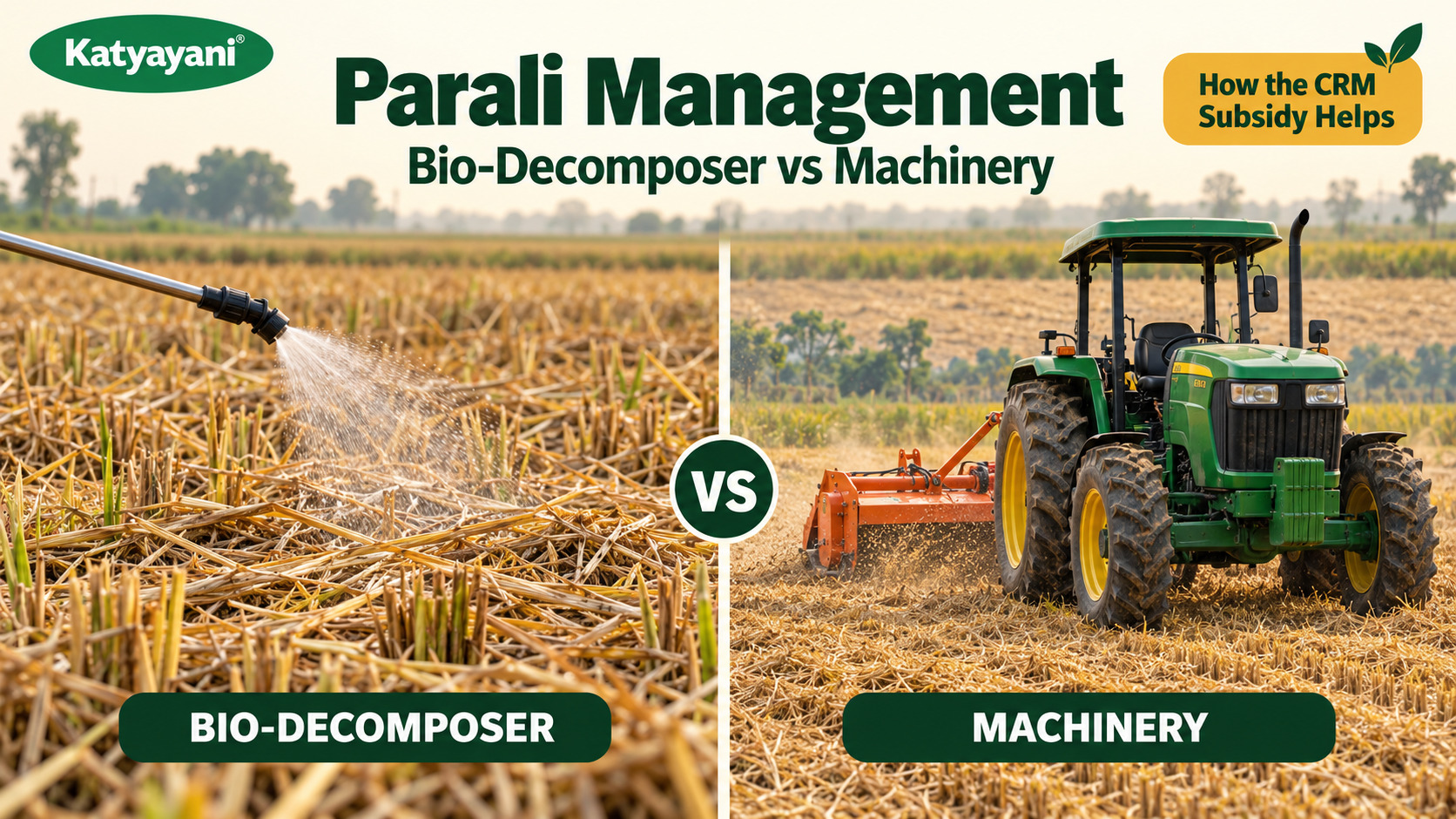
For most small and medium farmers, in-situ is the practical route because it needs no buyer and no transport. Ex-situ works well where a panchayat, FPO or aggregator has a contract with an industry buyer.
What is the PUSA decomposer and how does it work?
The PUSA decomposer is a microbial consortium of seven fungi developed by ICAR-Indian Agricultural Research Institute (IARI), New Delhi. The fungi produce enzymes that break down cellulose, hemicellulose and lignin, the tough parts of paddy straw, so the stubble softens and turns into organic matter.
As per the IARI practice note on PUSA decomposing, four capsules can be scaled up to 25 litres of liquid, enough for in-situ use on 1 hectare of paddy field. Residue decomposes within about 25 days, and in IARI's feedback survey 90% of farmers said stubble decomposed in 15 to 20 days. IARI also reported an 8 to 10% yield increase in the following crop and has licensed the technology to 18 companies.
The fungi are most active at 30 to 32 degrees C, which matches late October and early November in north India. Coverage has grown steadily: 6.89 lakh hectares in 2021 and 7.70 lakh hectares in 2022 were treated through state schemes and public-private partnerships.
Other decomposer options
Apart from the PUSA product, several licensed liquid and powder decomposers are sold by private companies. If you want to turn loose straw into compost in a pit or heap rather than in the field, a decomposting culture activator can speed up the heap. Adding a Trichoderma viride bio-fungicide to the compost also helps, because Trichoderma breaks down cellulose and later protects wheat roots from soil-borne fungi.
How to use a bio-decomposer for parali, step by step
A decomposer works only when the straw is in contact with moist soil. Spraying on dry, standing stubble and then waiting rarely gives good results. Follow the pack instructions of your product; the general IARI-style method is below.
- Harvest with a combine fitted with Super SMS (Super Straw Management System) so the straw is cut and spread evenly, not left in heaps.
- Prepare the brew as per the pack. For the capsule version, four capsules with jaggery and gram flour (besan) in water make about 25 litres. Commonly published guidance allows around 8 to 10 days of fermentation before use.
- Dilute the brew with clean water as the label says and spray it evenly over the straw and stubble of 1 hectare (about 2.5 acres). Ready-to-use liquid products can be sprayed directly at the label dose.
- Mix the straw into the top soil with a rotavator, disc harrow or mulcher within a day or two of spraying.
- Give a light irrigation so the soil stays moist. The fungi need moisture and warmth to work.
- Wait about 20 to 25 days. Check by pulling a handful of straw: it should feel soft and break easily.
- Sow wheat with a seed drill. If straw is still tough, a Happy Seeder or Super Seeder can sow through it.
At sowing, a basal dose of organic carbon support such as activated humic and fulvic acid can help the soil microbes keep working on leftover residue. Always follow the product label and local agriculture officer advice for doses.
Happy Seeder, Super Seeder and other CRM machines explained
CRM machines let you manage straw mechanically, usually in one or two passes. They are faster than a decomposer but need a suitable tractor and an operator, which is why most farmers hire them from a custom hiring centre (CHC).
Super SMS
Super Straw Management System is an attachment on the combine harvester. It chops the straw and spreads it evenly behind the combine. Even spreading is the base for every other method, including decomposer spraying and Happy Seeder sowing.
Happy Seeder
The Happy Seeder is a no-till planter that sows wheat directly into paddy stubble without seedbed preparation. It cuts the straw in front of each tine and leaves it on the surface as mulch. The mulch holds soil moisture, suppresses weeds and keeps soil temperature steady. It works efficiently only when the straw was spread by Super SMS.
Super Seeder and Smart Seeder
The Super Seeder cuts and incorporates the paddy straw, sows wheat and leaves residue over the sown area in a single pass. It needs a heavier tractor than a Happy Seeder and uses more fuel, but it handles thicker loads of straw. The Smart Seeder is a newer design that combines features of both.
Other in-situ and ex-situ machines
- Paddy straw chopper, shredder or mulcher: chops standing stubble into small pieces before ploughing.
- Reversible mould board (MB) plough: turns the straw deep into the soil.
- Zero till drill: sows wheat into lightly managed fields.
- Straw baler and rake: collects straw into bales for ex-situ use.
Decomposer vs Happy Seeder vs Super Seeder: which one should you choose?
Choose by the number of days you have before wheat sowing and by what is available in your village. If you have three weeks or more, a decomposer is cheap and builds soil carbon. If you have less time, a seeder is the safer bet.
| Factor | PUSA / bio-decomposer | Happy Seeder | Super Seeder |
|---|---|---|---|
| Time before sowing | Needs about 20 to 25 days | Sow the same day | Sow the same day |
| Upfront cost to farmer | Low (product cost plus one tillage and irrigation) | Machine or hire charge | Machine or hire charge, higher fuel use |
| Tractor needed | Any tractor for rotavator or harrow | Medium tractor | Heavier tractor |
| Soil moisture needed | Yes, field must stay moist | Sowing works in normal moisture | Sowing works in normal moisture |
| Effect on soil | Adds organic carbon | Mulch conserves moisture, reduces weeds | Mixes straw into soil, adds organic matter |
| Main limitation | Slow in cool or dry weather | Needs even straw spread by Super SMS | Slower field speed, higher running cost |
A practical combination used by many farmers is: Super SMS at harvest, decomposer spray on the straw, and then a Happy Seeder or Super Seeder if the straw has not fully softened by sowing time. This keeps wheat sowing on schedule and still gives the soil its organic matter.
How much subsidy does the CRM scheme give?
Under the central Crop Residue Management (CRM) scheme, individual farmers get 50% of the cost of a CRM machine. Cooperatives of farmers, FPOs, panchayats and rural entrepreneurs get 80% assistance for custom hiring centre projects costing up to Rs 30 lakh.
The scheme covers Punjab, Haryana, Uttar Pradesh and NCT of Delhi. According to a PIB release of 18 March 2025, Rs 3,698.45 crore was released between 2018-19 and 2024-25, more than 41,900 CHCs were set up, and over 3.23 lakh CRM machines were supplied.
| Beneficiary | Assistance | Condition |
|---|---|---|
| Individual farmer | 50% of machine cost | Machine from the approved list |
| Cooperative, FPO, panchayat, rural entrepreneur (CHC) | 80% of project cost | Projects up to Rs 30 lakh |
| Paddy straw supply chain project (ex-situ) | 65% of capital cost of machinery | Machinery cost up to Rs 1.50 crore |
For ex-situ supply chain projects, the revised CRM guidelines of July 2023 set the sharing as 65% government, 25% industry (the straw buyer) and 10% beneficiary. Subsidy amounts and application windows for the 2026-27 season are notified by each state, so check your state agriculture department portal before you buy.
How to apply for a CRM machine subsidy
Applications are made online on your state agriculture or agricultural engineering department portal, usually months before the paddy harvest. Selection is often by draw of lots when applications exceed the target.
- Watch for the notice from your state agriculture department or district agriculture officer. Application windows are usually short.
- Register on the state portal with Aadhaar, mobile number, land record details and bank account.
- Choose the machine from the approved list and, where required, pay the token or security amount mentioned in the notice.
- After selection, buy the machine from an empanelled manufacturer or dealer within the allowed time and upload the invoice.
- Allow physical verification of the machine by the department. The subsidy is then credited to your bank account through DBT.
If buying is not worth it for your land size, hire from a nearby CHC. Hire charges are far lower than ownership cost, and most CHCs were set up with the 80% subsidy precisely for this purpose.
Common mistakes that make parali management fail
Most failures come from timing and moisture, not from the product or the machine. Avoid these errors.
- Spraying decomposer on dry stubble and not mixing it into soil or irrigating.
- Starting decomposer late in November when night temperatures fall and microbes slow down.
- Using a Happy Seeder where straw lies in heaps because the combine had no Super SMS.
- Mixing decomposer or Trichoderma with chemical fungicides in the same tank.
- Skipping a small nitrogen top-up for wheat. Soil microbes use some nitrogen while breaking straw, so follow the soil test and local recommendation.
What to do next
Before harvest, count the days between your expected paddy harvest and wheat sowing date. If you have three weeks or more, book a decomposer and plan one light irrigation. If you have less, book a Happy Seeder or Super Seeder with your nearest CHC now, before the rush.
Dealers, FPOs and CHCs planning bulk decomposer or bio-input stock for the season can contact Katyayani Organics for supply. Whatever route you choose, keeping the straw in the field is an investment in your soil, and it keeps you on the right side of the law on stubble burning.
Why trust this guide
Written by Team Katyayani, Editorial Team at Katyayani Organics. Cross-checked against published research and university extension programs.



Leave a Comment