 5 min read
Quick answer: For chana pod borer control, install 5 pheromone traps and 20 bird perches per hectare at flowering, and act when you find one mature larva per metre row or 2 young larvae per 10 plants. For mustard aphid, spray only when 10% of plants carry 26 to 28 aphids on the top 10 cm of shoot.
Key Takeaways
- Gram pod borer (Helicoverpa armigera) is the main pest of chana. A single larva can destroy 30 to 40 pods, and severe attacks can cause up to 90% damage.
- NIPHM's IPM package sets the pod borer ETL at 5 to 8 eggs or 2 early instar larvae per 10 plants, or one mature larva per 10 plants or per metre row.
- ICAR-DRMR sets the mustard aphid ETL at 26 to 28 aphids per 10 cm terminal shoot in 10% of plants.
- Start with monitoring (pheromone traps, yellow sticky traps), then biologicals (HaNPV, neem, Verticillium lecanii), and use chemical insecticides only after the ETL is crossed.
- Spray flowering mustard in the afternoon to protect bees, and rotate insecticide groups to slow resistance.
Why chana pod borer and mustard aphid need early warning
Both pests build up quickly in December and January, often in the same village where chana and mustard are grown side by side. Once the pod borer larva enters the pod or the aphid colony covers the flower stalk, control becomes costly and yields have already been lost.
An early warning system rests on two ideas. The first is monitoring with traps and weekly field counts. The second is the economic threshold level (ETL), the pest level at which the expected loss becomes greater than the cost of control. Spraying below the ETL wastes money and kills natural enemies; waiting far beyond it costs yield.
How to identify chana pod borer damage
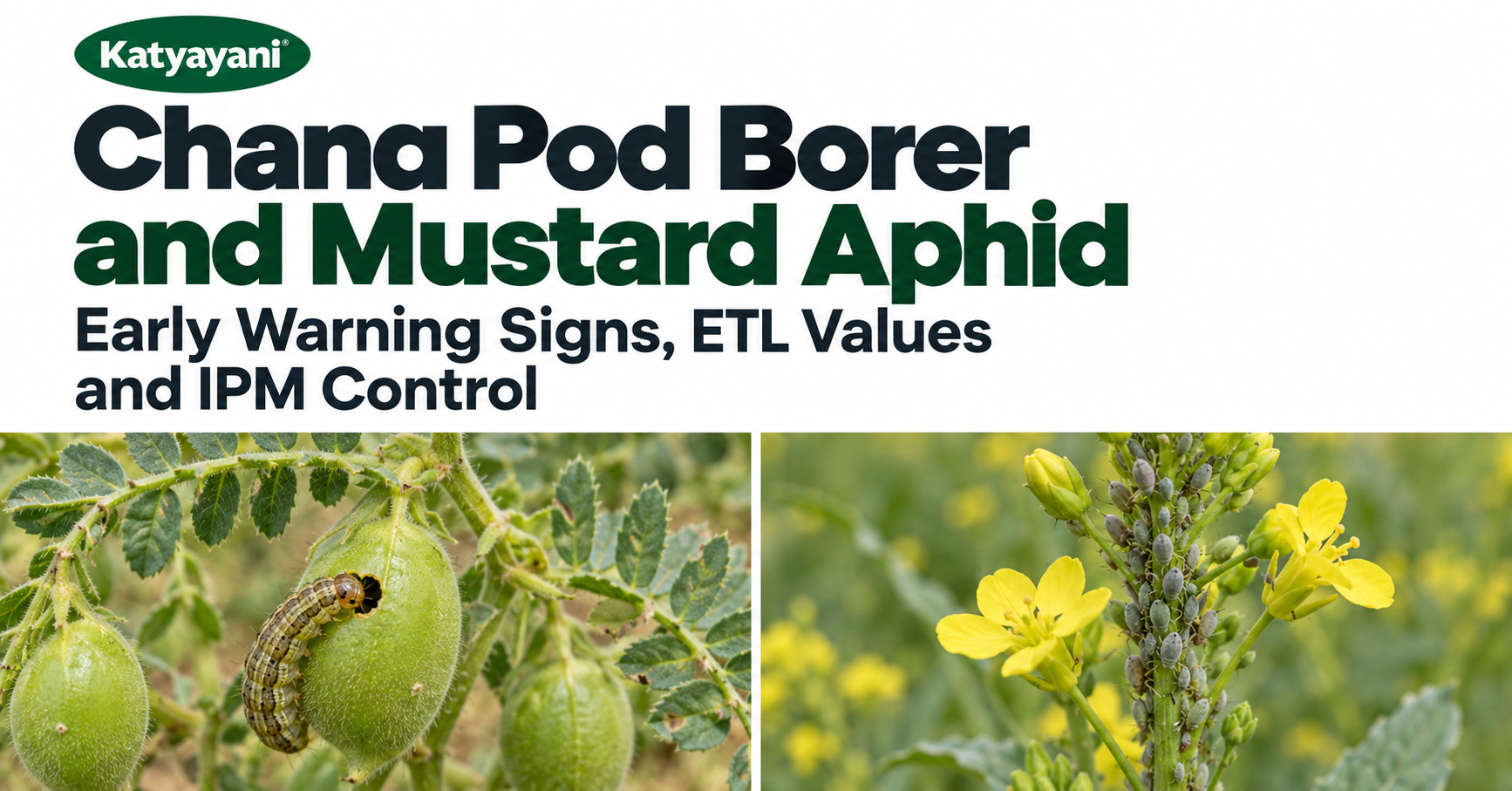
The gram pod borer (Helicoverpa armigera) is a moth whose caterpillar feeds on chana leaves, flowers and pods. Young larvae scrape tender leaves; older larvae bore a round hole into the pod and eat the developing seed, often with half the body hanging outside.
- Round holes in pods, many of them empty inside.
- Scraped or skeletonised young leaves at the top of the plant in early stages.
- Green, brown or pinkish caterpillars with pale side stripes, up to about 3.5 to 4 cm long when mature.
- Small, round, cream-coloured eggs laid singly on tender leaves, buds and flowers.
- Moths with light brown forewings and a dark spot, active at dusk and caught in pheromone traps.
The NIPHM IPM package notes that a single larva can destroy 30 to 40 pods before it matures, which is why even low numbers matter at pod formation.
What is the ETL for chana pod borer?
According to the NIPHM integrated pest management package for chickpea, control is needed when you find 5 to 8 eggs or 2 early instar larvae per 10 plants, or one mature larva (more than 1 cm long) per 10 plants or per metre of row.
| What you count | ETL (act at or above) | How to count |
|---|---|---|
| Eggs | 5 to 8 per 10 plants | Check tender tops and buds of 10 plants at 5 spots in the field |
| Early instar (small) larvae | 2 per 10 plants | Shake plants gently over a cloth or check tops |
| Mature larvae (over 1 cm) | 1 per 10 plants or 1 per metre row | Count along 1 m of row at 5 spots |
| Pheromone trap catch | Rising catches on consecutive nights signal egg laying | Check traps every 2 to 3 days and record moths |
Always average counts from at least five spots across the field, avoiding only the border rows, before deciding to spray.
How to use pheromone traps and bird perches in chana
Pheromone traps attract male moths and show when the pest population is rising. Bird perches invite insect-eating birds such as mynas and drongos into the field to pick larvae.
- Install 5 Helicoverpa pheromone traps per hectare (about 2 per acre) at the start of flowering, at least 75 feet apart, a little above crop height.
- Record moth catches every 2 to 3 days in a notebook. Change lures as per the maker's instructions, usually every 2 to 3 weeks.
- When catches rise on successive checks, start field counts of eggs and larvae twice a week.
- Fix 20 bird perches per hectare (about 8 per acre) using T-shaped sticks slightly taller than the crop. Remove them at pod maturity so birds do not feed on grain.
- If you grow chana with a border or intercrop of coriander, mustard or linseed, keep it; it supports natural enemies and some rows act as trap crops.
Cultural practices that lower pod borer pressure
Field practices reduce how many moths settle and how many larvae survive, so you reach the ETL later or not at all. The Springer review on chickpea pod borer lists timely sowing, moderate plant density, balanced fertiliser and intercropping among the most useful agronomic tools.
- Sow on time for your zone so pod formation finishes before the peak moth flight in warmer weeks.
- Avoid very dense stands and heavy nitrogen, which produce soft, lush growth that larvae prefer.
- Intercrop or border chana with mustard, linseed, coriander or wheat to break up the crop and support predators.
- Deep summer ploughing after harvest exposes pupae in the soil to heat and birds.
- Remove weed hosts on bunds and field edges, where moths also lay eggs.
Biological and chemical control of chana pod borer
Start with biological options when the pest is near the ETL and use chemical insecticides when it crosses it. The doses below are from the NIPHM chickpea IPM package. Always follow the product label and local agriculture officer advice.
Biological options
- HaNPV (Helicoverpa nuclear polyhedrosis virus) at 250 LE per hectare with 0.5% jaggery and 0.1% fabric whitener, sprayed in the evening on young larvae.
- Bacillus thuringiensis (Bt) at 1 kg per hectare against young larvae.
- NSKE 5% (neem seed kernel extract) at pre-flowering, repeated at 15-day intervals. A ready neem oil insecticide is a convenient alternative for egg and early larval stages.
Chemical options after ETL
| Insecticide | Dose (per litre of water) | Note |
|---|---|---|
| Emamectin benzoate 5% SG | 0.2 g | Effective on larvae of all sizes |
| Chlorantraniliprole 18.5% SC | 0.15 ml | Different mode of action; use in rotation |
| Novaluron | 1.5 ml | Insect growth regulator; most effective on young larvae |
Use 500 to 600 litres of water per hectare (200 to 240 litres per acre) for full coverage. Products such as emamectin benzoate 5% SG and chlorantraniliprole 18.5% SC belong to different insecticide groups, so alternate them rather than repeating one.
Spray tips that decide results
- Spray when larvae are young; large larvae inside pods are hard to reach with any product.
- Cover the top third of the plant well, where eggs, flowers and young pods are.
- Do not mix several insecticides in one tank in the hope of a stronger effect; it adds cost and speeds up resistance.
- Wear gloves and a mask, and keep the pre-harvest interval printed on the label.
How to identify mustard aphid attack
The mustard aphid (Lipaphis erysimi) is a small, soft, greenish-grey insect that lives in dense colonies on the flower stalk, buds, pods and underside of leaves. Both nymphs and adults suck sap.
- Colonies on the top 10 to 15 cm of the main shoot, making it look dusty grey.
- Curled leaves, stunted flower stalks and poorly filled or shrivelled pods.
- Sticky honeydew on leaves, followed by black sooty mould.
- Ants moving up and down stems, which often signals aphids above.
The NIPHM IPM package for mustard notes attack typically starts in the second to third week of December and continues till March, with cloudy, humid and mild weather favouring fast build-up.
What is the ETL for mustard aphid and how to manage it?
The ICAR-DRMR aphid management advisory recommends spraying when infestation reaches 26 to 28 aphids per 10 cm of terminal shoot in 10% of plants. Below this level, rely on cultural and biological control.
Cultural and biological steps
- Sow on time: DRMR advises sowing before 15 October in most of north India so the crop escapes peak aphid build-up.
- Avoid excess nitrogen, which makes plants more attractive to aphids.
- Pluck and destroy infested twigs from border rows 2 to 3 times at 10-day intervals.
- Install yellow sticky traps at 10 per hectare for monitoring.
- Protect ladybird beetles, syrphid flies and lacewings by not spraying before the ETL.
- Neem oil 2% and NSKE 5% are effective early options, and the entomopathogenic fungus Verticillium lecanii can be used in humid weather as per label.
Chemical options after ETL (ICAR-DRMR)
| Insecticide | Dose (per litre of water) |
|---|---|
| Oxydemeton methyl 25 EC | 1 ml |
| Dimethoate 30 EC | 1 ml |
| Thiamethoxam 25 WG | 0.2 g |
Repeat after 15 days only if the population rises again. Spray in the afternoon, as DRMR advises, when bees are less active on mustard flowers.
Weekly scouting calendar for chana and mustard
A fixed weekly routine is the simplest early warning system. The timings below are general; shift them by crop stage in your area.
| Period | Chana | Mustard |
|---|---|---|
| Late November to early December | Install pheromone traps and bird perches as flowering begins | Install yellow sticky traps; check border rows |
| December (flowering) | Count eggs and small larvae twice a week; NSKE or neem if eggs rise | Count aphids on 10 cm shoots of 20 plants; pluck infested twigs |
| January (pod formation) | Peak risk; spray HaNPV or chemical if ETL crossed | Peak aphid risk in cloudy spells; spray only above ETL, in afternoon |
| February | Continue counts until pods harden; remove bird perches near maturity | Watch for painted bug near maturity |
What to do next
Buy pheromone traps, lures and yellow sticky traps before flowering begins, and keep a small notebook in the field for counts. Decide in advance which biological and chemical products you will use, and check that they are in two different groups.
Spray only when counts cross the ETL, use the right water volume and protect bees on mustard. Dealers and FPOs stocking rabi IPM inputs can reach Katyayani Organics for bulk supply.
Why trust this guide
Written by Team Katyayani, Editorial Team at Katyayani Organics. Cross-checked against published research and university extension programs.

Leave a Comment