 10 min read
Sow pea (matar) from mid-October to mid-November in the plains. Use good seed coated with Rhizobium, keep rows about 30 cm apart, and give a small starter dose of fertiliser. Spray sulphur as soon as you see white powder on the leaves. Early varieties give the first green pods in about 65 to 70 days. Pick pods every 7 to 10 days while they are tender.
What is pea farming, and which type should you grow?
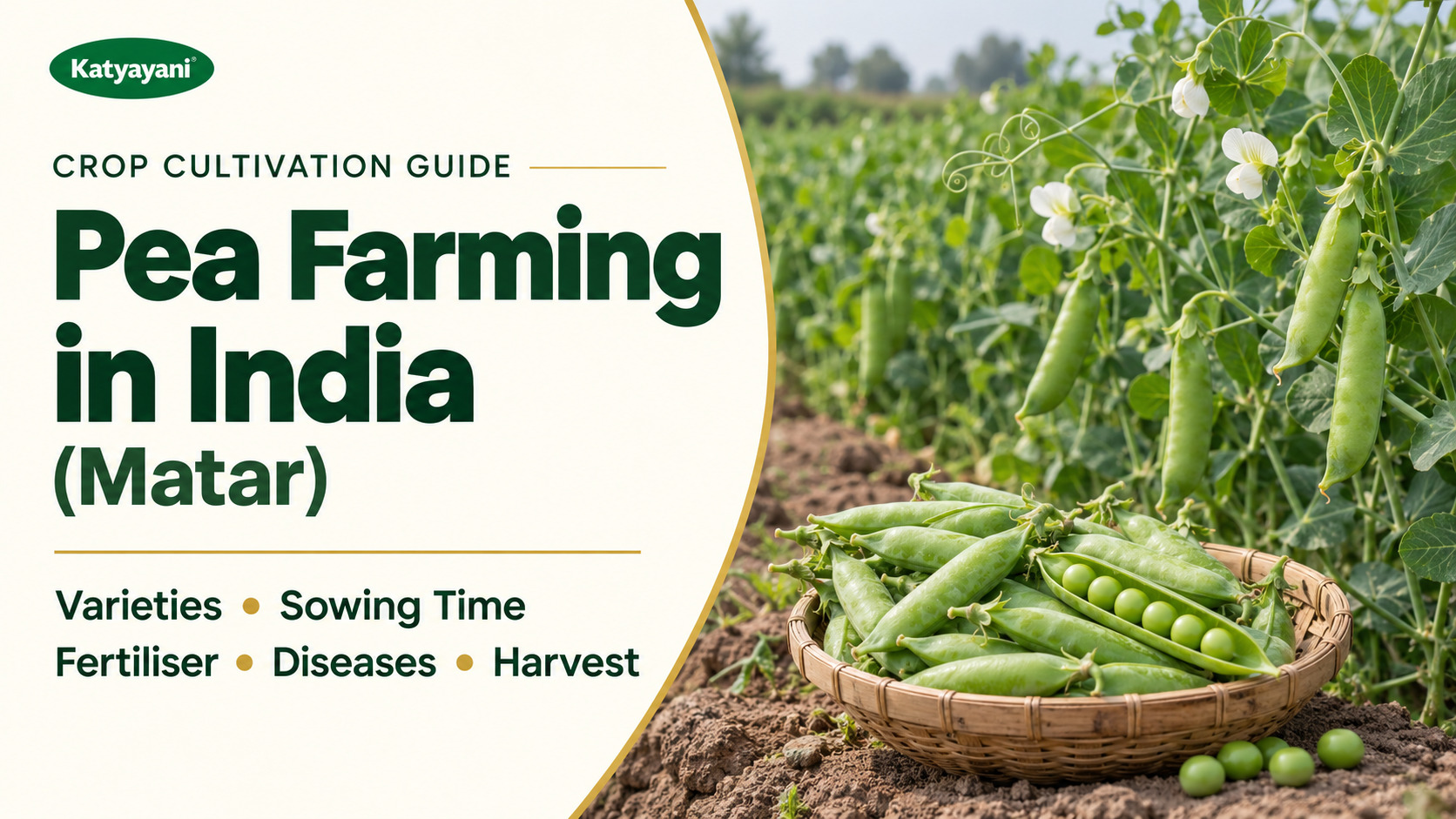
Pea (matar) is a cool-season crop that belongs to the legume family. In India it is grown for two main uses. Garden pea is grown for green pods that go to the market or the kitchen. Field pea is grown for dry grain that is made into dal. Garden pea sells for more per kilo, but you must pick it on time and sell it fast. Field pea is easier to handle and stores well.
Pea is a legume, so its roots work with soil bacteria that pull nitrogen from the air. This is why pea fits well between paddy and wheat in a crop rotation. It also explains why coating the seed with the right bacteria matters. If you already grow chickpea, the same idea applies. Our guide on biofertiliser for chana explains it in simple steps.
| Question | Garden pea (green pods) | Field pea (dry grain) |
|---|---|---|
| Main use | Fresh pods, frozen peas, vegetable market | Dal, flour, animal feed |
| Harvest | Tender green pods, picked many times | Fully dry pods, picked once |
| Main risk | Price crash if everyone harvests together; powdery mildew | Rust, wilt and late pod borer |
| Best for | Farmers near a town or market | Farmers who want a low-effort pulse |
Which are the best pea varieties?
Pick a variety by how fast it matures and how well it resists disease. The ICAR-IIVR Varanasi pea page lists the Kashi series, which is bred for green pods. The table below comes from that page. A dash means the page gives no value.
| Variety | Maturity | Pod length (cm) | Yield (q/ha) | Powdery mildew |
|---|---|---|---|---|
| Kashi Purvi | First picking in 65-70 days | 8-8.5 | 108-117 | Escapes it by maturing early |
| Kashi Tripti | 80-85 days to harvest | - | 90-100 | Resistant |
| Kashi Ageti | Early | - | 100-120 | - |
| Kashi Mukti | Early | 8.5-9 | 110-120 | Resistant |
| Kashi Nandini | Early | 8-9 | 110-120 | - |
| Kashi Udai | Early | 9-10 | 100-110 | - |
| Kashi Samridhi | 90-95 days (late type) | 7.5-8 | 120-140 | Resistant |
| Kashi Shakti | Medium | 10-11 | 140-160 | - |
The NIPHM pea package adds more names. For powdery mildew it lists Rachna, Pant P5, DMR 11, HUP 2, JP 885, KFP 103, Ambika, Shubhra, Aparna, Azad P4 and Pusa Panna. For rust it lists Hans, DMR 11 and Type 163. TNAU names Ooty 1, Bonneville, Arkel and Azad for its own region. Always buy certified seed of a variety your state agriculture university suggests for your zone.
Quick Rule: Choose an early variety for a quick market gain. Choose a mildew-resistant variety if your area had mildew last year. Buy sealed packets with a lot number, not loose seed from an open sack.
When is the best time to sow pea?
In most of the plains, sow from mid-October to mid-November. The Assam package of practices calls this the best window. The TNAU Agritech Portal lists October-November for plains in its region. Early varieties can go in at the start of the window. Very early sowing in warm weather invites wilt and mildew. Late sowing shortens the crop and cuts yield.
Sowing date also decides which problems you face. A late-sown crop may flower in a cold spell, and frost can damage the flowers. Read our guide on frost protection in crops before the cold sets in.
| Source | Sowing window |
|---|---|
| Assam package of practices (2021) | Mid-October to mid-November |
| TNAU Agritech Portal | February-March and October-November in the plains |
| Early varieties (such as Kashi Purvi) | Early in the window; first picking about 65-70 days after sowing (IIVR) |
How much seed does pea need, and what spacing should you keep?
Official sources do not agree on one number. Seed size, variety type and state practice all change the answer. Here is what each source says.
| Source | Seed rate | Spacing |
|---|---|---|
| TNAU Agritech Portal | 100 kg per hectare | 45 x 10 cm in lines |
| Assam package of practices (2021) | 60 kg per hectare | 30 cm between rows, 10 cm between plants |
In acre terms, 60 kg per hectare is about 24 kg per acre, and 100 kg per hectare is about 40 kg per acre. This conversion is our own estimate, so you can plan ahead. Large-seeded varieties need more seed. Sow in lines so weeding is easy, and place the seed about 5 cm deep in moist soil.
How do you treat pea seed before sowing?
Treat the seed on the day you sow. This one step decides how healthy the crop is for the first month. The sources list three treatments.
- Rhizobium culture: NIPHM advises 250 g per acre of seed. TNAU advises 2 kg of Rhizobium per hectare, applied before sowing. Rhizobium helps pea roots take nitrogen from the air. Katyayani stocks a Rhizobium nitrogen-fixing bio-fertiliser for legumes.
- Fungicide on the seed: The Assam package advises carboxin at 2 g per kg of seed. TNAU lists Thiram or Captan at 2 g per kg, or Trichoderma at 4 g per kg, to stop seed-borne disease.
- Friendly microbes for soil disease: NIPHM suggests Trichoderma and Pseudomonas fluorescens on seed and in soil. See our Trichoderma viride powder and Pseudomonas fluorescens powder.
The order matters. Apply the fungicide first and let the seed dry in shade. Coat it with Rhizobium last. Do not mix Rhizobium with a chemical fungicide, because the chemical can kill the bacteria. For a similar example in another pulse, read our post on chana seed treatment to prevent wilt.
What fertiliser does pea need?
Pea needs little nitrogen because it makes its own. It does respond well to phosphorus, potash and compost or farmyard manure (FYM). If you have a soil test, follow it. A soil health card tells you your soil's nutrient levels for free. If you have no test, use the doses below.
| Source | Organic manure | Chemical nutrients |
|---|---|---|
| NIPHM pea package | Well-rotted FYM at 8-10 t per acre, mixed with Trichoderma | Starter dose per acre at sowing: 10 kg N, 28 kg P2O5, 25 kg K2O. If growth is slow, top-dress 5-10 kg N per acre |
| TNAU Agritech Portal | FYM at 20 t per hectare | Per hectare at sowing: 60 kg N, 80 kg P, 70 kg K. Top-dress 60 kg N at 30 days |
The TNAU dose is higher than the NIPHM dose. The NIPHM figure is a light "starter" dose for a crop with Rhizobium on fertile soil. The TNAU figure is a fuller regional package. Remember that DAP supplies both nitrogen and phosphorus, so count its nitrogen in your starter dose. If DAP is hard to find, see our note on DAP alternative fertilisers.
Some growers also give a leaf spray of a water-soluble fertiliser such as NPK 19:19:19. The Assam package lists a 0.5% NPK (19:19:19) spray at the stage before flowering and at pod start. Do not spray when the crop is under heat stress.
How often should you irrigate pea?
Less often than most farmers think. Pea does not like standing water, and too much water causes root rot. The Assam package advises one irrigation at 40 to 50 days after sowing, if needed. The TNAU portal lists a weekly irrigation for its region, which has a different climate. A simple rule is to water at flowering and at pod filling. Keep the water light and drain any extra.
How do you control weeds in pea?
The first 30 to 45 days are when weeds hurt the crop most (NIPHM). Weed by hand once or twice, at 25-30 days and again at 45 days after sowing. TNAU advises the first weeding at 15 days. NIPHM also lists a spray applied before the weeds come up: linuron 50% WP at 0.5 to 0.8 kg per acre in 200 litres of water. Use any weedkiller only as the label says. A "stale seed bed" also helps: water the field, let weeds sprout, then till lightly just before sowing.
Which diseases attack pea, and how do you control them?
Four problems cause most of the damage: powdery mildew, rust, Fusarium wilt and root rot. The table shows the sign, the first fix and the options listed in the NIPHM pea IPM package.
| Problem | What you see | First fix (no spray) | Options listed by NIPHM |
|---|---|---|---|
| Powdery mildew | White powder on leaves, stems and pods | Grow resistant varieties; burn old stubble after harvest; do not sow next to last season's pea stubble | Sulphur 80% WG at 750 g to 1 kg per acre, or sulphur 40% WP, 52% SC or 85% DP. Carbendazim, dinocap, triadimefon and fenarimol are also listed. Spray again after 15-25 days |
| Rust | Orange-brown spots on leaves | Destroy diseased plant waste; rotate with non-legume crops; use tolerant varieties | Sulphur 80% WP, sulphur 85% DP or triadimefon. Spray again after 25 days |
| Fusarium wilt | Plants yellow from the base and die in patches | Use resistant varieties; avoid late sowing; treat the seed | Trichoderma or Pseudomonas on seed and in soil |
| Root rot | Poor stand, rotten roots, plants fall over | Wider spacing; avoid waterlogging | Treat the seed with friendly microbes; follow the label |
For powdery mildew, spray at the first sign, not after the whole plot turns white. A sulphur fungicide such as Sulphur 80% WDG matches the sulphur 80% WG option in the NIPHM table. Read the label for dose and waiting time. You can also browse our powdery mildew fungicide collection. Avoid spraying sulphur in very hot weather, because it can burn leaves.
Keep It Simple: A resistant variety, treated seed and no waterlogging prevent most of these problems before you need a single spray.
Which insect pests attack pea?
Three pests matter most: pea aphid, leaf miner and pod borer. NIPHM names two pod borers, Etiella zinckenella and Helicoverpa armigera. Start with traps and field hygiene, and spray only if the pest keeps growing.
| Pest | Damage | Traps and field steps (NIPHM) | What to do |
|---|---|---|---|
| Pea aphid | Tiny insects suck sap from tender shoots; leaves turn pale and curl | Yellow sticky traps, 4-5 per acre; tall border crops such as maize or sorghum; avoid too much nitrogen | See our aphid control collection; follow label rates |
| Leaf miner | White winding tunnels in leaves; flowers and pods suffer | Remove mined leaves; yellow sticky cards; tomato or marigold as a trap crop | See our leaf miner collection |
| Pod borer | Holes in pods with a caterpillar inside | Deep ploughing; hand-pick caterpillars; pheromone traps, 4-5 per acre; bird perches, 20 per acre | NIPHM lists malathion 50% EC at 600 ml in 200-400 litres of water per acre. Check the label and waiting time |
Never spray close to picking. Green pods go straight to the kitchen, so the waiting time on the label is a food safety rule. For early aphid and leaf-miner cases, a plant-based option such as activated neem oil is a gentle place to start.
When and how do you harvest pea?
For green pods, pick when the pod is full and bright green but the seeds are still tender. IIVR lists the first picking of Kashi Purvi at 65 to 70 days after sowing. TNAU gives 75 days for its region. Pick every 7 to 10 days. Harvest in the cool of the morning and keep the pods in shade. Hot weather at harvest lowers pea quality (TNAU).
For dry grain, wait until the pods turn straw-yellow and rattle. Harvesting on time also cuts pod shatter and split grain (NIPHM). Dry the grain well before storage. Keep the store clean, because pea weevil attacks stored grain.
How much yield can you expect per acre?
IIVR lists 90 to 160 quintals per hectare for its Kashi varieties. That is about 36 to 65 quintals per acre of green pods. TNAU gives 8 to 12 tonnes of pods per hectare, or about 32 to 49 quintals per acre. These are trial and station figures. Real farm yields are usually lower. They depend on sowing date, disease control and the number of pickings. The per-acre numbers here are our own conversion of the per-hectare sources.
What does pea farming cost per acre, and what can you earn?
There is no single official cost per acre. Land work, seed and labour costs differ by state. Here is one real example. The SMS Foundation case from Aurangabad district, Maharashtra reports that a farmer spent about Rs 16,600 on one acre of green pea. He picked 11 quintals in the first round and 9 in the second. His gross income was Rs 78,500 and his net income was Rs 61,900. The same article gives Rs 60 per kg as the expected selling price for the next planting. Market prices change daily, so redo the sums with your local mandi rate.
| Item (SMS Foundation, 1 acre, Maharashtra) | Value reported |
|---|---|
| Total cost of cultivation | About Rs 16,600 |
| Yield | 11 quintals (first picking) + 9 quintals (second picking) |
| Gross income | Rs 78,500 |
| Net income | Rs 61,900 |
If you plan to insure the crop, check our post on PMFBY Rabi registration for the last dates before you sow.
Common mistakes in pea farming
- Sowing too early in warm weather, then fighting wilt and mildew.
- Skipping seed treatment to save a small amount.
- Giving too much nitrogen. It grows leaves and aphids, not pods.
- Letting water stand. One extra irrigation can cause root rot.
- Waiting until mildew covers the field before the first spray.
- Spraying close to picking, or selling green pods before the waiting time is over.
Conclusion
Pea rewards farmers who get four things right: the right variety, sowing in the correct window, treated seed, and a spray at the first sign of powdery mildew. Start with a soil test, keep the water light, and pick pods on time. Use the numbers in this guide as a starting point. Then confirm the final dose with your state agriculture university or local farm science centre (KVK).
Why trust this guide
Written by Team Katyayani, Editorial Team at Katyayani Organics. Cross-checked against published research and university extension programs.

Leave a Comment