 11 min read
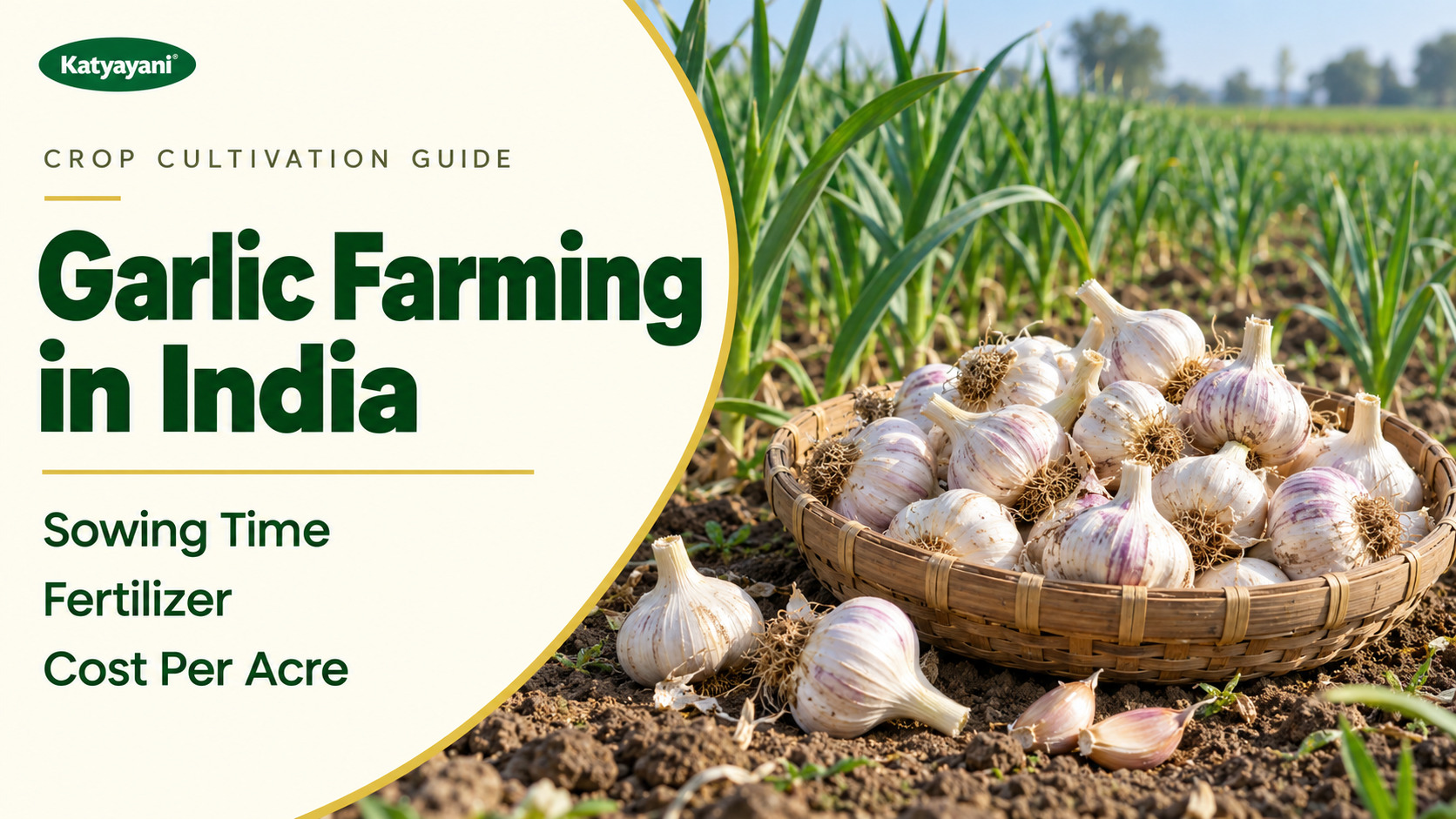
Sow garlic cloves from the last week of September to November. October to early November is best for most northern and central plains. Use about 200-240 kg of cloves per acre, planted about 15 cm by 10 cm apart. Treat the cloves before planting. Harvest comes 130-150 days later. Good crops give 32-48 quintals per acre. The cost changes a lot by state and seed price.
When is the best time to sow garlic (lahsun)?
Garlic is a winter (rabi) crop. It grows leaves in cool weather. It forms the bulb as the weather turns drier and warmer. Sources give slightly different dates. Use this table as a guide, then check the date with your local Krishi Vigyan Kendra (KVK), the government farm advice centre.
| Region / source | Sowing window | Note |
|---|---|---|
| Plains of northern India (Krishi Jagran guide) | October to November | Hilly areas sow in March-April in the same guide |
| Grower guides | Last week of September to end of November | Early sowing in cooler pockets |
| Karnal, Haryana (Krishak Jagat report, Dec 2023) | 15 to 30 October | Recommended for Karnal conditions |
| Nashik, Maharashtra (same report) | 25 October to 5 November | Recommended for Nashik conditions |
| TNAU (hill areas of Tamil Nadu) | June-July and October-November | Ooty-type hill conditions |
Sow too early in hot soil and the cloves sprout unevenly. Sow too late and the bulbs have less time to grow before the heat comes. If you also grow other winter crops, compare dates with our wheat sowing time and seed rate guide so that labour and water do not clash.
Which soil and climate suit garlic?
Garlic grows best in loose soil that drains well and has plenty of organic matter. The ideal pH is 6.0 to 7.0 (TNAU), or up to 7.5 in another guide. Heavy or waterlogged soil gives small bulbs and more rotting. Before you buy any fertilizer, get your soil tested. Our soil health card guide shows you how to read the report.
Which garlic variety should I choose?
Farm advice sources name these common varieties: G-1 (Yamuna Safed), G-41 (Agrifound White), G-282 (Yamuna Safed-3), Agrifound Parvati (G-313), Bhima Omkar and Bhima Purple. Ooty 1 suits hill areas. Pick a type that your local market buys. Buy clean, certified seed if you can.
| Variety | What published sources say | Source |
|---|---|---|
| Ooty 1 | 120-130 days; 17 t/ha (hill conditions) | TNAU |
| Bhima Purple | 8.65 t/ha in a Karnataka dry-zone trial | Journal trial |
| Yamuna Safed-3 (G-282) | 8.59 t/ha in the same trial | Journal trial |
| Bhima Omkar | 5.20 t/ha in the same trial | Journal trial |
| G-1, G-41, G-282, G-313 | Listed as common choices; no single yield figure | Krishi Jagran |
These numbers come from different places and seasons. Do not rank varieties by them. You can read the Karnataka garlic variety study yourself. Then ask your KVK which variety did best in your district last year.
How much garlic seed per acre, and at what spacing?
- Seed amount: 200-240 kg of cloves per acre. TNAU says 500-600 kg per hectare, which is about the same (200-243 kg per acre, our conversion).
- Gap between cloves: TNAU plants cloves 15 cm by 10 cm apart, on ridges 30 cm apart or on flat beds. Another guide puts rows 15-20 cm apart and cloves 7-10 cm apart in the row.
- Depth: 2-3 cm, with the pointed end up.
- Choose big cloves: split the bulbs a day or two before planting. Throw away small, sick or damaged cloves.
How to treat garlic cloves before planting
Rotting often starts in the clove or in the soil. So treat the cloves before you plant them. TNAU advises carbendazim, a fungicide, at 2 g per kg of cloves. A trial at Dharwad found that Trichoderma harzianum (a friendly fungus) at 10 g per kg of cloves gave the least disease, especially when followed by two sprays against purple blotch. For this step you can use a Trichoderma product such as Katyayani Trichoderma viride bio-fungicide powder. Follow the dose on the pack. Do not mix a chemical fungicide and a Trichoderma product in the same dip unless the label allows it.
Fertilizer for garlic: how much and when?
No single dose is right for every field. Here are three published plans side by side. Adjust them using your soil test.
| Source | Manure | Nitrogen : Phosphorus : Potash (N:P:K) | Top dressing |
|---|---|---|---|
| TNAU (per hectare) | 50 t farmyard manure (FYM) at last ploughing | 40 : 75 : 75 kg | N 35 kg/ha at 45 days after planting |
| Grower guide (per hectare) | 20-25 t FYM or compost | 100 : 50 : 50 kg | Half the urea at preparation, half 30-40 days later; zinc sulphate 25 kg/ha every 3 years |
| Agri Farming (per acre) | 2-3 t FYM | 24 : 14 : 24 kg | Not stated |
These are general guides, not a recipe for your field. A soil test is a better guide. If DAP is short or costly this season, read our DAP alternative fertilizer guide before you buy.
Micronutrients and bulb size
- Sulphur gives garlic its strong smell and helps bulb quality. Ammonium sulphate supplies it. TNAU prefers it to too much urea, which can make bulbs soft and rubbery.
- Zinc and boron: TNAU mentions boron sprays. A grower guide mentions zinc sulphate once every 3 years. Use zinc sulphate or boron 20% only if your soil test or the plant shows a need.
- Do not give heavy doses of nitrogen late in the crop. It makes soft bulbs that do not store well.
If you want a ready plan for each stage, look at these garlic kits: the garlic initial stage combo (10-20 days), the bulb growth combo (60-80 days) and the bulb special combo (90-110 days). The whole range is on our garlic crop products page.
How often should I irrigate garlic?
Water the field right after planting. After that, one source says every 7-10 days. Another says every 10-15 days. Use the shorter gap in light, sandy soil and the longer gap in heavy soil. Give a little extra water while bulbs are forming. Stop watering 10-15 days before harvest so the bulbs dry well and store better. Drip irrigation with fertilizer in the water (fertigation) is said to raise yield and also saves water.
Weed control in garlic
Garlic has shallow roots and grows slowly at first. So weeds hurt it more than most crops. TNAU says to weed on the 30th and 60th day after planting. Another guide says to weed first at 25-30 days and keep the field clean for 40-50 days. Straw mulch also helps. Use a weed killer only if your KVK suggests one, and follow the label.
Garlic crop calendar at a glance
| Days after planting | What to do |
|---|---|
| Before planting | Soil test, farmyard manure, last ploughing, base fertilizer, clove selection and treatment |
| 0-3 | Plant the cloves and give a light watering |
| 10-30 | Check that plants have come up. First weeding at 25-30 days. If you split nitrogen, give the second part at 30-40 days |
| 45-60 | TNAU: extra nitrogen at 45 days and second weeding at 60 days. Look for thrips and leaf spots |
| 60-90 | Bulbs are growing. Water steadily. Watch for purple blotch after cloudy or humid days |
| 90-130 | No more heavy nitrogen. Water less as leaves turn yellow |
| 130-150 | Harvest when about half the leaves are yellow and dry. Stop watering 10-15 days before |
Garlic pests and diseases: what to watch and what to do
Thrips
Thrips are tiny insects. They scrape the leaves and leave silvery streaks. Their wounds also let leaf diseases in. Check inside the leaf folds in the evening. Blue sticky traps (6-8 per acre in one guide) help you spot thrips early. One guide lists fipronil, profenofos and carbosulfan as sprays. Whatever you choose, follow the dose and waiting time on the label. Change the spray type from time to time. You can see matching products on the garlic thrips collection.
Purple blotch (Alternaria porri)
Purple blotch shows as small whitish spots. They grow into purple-brown patches with yellow edges. It spreads mostly in cloudy, humid weather. Use clean cloves and do not water late in the day. Do not overuse nitrogen. One course source lists mancozeb at 0.25% every 10-15 days from about 30 days after planting. The Dharwad trial used a fluopyram plus tebuconazole mix at 50 and 65 days. Check the label and ask your KVK before you choose. You can see options on the garlic purple blotch collection.
Base rot and clove rot
The base of the bulb turns soft and brown, and the roots rot. Prevention works best. Do not grow onion or garlic in the same field for several years (one source says 4-5 years). Plant treated cloves in soil that drains well. Never let water stand in the field. If you also grow onion, our onion farming in India guide covers problems the two crops share.
Safety: Spray doses in this article come from the sources named in the text. Always read the label. Wear protective clothing. Respect the waiting time before harvest. If you are unsure, ask your KVK or use the free video call in the Krishi Direct app.
When and how to harvest garlic
Harvest comes 130-150 days after sowing (Krishi Jagran). Agri Farming says 130-180 days, depending on variety and place. TNAU says to harvest when the tops turn yellow or brown and start to dry. Lift the bulbs with care so the skin does not get cut. Tie them in bunches. Then dry (cure) them for some days in a shaded, airy place. Keep them away from direct sun and rain. Store them in an airy room, not a damp closed one.
Garlic yield per acre
| Source | Yield quoted | Per acre (my conversion where needed) |
|---|---|---|
| Agri Farming | 32-48 quintals per acre (40 used as average) | 32-48 q |
| TNAU | 8-12 t/ha | about 32-49 q (1 ha = 2.47 acres) |
| Krishi Jagran | 100-200 quintals per hectare | about 40-81 q |
| Karnataka trial (Bhima Purple) | 8.65 t/ha | about 35 q |
| Karnataka paper on national average | 5 t/ha | about 20 q |
The range is wide. Variety, soil, watering, disease and sowing date all change the result. The national average is far lower than what good farms get. That is why the pest and nutrient steps above matter.
Garlic farming cost per acre: what published studies show
We could not find an official national cost figure for garlic. Here are the numbers we found, with the year and place. Treat them as a range, not a fixed price.
| Source | Cost figure | Note |
|---|---|---|
| Agri Farming (page dated 2019) | Total about Rs 30,250 per acre | Seed is shown as Rs 1,200, but the same page says seed can cost up to Rs 12,000 per acre, so the total is understated |
| Down To Earth (Aug 2022, Madhya Pradesh) | About Rs 90,000 for 3 bigha (0.6 acre), or Rs 30,000 per bigha | The farmer paid Rs 7,000 per quintal for seed and sold at Rs 400-500 per quintal in a crash year |
| Gujarat farmer union (2022, via FreshPlaza) | About Rs 37,100 per acre | Yield quoted about 3 tonnes per acre |
| Rajasthan study (Pratapgarh and Chittorgarh) | About Rs 1.22-1.25 lakh per hectare, roughly Rs 49,000-51,000 per acre | Seed was about half the total cost; per-acre figure is my conversion |
Do your own sum with today's prices. Start with seed: 200-240 kg per acre times your local price per kg. At the Rs 7,000 per quintal paid in 2022, seed comes to about Rs 14,000-16,800 per acre (our calculation). Then add ploughing, manure, fertilizer, labour for planting, weeding and harvest, sprays and water. A loan for seed and inputs may be possible under the Kisan Credit Card scheme.
Is garlic farming profitable? Price risk you must plan for
Garlic can pay very well in a good year. In a bad year it can lose money. Down To Earth reported in August 2022 that Madhya Pradesh farmers who sold at Rs 100-150 per 50 kg could not recover their costs. The report also said garlic has no minimum support price (MSP) and no central price-support scheme. To see which crops do have an MSP, read our rabi MSP crop-wise rates post. The same report quoted a trader saying garlic prices fall sharply every four to five years.
See how much price matters. One page works out a profit of about Rs 1.7 lakh per acre at 40 quintals and Rs 5,000 per quintal (Agri Farming, 2019 prices, seed cost too low). The same 40 quintals sold at Rs 500 per quintal bring in only Rs 20,000. So price, not yield, decides your profit. Find a buyer or plan airy storage before you sow.
Common mistakes in garlic farming
- Using poor or sick cloves, or buying seed without checking the variety.
- Skipping clove treatment, then losing plants to rot in the first month.
- Too much urea late in the crop. It makes soft bulbs that do not store.
- Water standing in the field, or watering right up to harvest.
- Growing garlic or onion in the same field year after year.
- Not planning where to sell, then having to accept any price.
To read more, see the TNAU garlic production page and the Krishi Jagran garlic guide.
Conclusion
Good garlic farming comes down to five things. Sow at the right time. Plant treated, clean cloves. Use a fertilizer plan based on a soil test. Water with care. Act early on thrips and purple blotch. Work out your own cost per acre using the local seed price. Decide how you will sell before you plant. Use the numbers in this guide to build your own plan.
Why trust this guide
Written by Team Katyayani, Editorial Team at Katyayani Organics. Cross-checked against published research and university extension programs.

Leave a Comment