 9 min read
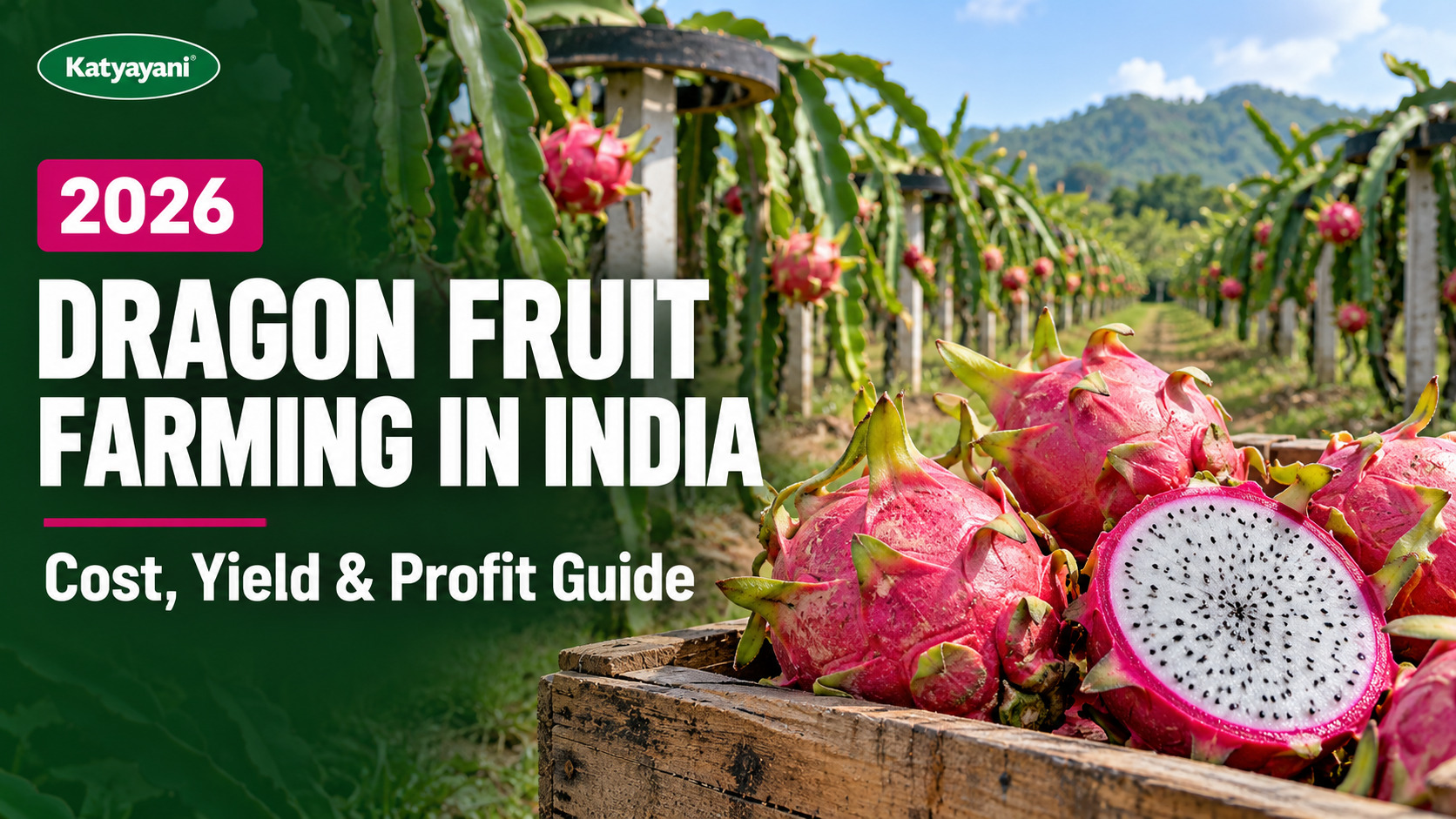
Dragon fruit farming in India costs roughly ₹4-₹6 lakh per acre to set up, mostly for poles and drip. Plants flower in 12-15 months and give economic yield from year 3. Reported yields are 5-10 tonnes per acre and prices ₹50-₹120 per kg, so profit varies widely.
What is dragon fruit farming?
Dragon fruit (pitaya) grows on a climbing cactus. It needs little water, handles dry weather, and lives for more than 20 years once planted, which is why many farmers in drought-prone areas try it. The plant climbs a pole, so the main investment is the support structure, not the plant. ICAR-NIASM has estimated that dragon fruit is grown on 3,000-4,000 hectares in India, with about 12,000 tonnes produced a year (Down To Earth, 2021, so the area is higher today).
Which climate and soil suit dragon fruit?
- Climate: warm, with low rainfall. Fruit sets from about June to November in many regions.
- Sun: full sun is good, but in hot semi-arid areas the plant can get sunburn. Give 25-30% shade using nets or trees.
- Soil: well-drained soil. Waterlogging rots the stems. Soil pH matters: a large Gujarat project in Kutch struggled with yields until the farmers lowered soil pH. Test your soil first and read our guide on soil pH and nutrient lock.
Dragon fruit farming cost per acre in India
| Cost item | Reported range | Source type |
|---|---|---|
| Total one-time investment (poles, plants, drip) | ₹4-₹6 lakh per acre | Farming guides |
| RCC support structure alone | ₹3-₹4 lakh per acre | Down To Earth (2021) |
| Cuttings | ₹30-₹80 per plant | Down To Earth (2021) |
| Drip irrigation | Extra, size dependent | Down To Earth (2021) |
Cost is the biggest barrier. A few farmers cut it by using cheaper pole materials, but get quotes in your district first.
How to plant dragon fruit: spacing and support
Dragon fruit is grown from stem cuttings that climb a support pole. Spacing between poles varies by system. Down To Earth lists these RCC pole spacings in use: 2.5 x 2 m, 3 x 1.5 m, 3 x 3 m and 4 x 3 m. Closer spacing means more plants per acre but also more humidity, so more disease risk. Keep the planting pit on raised, well-drained soil and add compost at planting.
Fertilizer and irrigation for dragon fruit
Feed on a schedule that matches the growth stage. These are practical guidelines, not a fixed label dose:
| Stage | What the plant needs | Katyayani options |
|---|---|---|
| Planting and early growth | Organic matter, root development, balanced NPK | Enriched vermicompost, NPK 19:19:19 water soluble, humic and fulvic acid |
| Before flowering | Phosphorus and micronutrients for bud set | Mix micronutrients, boron 20% |
| Fruit set and size | Potassium and calcium for firm, sweet fruit | NPK 13:00:45, NPK 00:00:50 potash, calcium nitrate |
Use drip irrigation, and water lightly: too much water causes stem rot. Always follow the dose on the pack and match it to your soil test. See our water soluble vs granular fertilizer guide to pick the right form, and browse the full NPK fertilizer collection.
Common dragon fruit pests and diseases
- Stem rot and fungal spots: caused by waterlogging and crowded plants. Improve airflow and drainage. Bio-fungicides such as Trichoderma viride are used for soil-borne problems; read the label for your crop.
- Mealybugs and sucking pests: check stem joints and fruit. Neem-based sprays like activated neem oil are a gentle first step. See our mealybug insecticide options.
- Sunburn: use shade net in hot, dry areas, as noted above.
- Dense planting: shade trees and tight rows raise humidity and invite disease, according to a Down To Earth report.
When does dragon fruit give fruit, and how much?
Plants begin to flower about 12-15 months after planting, but economic yields usually begin after 3 years. The fruit is harvested about 30-35 days after flowering, and a fruit weighs 200-700 g. Yield numbers differ by source. One guide says 8-10 tonnes per acre from year 3; Down To Earth says well-managed orchards reach an average of about 5 tonnes per acre. Plan with the lower figure.
Dragon fruit farming profit per acre: what is realistic?
Profit estimates online range from ₹5-₹6 lakh to ₹8-₹12 lakh per acre per year from year 3 and even higher for single farmers, but these come from blogs and individual success stories. Market prices are 'highly variable', reported at ₹50-₹120 per kg in Mumbai, Pune and Surat in 2021, and depend on fruit size and pulp colour. Many new nurseries are also selling cuttings, which has pushed supply up. A safer way to estimate:
| Step | Example method |
|---|---|
| 1. Yield | Use 5 tonnes per acre as a base case |
| 2. Price | Check today's price in your nearest mandi, not last year's |
| 3. Revenue | Yield x price |
| 4. Yearly cost | Fertilizer, labour, water, plant protection and picking |
| 5. Payback | Divide the ₹4-₹6 lakh set-up cost by yearly net profit |
Dragon fruit farming subsidy in India
Support comes mainly through the Mission for Integrated Development of Horticulture (MIDH). A Lok Sabha document says MIDH gives area expansion assistance at 40% of the maximum cost of ₹4 lakh per hectare, limited to 4 hectares per beneficiary, for cost-intensive crops, covering planting material, drip, trellises and nutrient and pest management. That document does not name dragon fruit, and state unit costs differ, so ask your state horticulture department which rate applies. See official pages at MIDH and the National Horticulture Board. For finance, read about the Kisan Credit Card, natural farming mission subsidy and agriculture subsidy schemes in India.
Should you start dragon fruit farming?
It suits farmers who can invest ₹4-₹6 lakh per acre, wait 3 years for steady income, and sell in a nearby city market or through a farmer group. It is a poor fit if you need quick returns or cannot reach a buyer. Start with one acre, visit a working orchard, and buy cuttings only from a registered nursery.
Get expert help and the right inputs on your phone
Two Katyayani apps help at different stages. Farmers can use the Katyayani Krishi Direct app: it has a free agri video call with a farming expert, a crop calendar, order tracking, and works in 9 languages (Hindi, English, Marathi, Kannada, Telugu, Tamil, Malayalam, Bengali, Odia). Retailers and dealers can use the Katyayani Partner (Retailer) app to see product details, place orders, track delivery and apply for credit with a simple KYC.
Conclusion
Dragon fruit can be a good long-term orchard for farmers with capital, patience and a nearby market, but it is not a get-rich-quick crop. Test your soil, start with one acre, calculate profit from a base yield of about 5 tonnes per acre and today's local price, and protect the plant with good drainage, nutrition and shade where needed. When you have a question on feeding or pests, ask in the Katyayani Krishi Direct app video call.
Why trust this guide
Written by Team Katyayani, Editorial Team at Katyayani Organics. Cross-checked against published research and university extension programs.

Leave a Comment