 11 min read
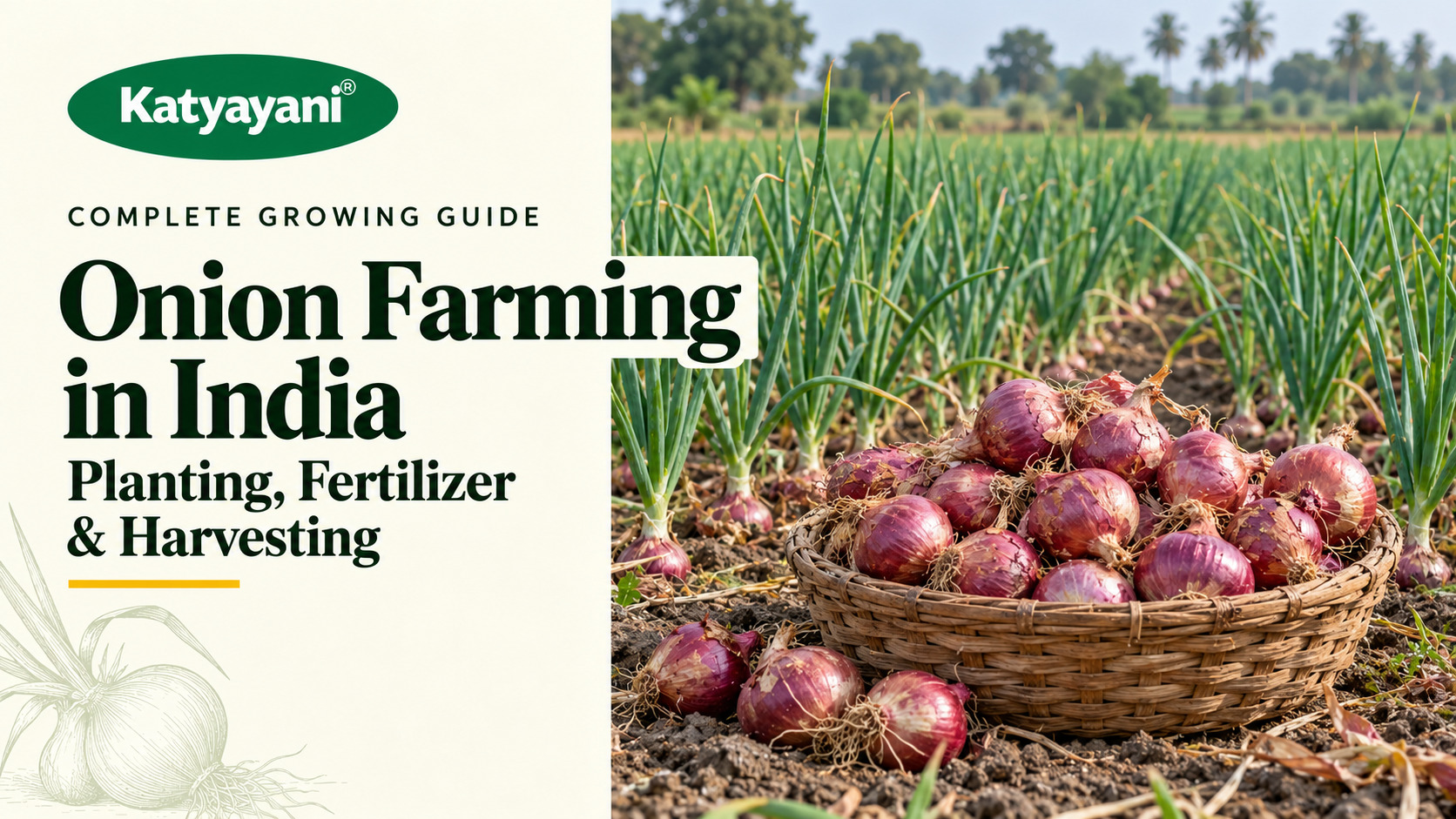
Onion farming in India is one of the most important vegetable businesses in the country. Onion is grown in almost every state, sold all year round and stored for months. But small mistakes are costly: wrong season, wrong variety, too much nitrogen, uncontrolled thrips or poor curing can wipe out much of the profit. This guide covers the full onion crop cycle, from season and variety to nursery, fertilizer, irrigation, plant protection, harvesting and storage, using recommendations from ICAR-Directorate of Onion and Garlic Research (ICAR-DOGR), the National Horticulture Board (NHB) and the NIPHM integrated pest management package.
How big is onion farming in India?
Onion (Allium cepa) is a bulb crop used fresh, cooked,
dehydrated and exported. India is the second largest onion growing country in
the world.
According to the Final Estimates of horticulture crops for
2024-25 released by the Ministry of Agriculture and Farmers Welfare on 17 March
2026 (PIB release):
|
Indicator |
2023-24 |
2024-25 |
|
Area under onion |
15.41 lakh ha |
19.68 lakh ha |
|
Onion production |
242.67 lakh tonnes |
307.67 lakh tonnes |
|
Change in production |
- |
+65 lakh tonnes (+26.79%) |
Dividing these two figures gives an average national productivity of roughly 15.6 tonnes per hectare in 2024-25. Good growers using the right variety and management regularly get much more than this, which shows how big the yield gap is.
Major onion states include Maharashtra, Madhya Pradesh,
Karnataka, Gujarat, Rajasthan, Bihar and Andhra Pradesh. According to an ICAR note
on onion cold storage, the rabi crop makes up about 60% of onion
production and reaches markets from March to June, and it has to carry the
market until the kharif crop arrives in October-November. That is why storage
matters so much in onion.
What climate and soil does onion need?
Climate
Onion is a cool-season crop that grows under a wide range of
conditions, but it does best in mild weather without extreme cold, heat or
heavy rain. Short-day onion is grown in the plains (10-12 hours day length) and
long-day onion in the hills (13-14 hours). As per the ICAR-DOGR-based package of practices on Vikaspedia:
·
Optimum temperature: 13-24 C for leaf
(vegetative) growth and 16-25 C for bulb development.
·
Relative humidity: about 70% for good growth.
·
Rainfall: 650-750 mm, well distributed, suits a
rain-fed crop.
Cooler weather and shorter days favour leaf growth; warmer
weather and longer days push the plant into bulbing.
Soil
Onion can grow in sandy loam, clay loam, silt loam and heavy
soils, but the best soil is deep, friable loam or alluvial soil with good
drainage and plenty of organic matter.
·
Ideal pH: 6.0-7.5. Onion struggles below pH 6.0
and is sensitive to highly acidic, alkaline and saline soils.
·
Salinity: yield starts falling when soil ECe
goes above about 4.0 dS/m.
·
Waterlogging: onion hates standing water. In
kharif, waterlogging increases anthracnose (twister) disease.
·
Heavy soils: bulbs may be misshapen unless
organic manure is added.
A soil test before the season tells you whether you need
extra sulphur or zinc and saves money on fertilizer you do not need. If you
already have a card, our guide on how to read a soil health card explains each
parameter.
Which are the onion seasons in India?
Onion is grown in three main seasons in India. Kharif onion
is planted during the monsoon and harvested in October-December. Late kharif
onion is planted after the rains and harvested in January-March. Rabi onion is
planted in winter and harvested in March-June; it is the main crop and the best
for storage.
The calendar varies by region (ICAR-DOGR-based package of
practices):
|
Region |
Season |
Seed sowing |
Transplanting |
Harvesting |
|
Maharashtra and parts of Gujarat |
Kharif |
May-Jun |
Jul-Aug |
Oct-Dec |
|
Maharashtra and parts of Gujarat |
Late kharif |
Aug-Sep |
Oct-Nov |
Jan-Mar |
|
Maharashtra and parts of Gujarat |
Rabi |
Oct-Nov |
Dec-Jan |
Apr-May |
|
Tamil Nadu, Karnataka, Andhra Pradesh |
Rabi |
Sep-Oct |
Nov-Dec |
Mar-Apr |
|
Rajasthan, Haryana, Punjab, UP, Bihar |
Kharif |
Jun-Jul |
Jul-Aug |
Oct-Nov |
|
Rajasthan, Haryana, Punjab, UP, Bihar |
Rabi |
Oct-Nov |
Dec-Jan |
May-Jun |
|
West Bengal and Odisha |
Rabi |
Sep-Oct |
Nov-Dec |
Mar-Apr |
|
Hilly areas |
Summer (long day) |
Nov-Dec |
Feb-Mar |
Aug-Oct |
Tip: Kharif onion fetches good prices because it reaches the market when stored rabi stock is running out, but it carries higher disease risk and does not store well. Rabi onion gives higher yield and better keeping quality.
Which onion varieties are best in India?
Choosing a variety suited to your season is the single
cheapest way to raise yield. ICAR-DOGR (Rajgurunagar, Pune), NHRDF (Nashik),
IARI, IIHR and state agricultural universities have released many onion
varieties. The figures below are from NHB's recommended onion varieties page and an ICAR note
on DOGR varieties. Yields are average or potential figures under
good management; your own field may differ.
Red onion varieties by season
|
Variety (developer) |
Best season |
Average yield |
Maturity (after transplanting) |
Keeping quality |
|
Bhima Super (DOGR) |
Kharif, also late kharif |
26-28 t/ha kharif; 40-45 t/ha late kharif (NHB) |
110-115 days |
Not specified |
|
Bhima Dark Red (DOGR) |
Kharif |
20-22 t/ha |
95-100 days |
Not specified |
|
Bhima Red (DOGR) |
Late kharif, kharif, rabi |
48-52 t/ha late kharif |
115-120 days |
Up to 4 months (late kharif), 3 months (rabi) |
|
Bhima Raj (DOGR) |
Kharif/late kharif (MH, KA, GJ), rabi in zone VI |
25-30 t/ha rabi |
120-125 days |
Not specified |
|
Bhima Kiran (DOGR) |
Rabi |
Up to 41.5 t/ha |
130 days |
Good, 5-6 months |
|
Bhima Shakti (DOGR) |
Late kharif and rabi |
45.9 t/ha late kharif; 42.7 t/ha rabi
(Maharashtra) |
130 days |
Very good; tolerant to thrips |
|
Agrifound Dark Red (NHRDF) |
Kharif |
30-40 t/ha |
95-110 days |
Average |
|
Agrifound Light Red (NHRDF) |
Rabi (all India) |
30-32.5 t/ha |
160-165 days after sowing |
Good |
|
Arka Kalyan (IIHR) |
Kharif |
33.5 t/ha |
100-110 days |
Average |
White and small onion varieties
White onion for processing includes Bhima Shweta (rabi,
about 35.9 t/ha, thrips tolerant), Bhima Shubhra, Pusa White Round and
Agrifound White. Small and multiplier onion types for South India include
Agrifound Rose, Arka Bindu, Co-1, Co-2 and MDU-1.
How to choose:
For kharif, pick a short-duration variety that bulbs under monsoon conditions
(Bhima Super, Bhima Dark Red, Agrifound Dark Red). For rabi, pick a variety
with good storage life (Bhima Kiran, Bhima Shakti, Agrifound Light Red) if you
plan to hold the crop. Buy certified seed from a trusted source and confirm
with your local KVK which variety is notified for your zone.
How to raise an onion nursery (seed rate and seed treatment)
Most onion in India is transplanted from a nursery. A good
nursery means uniform, healthy seedlings and fewer gaps in the field. For a
week-by-week plan for the main season, see our rabi onion nursery to transplant schedule.
1.
Area: About 0.05 hectare (500 sq m) of nursery is enough for one
hectare of field. For one acre, roughly 200 sq m is enough.
2.
Seed rate: 5-7 kg seed is needed to raise seedlings for one hectare
(about 2-3 kg per acre). Onion seed loses viability quickly, so always use
fresh seed of the current season.
3.
Bed preparation: Plough 5-6 times, remove stones and crop debris,
and mix about half a tonne of well-decomposed FYM into 0.05 ha. Make raised
beds 10-15 cm high and 1.0-1.2 m wide with at least 30 cm between beds. Raised
beds prevent seed wash-off and drain extra water.
4.
Seed treatment: Treat seed with thiram at 2 g per kg seed to protect
against damping off. Trichoderma viride at 1,250 g per hectare is also
recommended for healthy seedlings.
5.
Sowing: Sow in lines 50-75 mm apart, cover lightly with fine compost
or FYM and water gently. Drip or micro-sprinkler watering saves water in the
nursery.
6.
Weed control: Pendimethalin at 0.2% is recommended as a
pre-emergence herbicide in the nursery.
7.
Seedling age: Seedlings are ready in 35-40 days after sowing for
kharif, and 45-50 days for late kharif and rabi. Avoid both under-aged and
over-aged seedlings.
Damping off is the biggest nursery problem, especially in
kharif. The NIPHM IPM package notes that it can cause 60-75% damage under high
moisture and humidity. Avoid over-watering, use raised beds and do not sow too
densely.
How to prepare the field and transplant onion
1. Land preparation
Plough and harrow the field to a fine tilth. Incorporate
organic manure equal to about 75 kg N per hectare at the last ploughing:
approximately 15 t/ha FYM (about 6 t/acre), or 7.5 t/ha poultry manure or
vermicompost.
·
Rabi:
Flat beds of 1.5-2.0 m width and 4-6 m length are common.
·
Kharif:
Avoid flat beds. Use broad bed furrows (BBF) of 15 cm height and 120 cm top
width with 45 cm furrows. BBF drains extra rain water, improves aeration and
reduces anthracnose. It also suits drip and sprinkler irrigation.
2. Transplanting and spacing
1. Cut
one-third of the seedling top at transplanting for better establishment.
2. Dip
seedling roots in carbendazim solution (0.1%) for two hours before planting to
reduce fungal infection during establishment.
3. Plant
at 15 cm between rows and 10 cm between
plants. This is the optimum spacing recommended by ICAR-DOGR.
4. Give
a light irrigation at transplanting and again about three days later.
At 15 x 10 cm, the field holds about 66 plants per square
metre of planted bed area. Paths and furrows reduce the actual plant count per
acre, so do not compare plant population figures without checking the bed
layout.
Onion fertilizer schedule: how much NPK and sulphur?
Onion needs balanced nutrition, and the dose changes with
season because yield potential changes. The schedule below is the ICAR-DOGR
recommendation (per hectare), with approximate per-acre conversions (1 ha =
2.47 acres).
|
Season (yield potential) |
Total N:P2O5:K2O per ha |
Approx. per acre |
Basal (per ha) |
30 DAT |
45 DAT |
|
Kharif (25-30 t/ha) |
75:40:40 kg |
30:16:16 kg |
25 N + 40 P + 40 K |
25 kg N |
25 kg N |
|
Late kharif and rabi (40-50 t/ha) |
110:40:60 kg |
45:16:24 kg |
40 N + 40 P + 60 K |
35 kg N |
35 kg N |
|
Long-day onion, hills (100 t/ha) |
180:60:70 kg |
73:24:28 kg |
60 N + 60 P + 70 K |
60 kg N |
60 kg N (at 60 DAT) |
DAT = days after transplanting. Add organic manure equal to 75 kg N per hectare in all seasons.
Rule of thumb:
Apply one-third of the nitrogen and the full phosphorus and potash at
transplanting. Split the remaining nitrogen into two equal doses at 30 and 45
days after transplanting. Do not keep applying nitrogen late in the crop.
Excess nitrogen, especially late urea, is linked to thick necks, sprouting in
storage, splitting and higher thrips pressure.
Sulphur: the nutrient onion farmers often miss
Sulphur improves onion yield and pungency. ICAR-DOGR
recommends sulphur as a basal dose at transplanting:
·
15 kg S per hectare (about 6 kg per acre) where
soil sulphur is above 25 kg/ha.
·
30 kg S per hectare (about 12 kg per acre) where
soil sulphur is below 25 kg/ha.
·
50 kg S per hectare for long-day onion.
Using ammonium sulphate, single super phosphate or bentonite
sulphur as part of your basal dose can supply this.
Micronutrients: zinc, boron and others
Apply micronutrients based on a soil test. The NIPHM/DPPQS
IPM package lists these correction sprays when deficiency symptoms appear:
|
Deficiency |
What you see |
Correction (foliar) |
|
Zinc |
Restricted growth, yellow young leaves,
interveinal necrosis |
ZnSO4 0.5%, twice at fortnightly interval |
|
Manganese |
Tip burn, curling, delayed bulbing with thick
necks |
MnSO4 0.3%, twice at fortnightly interval |
|
Iron |
Complete yellowing of young leaves |
FeSO4 0.5% |
|
Sulphur |
Uniform yellowing of the whole plant |
K2SO4 or CaSO4 1%, twice at fortnightly interval |
Boron is important during bulb development. Katyayani's onion-specific Onion Pyaj Kand Vikas Combo for bulb growth pairs Boron 20% EDTA fertilizer (200 g per acre) with a growth regulator, sprayed around 80 days after transplanting as per the product page. Use boron only at the label dose; boron toxicity can happen if you overuse it.
To improve soil structure and root activity, especially in
tired or low-organic-carbon soils, many farmers add a humic acid fertilizer as a soil application or
through drip along with their basal dose. It supports, but does not replace,
FYM and NPK. If you prefer a ready soil package at planting, the Onion Unnati
Soil Kit combines bio NPK, Trichoderma, mycorrhiza (VAM), a granular insecticide
for early thrips and a mixed micronutrient.
How to irrigate onion (and why drip pays)
Onion has shallow roots, so it needs frequent, light
irrigation. Water stress followed by heavy irrigation causes split bulbs and
bolting.
·
Irrigate at transplanting, three days later, and
then every 7-10 days depending on soil moisture.
·
Number of irrigations (ICAR-DOGR): kharif 5-8,
late kharif 10-12, rabi 12-15.
·
Critical stages: establishment, bulb initiation
and bulb enlargement. Never let the field crack at bulbing.
·
Stop
irrigation 10-15 days before harvest, when the crop matures and tops start
falling. This reduces rotting in storage.
Drip and fertigation layout
|
Item |
ICAR-DOGR recommendation |
|
Bed |
Broad bed furrow, 15 cm high, 120 cm top width, 45
cm furrow |
|
Plant spacing |
10 x 15 cm |
|
Laterals |
Two 16 mm laterals per bed, 60 cm apart |
|
Emitters |
Inbuilt, 30-50 cm apart, 4 litres per hour |
|
Fertigation |
NPK 40:40:60 kg/ha basal, remaining 70 kg N in
seven splits through drip |
Research summarised in the same package found that drip at 100% pan evaporation improved marketable bulb yield by 15-25%, with more A-grade bulbs, about 35-40% water saving and 25-30% labour saving compared with flood irrigation.
How to control weeds in onion
Onion grows slowly in the first weeks and its thin leaves
cannot shade out weeds, so early weed control decides yield.
1. Deep
summer ploughing and a stale seedbed before transplanting reduce the weed seed
bank.
2. ICAR-DOGR
recommends oxyfluorfen 23.5% EC (1.5-2.0
ml per litre) or pendimethalin 30%
EC (3.5-4 ml per litre) before or at transplanting.
3. Follow
with one hand weeding at 40-60 days after transplanting.
4. Keep
the crop weed-free for the first 30-45 days.
Always use a herbicide registered for onion, at the label
dose, with a flat-fan nozzle and moist soil.
How to manage onion pests: thrips and others
Onion thrips
Onion thrips are tiny insects that rasp the leaf surface and
suck sap, leaving silvery-white streaks. Heavy attack dries leaf tips, reduces
bulb size and opens wounds for purple blotch and other diseases. Thrips are
worst in dry, warm weather. See the recommended solutions for thrips in onion on our Crop Finder.
The NIPHM AESA-based IPM package (crop stage-wise IPM for onion) recommends:
·
Cultural:
use tolerant varieties (Bhima Shakti and Bhima Shweta are listed as
thrips-tolerant by NHB), keep the field and bunds clean, avoid planting next to
garlic or other host crops, and plant two rows of maize (or an inner row of
wheat and outer row of maize) around the plot as a barrier crop. Sprinkler
irrigation reduces thrips compared with drip or surface irrigation.
·
Biological:
conserve predators such as minute pirate bugs, predatory thrips, lacewings,
ladybird beetles and spiders.
·
Chemical:
spray only when the population is high, with high volume and pressure aimed at
the leaf base, and add a sticker-spreader so the spray stays on the waxy,
upright leaves. Rotate insecticide groups to delay resistance.
Joker Fipronil 80% WG insecticide is labelled
on its product page for onion thrips at 30 g per acre in 200 litres of water.
For a ready onion pack that covers thrips and fungal diseases together, see the
Pyaaz Kheti Sooraksha Kit for onion (Joker +
IMD-70 + Dr. Zole).
Onion maggot, mites and caterpillars appear in some regions;
crop rotation, sanitation and pheromone traps are the first line of defence
there.
How to control onion diseases
|
Disease |
Key symptoms |
Favourable conditions |
Key management |
|
Damping off |
Seed rot; seedlings collapse at the collar |
Kharif, wet soil, high humidity |
Raised beds, seed treatment, Trichoderma, avoid
over-watering |
|
Purple blotch |
Small sunken whitish spots with purple centres on
leaves and stalks |
Hot, humid weather, 21-30 C, 80-90% RH |
Healthy seed, rotation, drainage, recommended
fungicide sprays |
|
Stemphylium leaf blight |
Yellow-orange flecks that become spindle-shaped
spots with pinkish margins |
18-25 C with long leaf wetness (16 hours or more) |
Sanitation, rotation, lower plant density,
protectant fungicides |
|
Downy mildew |
Leaves turn pale green, white cottony growth, then
yellow-brown and dry |
Warm, humid weather; late planting, poor drainage,
frequent irrigation |
Healthy bulbs for seed, rotation, avoid excess
nitrogen and water |
|
Anthracnose / twister (Jalebi rog) |
Water-soaked pale yellow spots; leaves twist, curl
and droop |
Warm (25-30 C), wet, organic-rich soils,
waterlogging |
Raised beds or BBF, drainage, sanitation |
Sources: NIPHM/DPPQS AESA-based IPM (onion diseases and symptoms).
Purple blotch and stemphylium blight
Purple blotch is the most common foliar disease of onion and
often follows thrips damage. The NIPHM package lists difenoconazole 25% EC (40
ml in 200 litres of water per acre) for purple blotch, and mancozeb 75% WP
(600-800 g per acre) for stemphylium leaf blight. Dr. Zole Azoxystrobin + Tebuconazole fungicide
is listed on its product page for onion purple blotch at 300 ml per acre.
Compare symptoms and recommended solutions on our Crop Finder pages for purple blotch in onion and stemphylium blight in onion.
Downy mildew and twister
Downy mildew is favoured by humid weather and is worse in
late-planted, poorly drained, over-watered or over-fertilised crops. Twister
(anthracnose) is mainly a kharif problem in waterlogged fields, so raised beds
and drainage are your best defence. See the Crop Finder pages on downy mildew in onion and anthracnose (twister) in onion.
Viral diseases such as iris yellow spot and onion yellow
dwarf have no cure, so manage the insect vectors, plant healthy seedlings and
remove infected plants.
Safety first: Use
only pesticides registered for onion, read the label for dose, waiting period
(pre-harvest interval) and protective equipment, and never mix products without
checking compatibility. When in doubt, ask your local agriculture officer or
KVK. Avoid spraying in the last weeks before harvest unless the label allows
it.
When and how to harvest onion
Onion is ready for dry bulb harvest in about five months
from sowing (most varieties mature 95-130 days after transplanting). Green
onion can be harvested in about three months.
·
Rabi
crop: the best time to harvest is one week after about 50% of the tops have
fallen over.
·
Kharif
crop: tops often do not fall, so harvest when leaves turn slightly yellow
and red colour develops on the bulb.
·
Timing
matters: early harvest leads to sprouting in storage; late harvest causes
secondary root growth in storage, and in kharif it causes doubles and bolting.
Harvesting steps
1. Stop
irrigation 10-15 days before harvest.
2. Pull
bulbs by hand in light soil, or loosen with a fork or hoe in heavier soil.
3. Leave
bulbs in windrows in the field for a few days with the leaves covering the
bulbs to protect them from sunburn.
4. After
the leaves dry, cut the tops leaving 2-2.5 cm of neck above the bulb. Cutting
too close leaves the neck open to rot.
5. Dry
further in shade. The NIPHM package suggests two days of field drying followed
by 10-15 days of shade drying before storage.
6. Grade
the bulbs by size and remove damaged, doubled, bolted or diseased bulbs before
storage.
How to store onion and reduce losses
Onion is semi-perishable. According to ICAR,
30-40% of onion is lost during storage, and losses go above 40% in years of
natural calamities. The main causes are weight loss, sprouting and rotting.
|
Storage type (ICAR data, about 4 months) |
Reported loss |
|
Low-cost thatched bamboo structure |
Up to 42% |
|
Bottom and side ventilated structure |
Up to 46% |
|
Ventilated storage without temperature control
(120 days) |
54.89% |
|
Conventional cold storage at 0 C (120 days) |
5.00% |
|
ICAR-DOGR cold storage, 27 +/- 2 C, 60-65% RH (120
days) |
7.14% |
Practical storage rules:
·
Store only well-cured, healthy bulbs of
varieties with good keeping quality.
·
Ventilate from the bottom and sides; bag stacks
should not exceed about 5 feet, with space all around.
·
Avoid bruising, and remove rotting or sprouting
bulbs early.
·
Excess late nitrogen and late irrigation shorten
storage life, so good storage starts in the field.
What yield can you expect from onion farming?
Onion yield in India depends heavily on season, variety,
irrigation and plant protection.
·
ICAR-DOGR yield potential: kharif 25-30 t/ha,
late kharif and rabi 40-50 t/ha, long-day onion up to 100 t/ha.
·
The ICAR-DOGR-based package states that
irrigated rabi onion typically yields 25-30 t/ha.
·
In ICAR-CAZRI KVK frontline demonstrations in
Kachchh, Gujarat (rabi 2013-14 to 2015-16), improved practices gave
254.62-275.50 q/ha compared with 205-216 q/ha under farmers' practice, a 24-28%
gain (Indian Journal of Arid Horticulture, 2024).
For a rough per-acre picture, 25-30 t/ha is about 100-120
quintals per acre.
What is the cost and profit of onion farming per acre?
Onion profit depends far more on the selling price than on
any other factor, and onion prices swing sharply between years and months. So
treat any profit number as an example, not a promise.
A field study in Haveri district, Karnataka (Mysore Journal of Agricultural Sciences, 2024,
survey of 100 farmers) found:
|
Item |
Per acre (Haveri study) |
|
Cost of cultivation |
Rs 49,283.87 (variable cost about 87%) |
|
Largest cost items |
Human labour (28%), manure (17%), seed (15%) |
|
Average yield |
41.69 quintals |
|
Average price received |
Rs 1,833 per quintal |
|
Gross returns |
Rs 76,409 |
|
Returns per rupee spent |
Rs 1.55 |
The Haveri yield is low because much of the crop there is grown under kharif conditions. The Gujarat frontline demonstrations above reported benefit-cost ratios of 2.23-4.26 with improved practices versus 2.02-3.80 for farmers' practice.
How to calculate your own onion profit
1. Add
up all costs: seed, nursery, land preparation, FYM, fertilizers, plant
protection, irrigation, labour, bags, transport and rent or interest.
2. Multiply
a realistic yield for your season and variety by a conservative price from your
nearest mandi for your selling month, not last year's peak.
3. Subtract
cost from gross returns, then re-check with a price 30% lower. If you still
cover cost, the plan is safer.
Storable rabi varieties, staggered selling, drip irrigation
and early control of thrips and purple blotch are the most reliable ways to
protect profit.
Conclusion
Onion farming in India rewards farmers who get the basics
right: the right season and variety, a healthy nursery, correct spacing,
balanced NPK with sulphur, timely irrigation that stops before harvest, early
control of thrips and purple blotch, and careful curing and storage. Most of
the yield gap between the national average of about 15-16 t/ha and the 40-50
t/ha potential of good rabi varieties comes from these practical steps, not
from any single input.
Plan your season with your local KVK or agriculture officer,
test your soil, and keep records of cost and yield every season so your
decisions get better each year. When you need onion-specific inputs, from
thrips insecticides and purple blotch fungicides to boron, humic acid and ready
onion kits, you can find label-checked options at Katyayani Organics
(katyayaniorganics.com) and get advice from our agri experts before you buy.
Why trust this guide
Written by Team Katyayani, Editorial Team at Katyayani Organics. Cross-checked against published research and university extension programs.


Leave a Comment