 12 min read
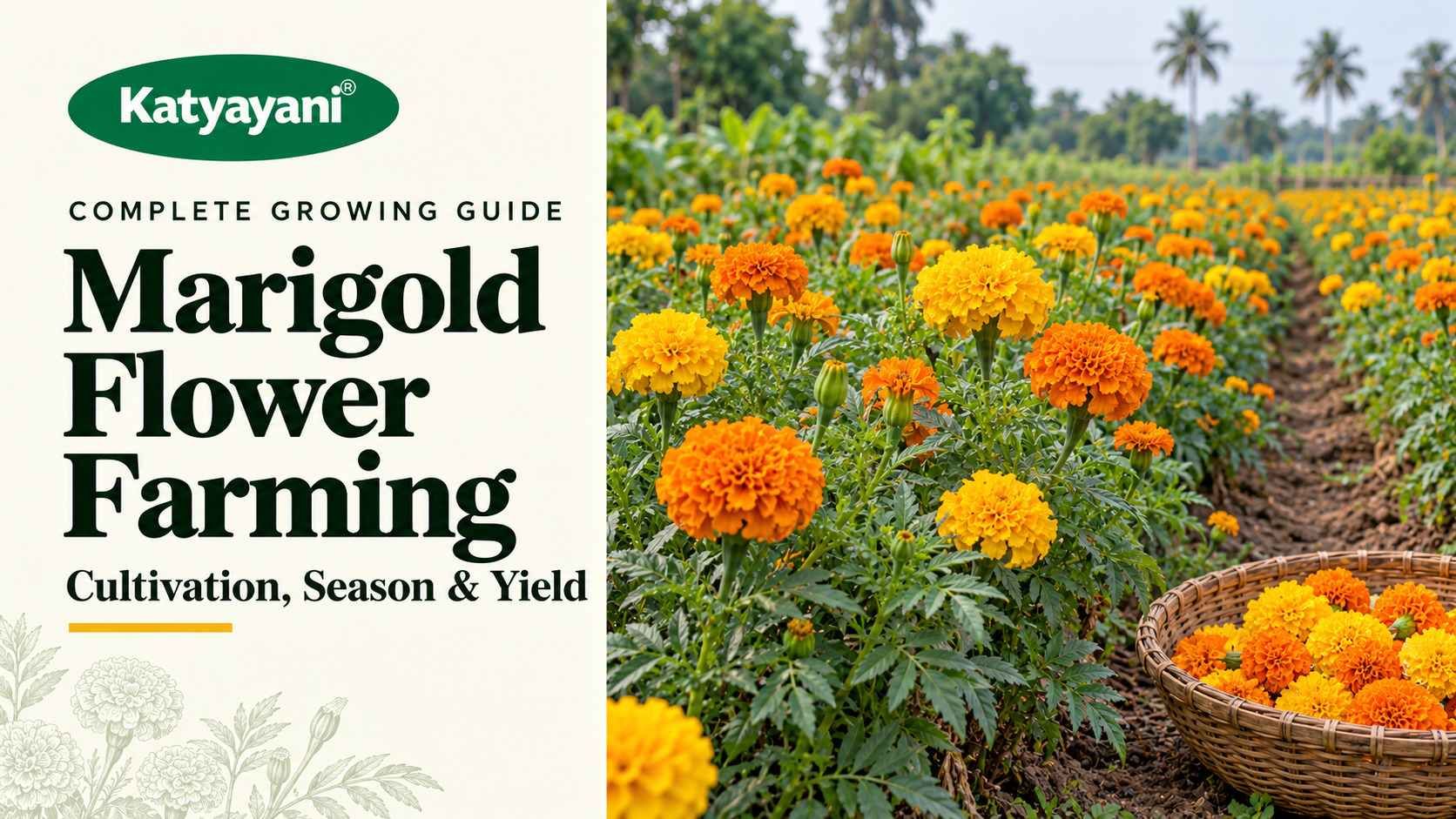
Marigold flower farming is one of the easiest ways for a small or marginal farmer in India to earn steady cash from flowers. Marigold (genda) is a hardy, short-duration crop that can be grown in all three seasons, and its loose flowers are used every day for garlands, temple offerings and decoration. Demand jumps sharply around Dussehra and Diwali, and the petals are also used to extract xanthophyll pigment for poultry feed. This guide explains every step of marigold cultivation, from choosing African or French types and IARI varieties to nursery, spacing, pinching, fertilizer, pest control, harvest, yield and income, using figures from Indian agricultural universities and ICAR publications.
What Is Marigold and Why Is It a Good Cash Crop?
Marigold is an annual flowering plant of the genus Tagetes
in the family Asteraceae, native to Mexico and Central America. Two species
dominate commercial marigold flower farming in India: African marigold (Tagetes
erecta) and French marigold (Tagetes patula).
Reasons farmers choose marigold:
·
Year-round
planting: According to an ICAR Indian Farming article by KVK Birauli (Dr
Rajendra Prasad Central Agricultural University, Bihar), marigold can be
planted round the year in three seasons, so flowers can reach the market in
every season.
·
Quick
returns: TNAU notes that flower picking can start about 60 days after
planting, and the crop lasts 130-150 days.
·
Many
uses: Loose flowers for garlands and religious functions, flower strings,
pot and bedding plants, and pigment (xanthophyll/lutein) extraction for poultry
feed.
·
Helps
other crops: The same ICAR article notes that marigold acts as a trap crop
for fruit borer in tomato and helps suppress nematodes.
African vs French Marigold: Which Type Should You Grow?
African marigold is a tall plant with large, fully double
flowers in orange or yellow, mainly grown for loose flowers and garlands.
French marigold is a dwarf, bushy plant with smaller flowers, often in orange,
red or bicolour shades, used for borders, pots and smaller garlands.
|
Feature |
African Marigold (Tagetes erecta) |
French Marigold (Tagetes patula) |
|
Plant height |
Tall, may need staking |
Dwarf and bushy |
|
Flower size |
Large, double |
Small to medium |
|
Main use |
Loose flowers, garlands, pigment |
Garlands, borders, pots |
|
Spacing (Bihar KVK) |
40 x 40 cm |
30 x 30 cm |
|
Flower yield (Bihar KVK) |
125-150 q/ha |
80-120 q/ha |
|
Example varieties |
Pusa Narangi Gainda, Pusa Basanti Gainda, Arka
Agni |
Pusa Arpita, Pusa Deep, Jafri, Red Brocade |
For the festival loose-flower market, most commercial growers prefer African marigold because of its big, heavy blooms. French types suit farmers who sell to nurseries, landscapers or make smaller garlands. If you only want a few plants on a balcony or terrace rather than a field crop, see our guide to marigold care in pots and other winter flowers.
Best Marigold Varieties for Indian Farmers
The ICAR Indian Farming article notes that most farmers
still grow local varieties, which are generally low yielders, while IARI New
Delhi, IIHR Bengaluru and BCKV Mohanpur have released improved varieties for
the Indian plains.
1. African marigold varieties
·
Pusa
Narangi Gainda (IARI): Orange, double flowers. Bred from Cracker Jack x
Golden Jubilee. In field trials at Sabour (Bihar) and Jhansi (Uttar Pradesh),
it gave more flowers per plant than Pusa Basanti Gainda.
·
Pusa
Basanti Gainda (IARI): Yellow flowers, bred from Golden Yellow x Sun Giant;
recorded the taller plants in the same trials.
·
Arka
Agni, Arka Alankara, Arka Bangara (IIHR): Varieties released by ICAR-IIHR,
Bengaluru.
·
Siracole:
A Bihar KVK case study describes it as strong, durable and in good market
demand.
·
Others
named in university lecture notes: Bidhan Marigold-1 and 2 (BCKV), Hisar
Beauty, Hisar Jaffri-2, MDU 1 (TNAU).
2. French marigold varieties
·
Pusa
Arpita (IARI): Note that sources differ on its classification; some list it
as French marigold and the ICAR Indian Farming article lists it under African
types. Confirm with your seed supplier.
·
Pusa
Deep, Jafri, Red Brocade: Listed as French marigold varieties by the ICAR
Indian Farming article.
Tip: Marigold is a short-day plant, so match the variety to
your season. Buy seed from IARI's seed unit, a state university, or a trusted
supplier, and ask for the season recommendation.
Climate and Soil for Marigold Cultivation
Climate
Marigold is hardy but flowers best in mild weather. A
university lecture note based on ICAR e-course material states that mild
temperatures of about 14.5-28.6 degrees C greatly improve flowering, while
higher temperatures of about 26.2-36.4 degrees C reduce flower production.
Seeds germinate best between 18 and 30 degrees C. This is why the winter crop
usually gives the most flowers, while the summer crop gives smaller blooms.
Soil
TNAU recommends well-drained loamy soil with pH 7.0-7.5 and
notes that saline and acidic soils are unsuitable. The ICAR Indian Farming
article calls fertile sandy loam ideal, with pH 6.5-7.5 and good water-holding
capacity. Avoid fields where water stands after rain, because waterlogging
causes root and collar rot.
Marigold Sowing Time: Season-Wise Calendar
Marigold flower farming follows three seasons. Plan your
sowing backwards from the market you want to hit.
|
Flowering season |
Nursery sowing |
Transplanting |
Flowering period |
Market fit |
|
Rainy (late rains) |
Mid June |
Mid July |
Mid September to December |
Navratri, Dussehra, Diwali, wedding season |
|
Winter |
Mid September |
Mid October |
Mid January to March |
High yield, steady demand |
|
Summer |
January-February |
February-March |
Mid May to onset of rains |
Smaller flowers, lower supply |
Source: sowing and transplanting dates from the ICAR Indian Farming article (KVK Birauli, Bihar); flowering periods from university lecture notes based on ICAR e-course material. Dates shift by region, so check with your local KVK.
Market tip: The rainy-season crop flowers right through the
festival months, when demand for marigold is very high. The winter crop usually
gives the heaviest yield, but prices may be lower after the festival peak.
Nursery Raising and Seed Rate
How much marigold seed is needed per acre?
Seed rates differ by source and season:
·
Bihar KVK
(ICAR Indian Farming): 200-300 g per acre for summer and rainy seasons, and
150-200 g per acre for winter.
·
TNAU:
1.5 kg per hectare (about 600 g per acre).
·
University
lecture note (ICAR e-course based): 1.0 kg per hectare (about 400 g per
acre).
Hybrid seed is costly, so follow the seed packet's
recommendation for hybrids.
Nursery steps
1. Prepare
raised beds (a lecture note suggests 3 x 1 m) and mix well-rotted farmyard
manure (FYM) into the soil.
2. Treat
seed before sowing. The ICAR Indian Farming article recommends Captan at 2.5 g
per kg of seed. TNAU suggests treating seed with Azospirillum (200 g in 50 ml
rice gruel). Seed treatment is the first defence against damping off in marigold nurseries.
3. Sow
thinly in lines 6-8 cm apart, about 2 cm deep, and cover with fine sieved
manure or leaf mould.
4. Keep
beds moist but not soggy. Seeds germinate in 4-5 days.
5. Seedlings
are ready in 3-4 weeks, when they are 7-10 cm tall with 3-4 true leaves.
6. Water
the nursery a day before uprooting and transplant in the evening for better
establishment.
Damping off is the main nursery risk. See the disease
section below for prevention.
Field Preparation, Spacing and Transplanting
Land preparation
Plough 2-3 times to a fine tilth. TNAU recommends 25 tonnes
of FYM per hectare (about 10 tonnes per acre) mixed at the last ploughing. TNAU
also suggests planting on one side of the ridge, which helps drainage during
rains.
Recommended spacing
|
Source |
African marigold |
French marigold |
|
TNAU |
45 x 35 cm |
Not specified |
|
ICAR Indian Farming (Bihar KVK) |
40 x 40 cm |
30 x 30 cm |
|
University lecture note |
60 x 30 cm or 45 x 30 cm |
20 x 20 cm or 20 x 15 cm |
At 45 x 35 cm, you need about 25,700 plants per acre; at 40 x 40 cm, about 25,300 plants per acre (calculated from spacing). Closer spacing gives more plants but smaller flowers, so do not crowd tall African types.
Transplanting tips
·
Choose healthy, short, sturdy seedlings; thin
and long seedlings establish poorly.
·
Press soil firmly around roots to remove air
pockets.
·
Irrigate immediately after planting. TNAU
advises a life irrigation on the third day.
Marigold Fertilizer Schedule
Marigold is a short-duration, heavy-flowering crop, so
balanced nutrition makes a big difference. Always adjust doses after a soil
test.
Recommended NPK dose
·
TNAU
(Tamil Nadu): 45:90:75 kg NPK per hectare as basal, plus 45 kg N per
hectare as top dressing 45 days after planting.
·
ICAR
Indian Farming (Bihar): 150-200 quintal FYM per hectare, 200 kg N and 60-80
kg each of P and K per hectare. Give full P and K before transplanting and
split N into two doses at 30 and 60 days after transplanting.
TNAU dose converted to fertilizer per acre (approximate)
|
Timing |
Nutrient (per acre) |
Approx. fertilizer per acre |
|
Basal |
18 kg N |
40 kg Urea |
|
Basal |
36 kg P2O5 |
225 kg Single Super Phosphate (SSP) |
|
Basal |
30 kg K2O |
50 kg Muriate of Potash (MOP) |
|
45 days after planting |
18 kg N |
40 kg Urea |
Conversion: 1 hectare = 2.47 acres; Urea 46% N, SSP 16% P2O5, MOP 60% K2O. Figures are rounded.
Organic matter and micronutrients
·
Humic
acid: Humic acid improves soil structure, root growth and nutrient uptake,
which helps in light or tired soils. The Katyayani activated humic acid fertilizer
lists flowers among its crops, with a label soil dose of 2 kg per acre along
with urea or manure.
·
Boron:
Boron supports pollen development and flowering. If your soil test shows boron
deficiency, a foliar spray of Boron 20% EDTA fertilizer can be used as per
label (1-1.5 g per litre, 2-3 sprays at 15-20 day intervals from the flowering
stage). Do not exceed the label dose, as excess boron is toxic to plants.
Irrigation Schedule for Marigold
Marigold needs steady soil moisture, especially during the
vegetative stage (first 55-60 days) and at flowering. Moisture stress at any
stage reduces growth and flowering.
|
Situation |
Irrigation interval |
Source |
|
General (TNAU) |
About once a week |
TNAU |
|
Sandy loam, September-March |
Weekly |
University lecture note |
|
Sandy loam, April-June |
Every 4-5 days |
University lecture note |
|
Bihar conditions |
Every 7-8 days, depending on soil and season |
ICAR Indian Farming |
Key rules:
·
Light soils need more frequent irrigation than
heavy soils.
·
Avoid heavy irrigation and waterlogging, which
invite root rot.
·
Irrigate the field before picking so harvested
flowers stay fresh longer.
·
Drip irrigation saves water and suits
fertigation. TNAU's precision production system with drip fertigation reports
30-35 tonnes per hectare from the L3 hybrid, but this is a high-input system
and results vary.
Weed Control and Pinching
Weed management
Weeds are a major problem, especially in the rainy-season
crop. The ICAR Indian Farming article reports that pre-emergence pendimethalin
at 1.0 kg active ingredient per hectare, followed by hand weeding at 30 and 60
days after planting, is effective. University notes recommend 3-4 hoeings and
weedings during the crop. Earthing up after weeding helps tall African plants
stand firm.
What is pinching and when should you pinch marigold?
Pinching is the removal of the top growing tip of the main
shoot so that the plant produces more side branches, and therefore more flowers
of uniform size.
|
Source |
Pinching time |
|
TNAU |
30 days after planting |
|
ICAR Indian Farming (Bihar) |
34-40 days after transplanting, when plants are
30-40 cm tall or before bud formation |
|
University lecture note |
40 days after transplanting; double pinching at 40
and 60 days recommended for higher flower and seed yield |
Practical tip: Pinch once before the first bud appears. A second pinch can also be used to delay flowering and avoid a market glut, so you can time your crop to a festival.
Tall African varieties may need staking with bamboo during
the rains to prevent lodging.
Marigold Pests and Their Management
Marigold is fairly hardy, but some pests cause serious
losses if ignored. Use integrated pest management (IPM): monitor the crop
weekly, use traps and neem-based sprays first, and use a chemical only when the
pest crosses a damaging level. Always follow the product label and your local
agriculture officer's advice, and spray in the evening to protect bees and
pollinators.
|
Pest |
Damage signs |
Sourced control options |
|
Pale spots, silvery streaks, leaves curl upward
and crumble |
Yellow sticky traps at 20 per acre (TNAU) or blue
sticky traps at 20 per ha (KAU); neem oil-garlic emulsion (KAU); TNAU lists
fipronil 1.5 ml/L, spiromesifen 0.75 ml/L or azadirachtin 3 ml/L |
|
|
Red spider mite |
Speckling, discoloured and dusty-looking leaves;
most active at flowering |
Neem or castor oil-garlic-soap emulsion; wettable
sulphur 80 WP at 2 g/L (KAU) |
|
Bud caterpillar / bud borer (Helicoverpa armigera) |
Larvae feed on florets and buds; defoliation |
Keep field weed-free, hand-collect and destroy
larvae, neem oil-garlic emulsion (KAU) |
|
Leaf miner (Liriomyza) |
Thin, winding tunnels inside leaves |
Neem oil-garlic emulsion: 20 ml neem oil + 20 g
garlic paste + 5 g soap per litre (KAU) |
|
Aphids |
Colonies on tender shoots, sticky leaves |
Imidacloprid sprays are mentioned in the ICAR
Indian Farming article |
|
Mealybug |
White cottony insects on stems |
Dimethoate 2 ml/L or fish oil rosin soap 25 g/L
(TNAU) |
Product options (use only as per label)
·
Neem oil
first: Neem oil is a good first line of defence against leaf miner, thrips
and other sucking pests. Dr. Neem 10000 ppm neem oil insecticide lists
flowers among its crops and leaf miners, thrips and aphids among its pests
(label dose 1.5-2 ml per litre).
·
Mites:
Ozil Spiromesifen 22.9% SC insecticide is
labelled for red spider mite and whitefly on vegetable and fruit crops. TNAU
lists spiromesifen among options for marigold sucking pests; marigold is not on
this product's label, so confirm with your agriculture officer before use.
·
Aphids:
Imidacloprid 17.8% SL insecticide is a
systemic option for aphids and other sucking pests; use the label dose and
avoid spraying open flowers when bees are active.
·
Bud
borer: If caterpillar damage keeps rising despite neem sprays and
hand-picking, ask your local agri officer about a caterpillar-specific
insecticide such as Emamectin Benzoate 5% SG insecticide, which is
labelled for borers and fruit borers in crops like chilli, okra and brinjal.
Marigold is not listed on its label.
Marigold Diseases and Their Management
|
Disease |
Symptoms |
Sourced control options |
|
Damping off (nursery) |
Water-soaked lesions at the stem base, seedlings
collapse and rot; worse in cool, wet weather |
Captan seed treatment 2.5 g/kg (ICAR Indian
Farming); Trichoderma viride 2.5 kg/ha mixed with 225 kg dried FYM + 25 kg
neem cake, or Pseudomonas fluorescens 20 g/L soil application (KAU);
carbendazim 1 g/L seed treatment; copper oxychloride 50 WP 2 g/L as a
preventive drench of planting pits (KAU) |
|
Leaf spot and blight |
Brown spots on leaves that join and dry the leaf |
Carbendazim (Bavistin) 1 g/L (TNAU); mancozeb
(Dithane M-45) 2.5 g/L (ICAR Indian Farming) |
|
Flower bud rot (Alternaria) |
Young buds dry and rot; mature buds fail to open |
Mancozeb 75 WP 3 g/L, spray and soil drench (KAU) |
|
Powdery mildew |
White powdery growth on leaves and stems, mostly
lower leaves; leaves yellow and dry |
Wettable sulphur 80 WP 2 g/L, sulphur dusting 8
kg/acre in the morning, or carbendazim 50 WP 1 g/L (KAU) |
|
Wilt, root rot and collar rot |
Plants droop and dry; roots and stem base rot |
Carbendazim (Bavistin) drench 1 g/L (TNAU); avoid
waterlogging; Trichoderma soil application |
Product options (use only as per label)
·
Damping
off and root diseases: Trichoderma viride bio-fungicide powder is
labelled for damping off, wilt, root rot and collar rot. Its label gives
nursery treatment of 500 g mixed in 10 kg of manure and soil application of 1-2
kg per acre.
·
Preventive
copper drench: KAU recommends copper oxychloride 50 WP at 2 g per litre as
a preventive drench for damping off in marigold. Copper Oxychloride 50% WP fungicide contains
this active ingredient; follow the product label and local advice.
·
Leaf spot
and bud rot: Mancozeb 75% WP fungicide is a broad-spectrum
contact fungicide labelled for leaf spot and blight on many crops. KAU
recommends mancozeb 75 WP at 3 g per litre for marigold flower bud rot.
Prevention is cheaper than cure: use healthy seed, treat the
seed and nursery soil, keep good spacing for airflow, avoid waterlogging,
remove infected plants, and rotate marigold with non-host crops.
Harvesting Marigold Flowers
According to TNAU, flower picking starts about 60 days after
planting and should be done every 3 days. The crop duration is 130-150 days.
Harvesting tips:
1. Pick
flowers when they reach full size and are fully open.
2. Harvest
in the cool morning or evening hours.
3. Irrigate
the field before picking so flowers keep longer.
4. Regular
picking and removal of dried flowers (deadheading) increases the number of new
flowers.
5. Pack
loose flowers in bamboo baskets or gunny bags and send to market quickly to
avoid heating and wilting.
Marigold Yield Per Acre and Per Hectare
Yield depends on variety, season, spacing and care. Here is
what Indian research sources report:
|
Source |
Type / system |
Yield per hectare |
Approx. yield per acre |
|
TNAU (conventional) |
African marigold |
About 18 t (average) |
About 7.3 t |
|
TNAU (precision, drip fertigation) |
L3 hybrid |
30-35 t |
12-14 t |
|
ICAR Indian Farming (Bihar KVK) |
African marigold |
125-150 q |
50-60 q |
|
ICAR Indian Farming (Bihar KVK) |
French marigold |
80-120 q |
32-48 q |
|
University lecture note (ICAR e-course based) |
African marigold |
8-12 t |
3.2-4.9 t |
|
University lecture note (ICAR e-course based) |
French marigold |
11-18 t |
4.5-7.3 t |
Per-acre figures are calculated using 1 hectare = 2.47 acres. These are research or average figures, not guarantees. The winter crop generally yields more, while the rainy-season crop often earns a better price.
Marigold Farming Profit: What Do Real Studies Show?
Profit in marigold flower farming swings with market prices,
transport cost and festival timing, so treat every figure below as an example,
not a promise.
·
Punjab
study: A 2022 study of 25 marigold farmers in Amritsar district (survey
year 2020-21), published in the Asian Journal of Agricultural Extension,
Economics and Sociology, found a total variable cost of about Rs 49,519 per
acre and a net income of about Rs 48,934 per acre. Transport and packing were
the major costs. (Cost-benefit analysis of marigold in Amritsar)
·
Bihar KVK
case: The ICAR Indian Farming article describes a Samastipur farmer growing
cv. Siracole on 350 square metres who earned a gross Rs 10,000, spent Rs 4,500
and kept Rs 5,500 net in one season, partly by making and selling flower
strings.
How to improve your marigold income
·
Time transplanting so peak flowering falls in
Navratri, Dussehra and Diwali.
·
Stagger planting in batches to avoid selling
everything in one glut week.
·
Use a second pinch to delay flowering if prices
are low.
·
Add value with flower strings and garlands, as
in the Bihar case.
·
Explore buyers beyond the local mandi: temples,
event decorators, wedding planners and, where available, xanthophyll extraction
units.
·
Keep transport and packing costs low by grouping
harvest with neighbouring growers.
Common Mistakes in Marigold Cultivation
·
Using very old or low-quality local seed.
·
Transplanting thin, overgrown seedlings.
·
Crowding plants, which leads to small flowers
and more disease.
·
Skipping pinching, which gives fewer branches
and fewer flowers.
·
Over-irrigation or poor drainage in the rainy
season.
·
Spraying chemicals at full bloom in the daytime,
which harms bees and may damage petals.
·
Planting without a market plan, then selling in
a glut.
Conclusion
Marigold flower farming rewards farmers who plan the season,
choose a proven variety, raise healthy nursery seedlings, pinch on time, feed
the crop in a balanced way and keep pests in check with IPM. With TNAU
reporting an average of around 18 tonnes of flowers per hectare and festival
demand that never fades, marigold can be a dependable cash crop alongside your
main field crops. Results will vary with your region, soil and market, so
consult your nearest KVK for local advice.
To identify a problem in your field stage by stage, use the
Katyayani Organics Crop Finder page on marigold growth stages, problems and solutions.
When you are ready to buy bio-fungicides, neem oil, humic acid or
micronutrients for your marigold crop, explore the full range at Katyayani
Organics (katyayaniorganics.com) and always follow the label directions.
Why trust this guide
Written by Team Katyayani, Editorial Team at Katyayani Organics. Cross-checked against published research and university extension programs.



Leave a Comment