 8 min read
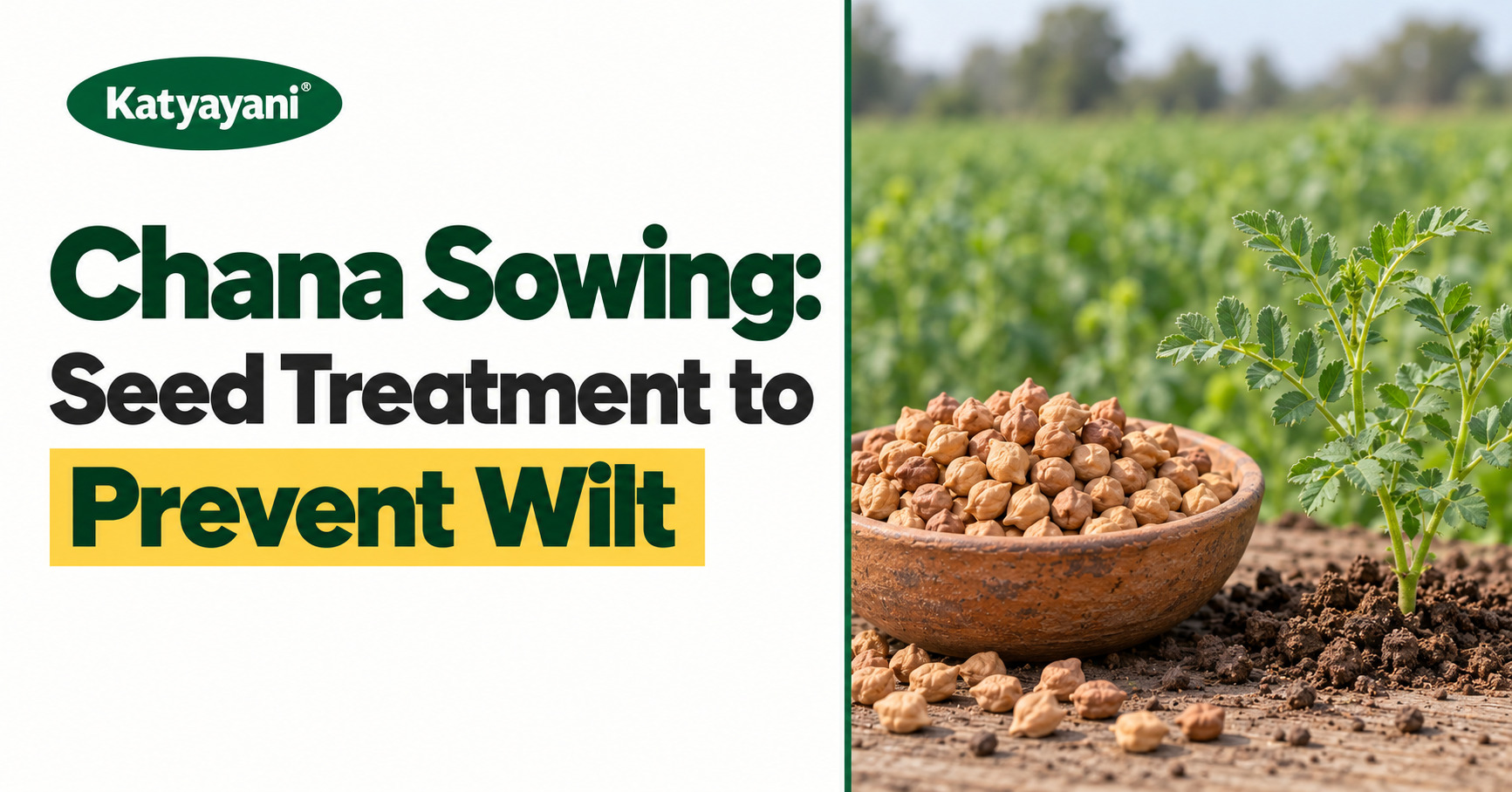
What is chickpea wilt (ukhta rog) and why does it spread?
Chickpea wilt, called ukhta or
ukheda rog by farmers, is a fungal disease caused by Fusarium oxysporum f. sp.
ciceris. The fungus blocks the water-carrying vessels of the plant, so the
plant droops and dries even when the soil is moist.
The fungus survives in soil and
plant debris as tough resting spores (chlamydospores) for several years, and it
also travels with infected seed. This is why the same fields wilt year after
year, and why seed treatment plus crop rotation is needed rather than one
spray.
Wilt is worse in light, sandy
soils, at soil temperatures around 25°C, and when the crop faces moisture
stress. Early sowing in warm soil raises the risk. Losses range from 10 to 100%
depending on variety and conditions, according to a review of chickpea wilt
research.
How to recognise wilt in chana
Wilt shows up as drooping plants
in patches, first in seedlings and again at flowering and pod stage. Early wilt
causes more loss than late wilt because the plant dies before it sets pods.
•
Seedlings collapse and lie flat on the soil within 3 to
5 weeks of sowing.
•
In older plants, leaves droop from the top, turn yellow
and then dry, while the plant stays green-stemmed for a few days.
•
Split the stem lengthwise near the base: brown to black
streaks inside the stem (vascular browning) confirm Fusarium wilt.
•
Roots look healthy from outside, unlike dry root rot
where roots are black, brittle and rotted.
•
Patches spread in the same part of the field each
season.
Dry root rot and collar rot are
often confused with wilt. Seed treatment with Trichoderma and a fungicide helps
against all three, which is another reason not to skip it.
What goes into a complete chana seed treatment?
A complete chana seed treatment
protects against disease and helps the crop fix nitrogen and take up
phosphorus. It has up to four components.
|
Component |
Purpose |
Common dose
per kg seed |
When to
apply |
|
Fungicide (e.g. carbendazim
50 WP, or carbendazim + mancozeb, or carbendazim + thiram) |
Kills seed-borne Fusarium
and early soil fungi |
About 2 to 2.5 g of product
(as per label) |
First, 1 day before sowing |
|
Trichoderma viride or T.
harzianum |
Protects roots from wilt,
dry root rot and collar rot |
About 4 to 10 g (as per
label) |
First (if used instead of
fungicide) or with a compatible fungicide |
|
Insecticide (termite-prone
fields only) |
Prevents termite and soil
insect damage to seedlings |
As per label for chickpea |
Second, after fungicide
dries |
|
Rhizobium culture |
Forms root nodules that fix
nitrogen |
About 20 g (200 g per 10 kg
seed) or liquid as per label |
Last, a few hours before
sowing |
|
PSB culture |
Makes soil phosphorus
available |
About 20 g (200 g per 10 kg
seed) or liquid as per label |
Last, along with Rhizobium |
Doses vary by formulation.
Follow the product label and local agriculture officer advice.
Why the order of seed treatment matters (FIR rule)
Seed treatment follows the FIR
order: Fungicide, then Insecticide, then Rhizobium. Chemicals applied after
Rhizobium kill the bacteria, and the crop then forms few nodules.
Trichoderma needs special care.
It is a living fungus, and carbendazim, a systemic fungicide, can suppress many
Trichoderma strains. So choose one of two routes: a chemical fungicide followed
by Rhizobium and PSB, or Trichoderma followed by Rhizobium and PSB. If you want
both a chemical and Trichoderma, use a fungicide that the Trichoderma label
says is compatible.
Research under the ICAR All
India Coordinated Research Project on Chickpea has tested such combinations,
for example Trichoderma harzianum with propineb, as reported in the AICRP
Chickpea report 2021-22. Rhizobium and PSB are generally compatible with
Trichoderma, so the bio-only route is simple for organic growers.
Step-by-step: how to treat chana seed at home
1.
Take good seed of a wilt-resistant variety. Remove
shrivelled, broken and discoloured seed.
2.
Day before sowing: spread seed on a clean sheet or use
a seed treatment drum. Sprinkle a little water so the dressing sticks.
3.
Mix the fungicide at the label dose and roll the seed
until every grain is evenly coated. Dry in shade. If you are using the bio-only
route, mix Trichoderma
viride biofungicide at this step instead.
4.
If termites are a problem in your field, apply the
label dose of a seed treatment insecticide approved for chickpea. Let it dry.
5.
Morning of sowing: boil about 100 g jaggery in 1 litre
of water and let it cool. Mix in the Rhizobium
biofertilizer and the PSB biofertilizer at the label dose to make a slurry.
6.
Pour the slurry over the seed and mix gently by hand.
Do not rub hard, or the coating comes off.
7.
Dry in shade for 20 to 30 minutes and sow the same day.
Never leave treated seed in the sun, which kills the bacteria.
Wear gloves and a mask while
handling chemical dressings, and never use leftover treated seed as food or
animal feed.
Which chana varieties resist wilt?
Seed treatment reduces
infection, but a susceptible variety sown in a sick field will still wilt.
Choosing a resistant variety is the single biggest step.
Pusa Chickpea 20211 (Pusa
Manav), released in December 2020 for Madhya Pradesh, Gujarat and Maharashtra,
was bred for Fusarium wilt resistance using genomics-assisted breeding.
According to CGIAR's
report on Pusa Chickpea 20211, it gave a weighted mean yield of 2,392 kg
per hectare under wilt stress and matures in about 108 days.
In central India, JG 11 and JAKI
9218 are widely grown wilt-tolerant desi varieties. Seed companies and state
universities release new resistant lines regularly, and the ICAR coordinated
project screens dozens of entries for wilt each year. Ask your KVK for the
latest resistant variety notified for your state.
Other field practices that prevent wilt
Wilt is controlled most reliably
when seed treatment is combined with good field practices. No single step is
enough in a field with a long wilt history.
•
Crop rotation: keep at least three years between
chickpea crops in wilt-sick fields; rotate with wheat, mustard or sorghum.
•
Sowing date: avoid early October sowing in warm soil. A
review of wilt studies found late October sowing reduced wilt incidence.
•
Deep summer ploughing: exposes and dries infected
debris in May and June.
•
Soil application of Trichoderma: mix Trichoderma with
well-rotted FYM, keep it moist in shade for about a week, then broadcast before
sowing.
•
Moisture: avoid moisture stress at flowering; one light
irrigation before flowering helps where water is available.
•
Field hygiene: pull out and burn wilted plants, and do
not carry soil from sick fields on equipment.
Seed rate, sowing and basal nutrition for chana
Use 75 to 80 kg seed per hectare
for small-seeded desi chana and 90 to 100 kg per hectare for large-seeded
types, which is roughly 30 to 40 kg per acre. Sow in rows about 30 cm apart for
desi types.
Chana fixes its own nitrogen
once nodules form, so it needs only a starter dose of nitrogen. Phosphorus and
sulphur matter more; SSP is a good basal choice because it supplies both. Seed
treated with Rhizobium and PSB makes better use of this basal dose. A chana
nutrition soil kit can be added at sowing where soils are low in organic
matter.
Rhizobium matters most in fields
where chana has not been grown for several years, or never, because the right
bacteria are scarce in that soil. In such fields, untreated seed often shows
few pink nodules and pale plants at 30 to 40 days. Pull up a few plants
carefully at that stage and split the nodules: a pink or red inside means they
are fixing nitrogen, while white or green nodules are not working.
Sow chana about 8 to 10 cm deep
in light soils so the seed reaches moist soil, and a little shallower in heavy
soils. Avoid heavy irrigation soon after sowing, which can cause seed rot and
collar rot.
Seed treatment planning for dealers and FPOs
For dealers, seed treatment is a
small-ticket item that farmers often skip because it is not on their list.
Selling it as a per-acre pack with seed changes that.
|
Input |
Per acre
(about 35 kg seed) |
Per 100
acres |
|
Fungicide dressing (at 2.5
g/kg) |
About 90 g |
About 9 kg |
|
Trichoderma powder (at 4 to
10 g/kg) |
About 140 to 350 g |
About 14 to 35 kg |
|
Rhizobium (200 g per 10 kg
seed) |
About 700 g |
About 70 kg |
|
PSB (200 g per 10 kg seed) |
About 700 g |
About 70 kg |
Biofertilizers have a shelf
life, so order close to the sowing season and store them in a cool, shaded
place. For bulk and institutional orders of bio-agents and biofertilizers,
Katyayani Organics supplies distributors across India.
What to do next
Before sowing, pick a
wilt-resistant variety, buy the fungicide or Trichoderma plus Rhizobium and
PSB, and plan to treat seed a day ahead. Follow the FIR order, dry seed in
shade and sow on time. Follow the product label and local agriculture officer
advice for every dose.
Why trust this guide
Written by Team Katyayani, Editorial Team at Katyayani Organics. Cross-checked against published research and university extension programs.



Leave a Comment