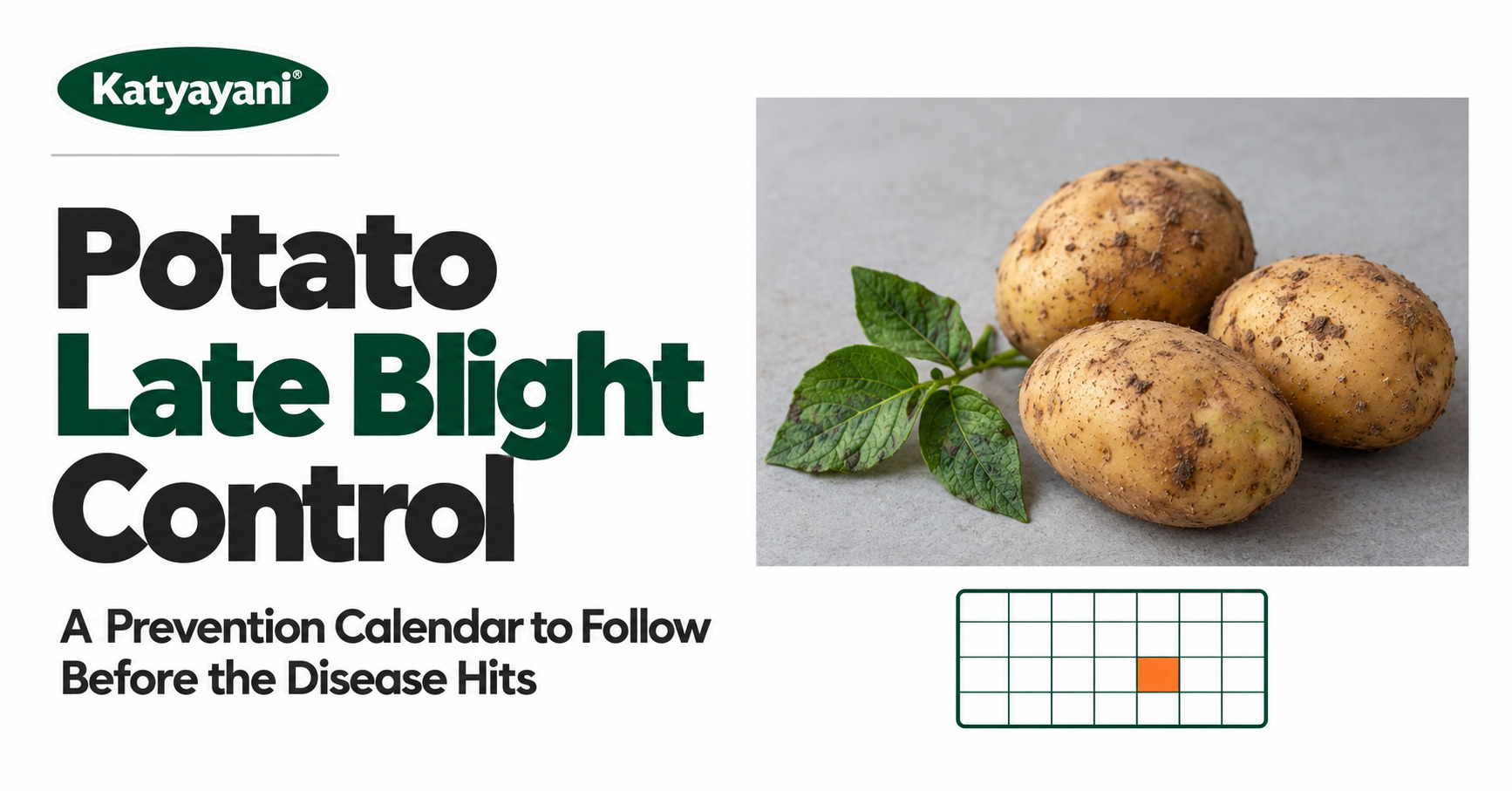
 5 min read
Quick answer: Potato late blight control depends on spraying before symptoms appear. Start a protective mancozeb or chlorothalonil spray (0.2 to 0.25%) when forecasts show 10 to 20 C with high humidity or fog for more than 18 hours. At the first lesion, switch to a systemic such as cymoxanil + mancozeb or dimethomorph, repeating every 7 to 10 days.
Key Takeaways
- Late blight is caused by Phytophthora infestans, a water mould that spreads fast in cool, humid, foggy weather. In the Indo-Gangetic plains it usually appears in December and January.
- ICAR-CPRI work shows that 10 to 20 C with 80% or higher relative humidity for 18 hours or more can trigger infection within a week.
- A protective spray before canopy closure matters more than any curative spray. Once the disease spreads, even systemic fungicides only slow it down.
- Rotate systemic fungicide groups and do not repeat the same product back to back. Add a sticker so rain does not wash the spray off.
- Plant healthy seed, choose a resistant Kufri variety where possible, and cut haulms 2 to 3 weeks before harvest to protect tubers.
What is potato late blight?
Potato late blight (pichheti jhulsa) is a leaf, stem and tuber disease caused by Phytophthora infestans. It is not a true fungus but an oomycete, or water mould, which is why it spreads so fast when leaves stay wet. The same pathogen attacks tomato.
A review by ICAR-CPRI scientist Sanjeev Sharma puts the average crop loss from late blight in India at about 15%, with local losses ranging from 10% to complete crop failure in epidemic years. In the plains, the disease normally appears in December and January. In the hills, it arrives with the monsoon in June and July.
Late blight is different from early blight. Early blight (Alternaria) causes brown spots with concentric rings on older leaves and moves slowly in warm weather. Late blight causes water-soaked patches that can blacken a field within a week of cold, foggy weather.
How to identify late blight symptoms early
The first sign is small, pale green or water-soaked spots, often on the leaf tip or edge of lower leaves. Within days the spots turn brown to black and spread across the leaf.
- White, cottony growth on the underside of leaves around the edge of the spot, easiest to see early in the morning when leaves are wet.
- Dark brown to black lesions on stems and leaf stalks; stems may break at the lesion.
- A foul smell from rotting foliage in badly affected patches.
- Tubers with purplish-brown, slightly sunken patches on the skin and reddish-brown rot underneath, often followed by soft rot in storage.
Walk the field every two to three days from December onward, especially low-lying corners, areas near trees and field edges where fog lingers. Finding the first plant is what gives you time to act.
What weather triggers late blight?
Late blight needs cool temperatures and long periods of high humidity or leaf wetness. Cold waves with fog, drizzle or cloudy days in December and January are the classic trigger in north India.
According to the CPRI status review on late blight in India, infection is favoured between 7.2 and 26.6 C with relative humidity of 85% or more. A critical signal is 10 to 20 C with at least 80% humidity for 18 continuous hours, which can lead to disease within about a week.
| Weather in your area | Risk level | What to do |
|---|---|---|
| Clear, sunny days, dry nights, day temperature above 25 C | Low | Keep scouting; no spray needed if canopy is healthy |
| Nights 10 to 20 C, heavy dew, humidity above 80% for part of the day | Moderate | Give a protective contact spray if not done in the last 10 days |
| Fog or drizzle for 2 days or more, humidity above 80% for 18 hours or more | High | Protective spray immediately; plan a systemic spray if spots appear |
| Disease already seen in your or a nearby field | Very high | Systemic spray now, repeat every 7 to 10 days, rotate groups |
Forecasting tools from ICAR-CPRI
ICAR-CPRI has developed forecasting systems such as JHULSACAST and the location-independent Indo-Blightcast model, which use hourly humidity, temperature and rainfall to predict blight outbreaks. CPRI and state departments issue advisories through their websites, KVKs, radio and mobile messages. Follow these alerts along with the IMD agromet bulletin for your district.
Late blight prevention calendar for rabi potato
The calendar below is for a potato crop planted in the plains in October or November. Hill growers can use the same crop-stage logic for the monsoon season.
| Crop stage / time | Main risk | Action |
|---|---|---|
| Before planting (Oct to Nov) | Infected seed tubers, volunteer plants | Use healthy, certified or cold-store seed; discard tubers with brown patches; clear old potato and tomato debris |
| Planting to 30 days | Low | Earthing up, balanced nutrition, avoid excess nitrogen; set up weekly scouting |
| 30 to 45 days, before canopy closes | Rising, as rows close and humidity builds | First protective spray of mancozeb or chlorothalonil at 0.2 to 0.25% when forecast shows cool, humid weather |
| 45 to 75 days (usually December to early January) | High in foggy spells | Repeat protective spray every 7 to 10 days in risky weather; at first spots, switch to a systemic |
| 75 days to haulm cutting (January to February) | High until warm days return | Continue sprays as needed, rotating systemic groups; avoid irrigation just before foggy nights |
| Haulm cutting, 2 to 3 weeks before harvest | Spores reaching tubers | Cut and remove haulms, let skin set, then dig on a dry day |
| Storage | Tuber rot | Store only dry, sound tubers; remove any rotting ones |
Which fungicides control potato late blight?
Use a contact fungicide to protect healthy leaves and a systemic or translaminar fungicide once the disease is present. The doses below are from ICAR-CPRI advisories and published ICAR research. Always follow the product label and local agriculture officer advice.
| Type | Active ingredient | Typical dose | When to use |
|---|---|---|---|
| Contact (protective) | Mancozeb 75% WP | 0.2 to 0.25% (2 to 2.5 g per litre) | Before symptoms, when weather turns risky |
| Contact (protective) | Chlorothalonil | 0.2 to 0.25% as per label | Alternative to mancozeb before symptoms |
| Systemic + contact | Cymoxanil 8% + Mancozeb 64% WP | About 0.3% (3 g per litre) | At first appearance of spots |
| Systemic | Dimethomorph 50% WP | 1 g per litre | At first appearance, rotate with other groups |
| Systemic + contact | Dimethomorph + Mancozeb | 1 g + 2 g per litre | Tank mix at disease appearance |
| Systemic | Ametoctradin + Dimethomorph | 2 ml per litre | Curative, rotate |
| Systemic | Fluopicolide + Propamocarb | 3 ml per litre | Curative, rotate |
| Systemic | Metalaxyl + Mancozeb | As per label | At disease appearance, limit repeat use |
For protective sprays, a mancozeb 75% WP fungicide is the standard first choice. When the first lesions appear, a ready mix of cymoxanil 8% and mancozeb 64% WP gives both systemic and contact action, and dimethomorph 50% WP belongs to a different group that suits rotation.
Research published in the ICAR Potato Journal has also evaluated translaminar fungicides and tank mixes for the subtropical plains. The consistent message: rotate modes of action and do not rely on one systemic product all season.
How to spray correctly for late blight
Good coverage decides whether a spray works. Late blight starts on lower leaves and on the underside, so a quick spray over the top of the canopy often misses it.
- Check the forecast. Spray before a foggy or rainy spell, not in the middle of rain.
- Measure the fungicide exactly per litre of water. Do not increase dose on your own.
- Add a sticker or spreader at about 0.1% (around 1 ml per litre) so the spray stays on leaves. A silicon-based super spreader also improves coverage on the waxy potato leaf.
- Use a hollow cone nozzle and enough water to wet both sides of leaves, including the lower canopy.
- Spray in the late morning after dew dries, so the spray is not diluted.
- Repeat every 7 to 10 days in risky weather. Shorten to 7 days if disease is active.
- Rotate: do not apply the same systemic fungicide twice in a row. Use a contact fungicide between systemic sprays.
Cultural practices that reduce late blight
Fungicides work better when the field itself is less favourable to the disease. These practices cost little and reduce the starting inoculum.
- Plant healthy seed tubers and reject any with dark, sunken patches.
- Remove volunteer potato plants and heaps of discarded tubers near the field; they carry the pathogen into the new crop.
- Do high earthing up so tubers are covered well and spores washing down from leaves do not reach them.
- Avoid irrigation in the evening before a foggy night, and avoid waterlogging.
- Keep potato away from tomato plots, which share the same disease.
- Balance fertiliser; heavy nitrogen makes a dense, soft canopy that stays wet longer.
- Pull out and bury the first infected plants if the disease is limited to a few spots.
Which potato varieties resist late blight?
ICAR-CPRI has released several varieties with field resistance to late blight. Resistance reduces spread and gives you more time between sprays, but it does not make the crop immune, so protective sprays are still needed in bad years.
| Region | Resistant varieties listed by CPRI |
|---|---|
| Plains | Kufri Anand, Kufri Arun, Kufri Pushkar, Kufri Sadabahar, Kufri Khyati, Kufri Lalit, Kufri Mohan, Kufri Neelkanth, Kufri Chipsona series |
| Hills | Kufri Giriraj, Kufri Kanchan, Kufri Shailja, Kufri Himalini, Kufri Himsona, Kufri Giridhari, Kufri Neelima, Kufri Karan |
Early varieties that are dug before the peak blight period can also escape the worst of the disease. Ask your state potato seed agency or KVK which resistant variety is available for your zone and market.
What to do next
Stock a contact fungicide and one systemic option before December, so you are not searching for them in a foggy week when every shop is sold out. Mark the date your canopy will close, since that is when the first protective spray is due.
Follow CPRI and district advisories, scout every two to three days in cold weather, and keep a written record of sprays with product names and dates. Dealers stocking for the potato season can contact Katyayani Organics for bulk supply of fungicides and spreaders.
Why trust this guide
Written by Team Katyayani, Editorial Team at Katyayani Organics. Cross-checked against published research and university extension programs.

Leave a Comment