 15 min read
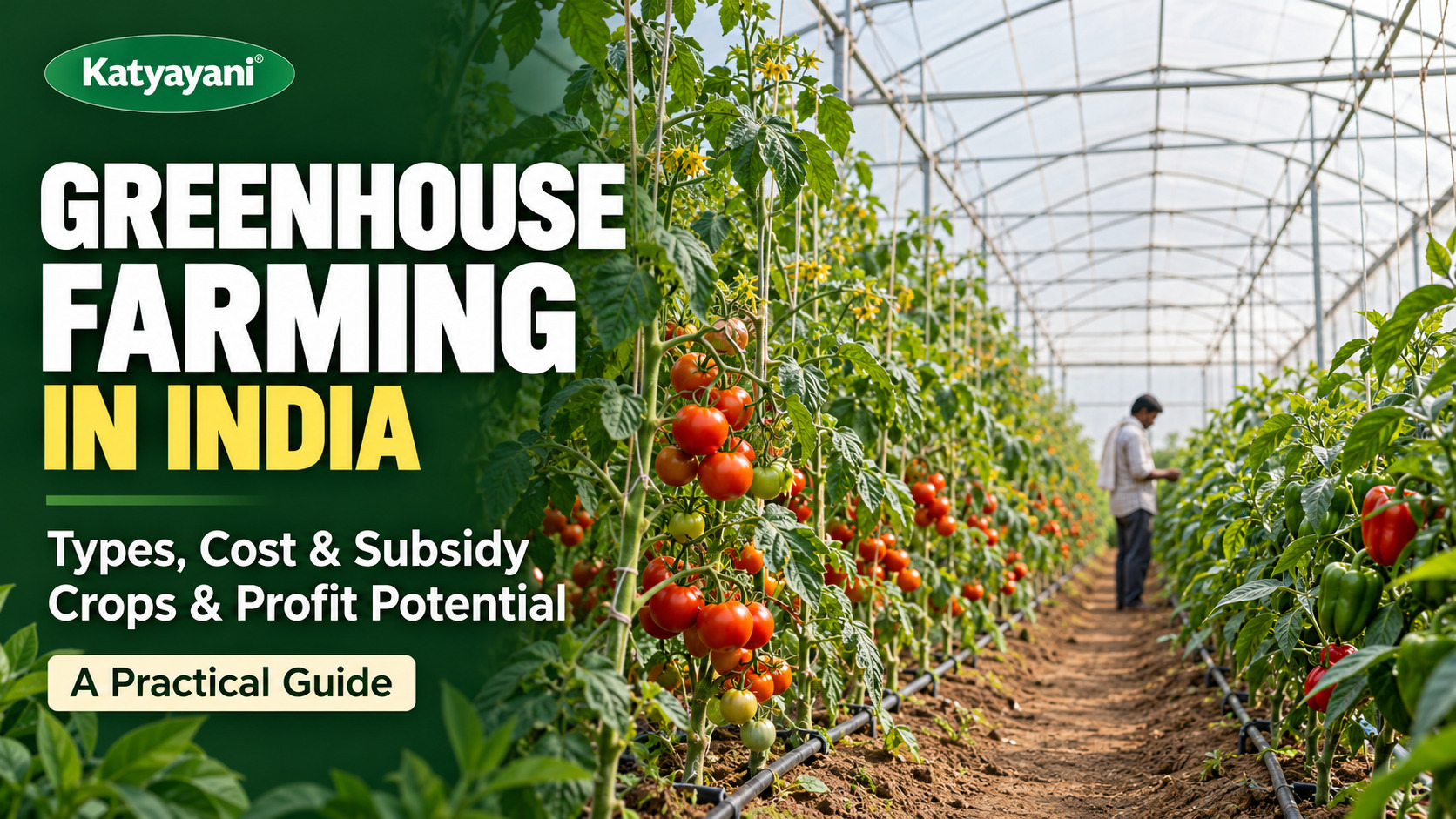
Greenhouse farming is growing crops inside a covered structure where temperature, humidity, light and water are managed, so plants can grow through the year or out of season. In India most structures use UV plastic film on a galvanised pipe frame. Cost ranges from about Rs 300 per sq m for simple designs to Rs 3,500 per sq m for fully automated ones (TNAU).
What is greenhouse farming?
Greenhouse farming means growing crops inside a structure covered with a transparent material, where the grower controls or moderates the growing environment. TNAU Agritech describes greenhouses as frames covered with transparent material in which crops are grown under controlled environment conditions, so production is possible through the year or for part of it. The main parameter managed is temperature, but control can also extend to shading or supplementary light, carbon dioxide, humidity, water, nutrients and pest control.
In cold countries greenhouses are used mainly for heating. In India the problem is often the opposite: TNAU notes that greenhouses in the plains and coastal regions need cooling, those in the hot summer north need evaporative cooling, and the northern plains may need both cooling and heating depending on the crop.
TNAU is also frank about the economics: controlled environment agriculture needs far more capital investment per unit area than field agriculture and so must be correspondingly more intensive to justify the cost. That single sentence is the right lens for everything below.
What is the difference between a greenhouse, polyhouse and shade net house?
| Structure | Cover | What it does | Best use (as described by TNAU/Agriplast) |
|---|---|---|---|
| Greenhouse (general term) | Glass, fibre-glass, polycarbonate or plastic film | Controls or moderates temperature, light, humidity | High-value crops, off-season production |
| Polyhouse | UV-stabilised polyethylene film | A greenhouse using plastic film; TNAU says it gives a more stable environment than open field and protects from insects and weather | Vegetables, cut flowers, nursery |
| Naturally ventilated (NV) polyhouse | Film with roof and side vents, sometimes foggers | Relies on ventilation, no fans | Mild and coastal climates |
| Fan-and-pad (FP) polyhouse | Film with exhaust fans and wet cooling pads | Evaporative cooling; lowest temperature cannot go below wet-bulb temperature | Hot, dry plains |
| Shade net house | Polypropylene shade nets, often black, green or white | Cuts light and heat, keeps pests out partially | Nursery, shade-loving plants, summer cover |
| Tunnel | Steel-hoop frame with film | Low, simple cover (Agriplast lists ventilation and round tunnels) | Short-duration crops |
In plain words, "greenhouse" is the family name and "polyhouse" is the common Indian name for the plastic-film member of that family. The cover and the cooling system decide how much it costs.
What are the types of greenhouse?
TNAU sorts greenhouses in four ways. Pick the one that matches your question.
| Classification | Types | Notes |
|---|---|---|
| By cost and technology | Low-cost (bamboo or timber frame, UV film, no control devices), medium-tech (GI pipe frame, thermostat fans, cooling pads, mist), hi-tech (fully automatic control) | Low-cost suits cold climates; medium-tech suits dry and composite climates |
| By structure | Quonset, curved roof, gable roof | TNAU: under Indian conditions a Quonset-type multispan greenhouse is most suitable for its low cost and ease of fabrication |
| By number of spans | Free-standing (single span) or multispan (ridge-and-furrow, gutter-connected) | Multispan saves material per square metre |
| By environment control | Naturally ventilated, fan-and-pad or other environment-controlled | Decides cost and which crops you can grow |
| By glazing | Glass, fibre-reinforced plastic, plastic film (UV-stabilised LDPE) | Plastic film dominates in tropical and sub-tropical areas for cost |
So, what are the four types of greenhouse? The most useful four for a buyer are: low-cost, naturally ventilated polyhouse, fan-and-pad polyhouse, and hi-tech automated greenhouse.
Which cover material lasts longest?
| Cover (TNAU table) | Durability | Note |
|---|---|---|
| Polyethylene (plain) | About 1 year | Not UV-stabilised |
| Polyethylene, UV-resistant | About 2 years in the table; TNAU text says LDPE or LLDPE UV film lasts 3 to 4 years | The table and text differ, so ask the supplier for a written warranty |
| Fibre glass | About 7 years | Rigid; heavier frame |
| Polycarbonate / glass | Decades per the TNAU table | Much higher cost |
TNAU suggests a single 200-micron UV-resistant LDPE film is sufficient for both naturally ventilated and fan-and-pad greenhouses, stretched fully and fastened with T-lock or L-lock channels rather than nails or screws, which cause tearing.
How much does greenhouse farming cost in India?
Cost is quoted per square metre of covered area. Different sources give different numbers because they cover different dates, structures and inclusions. Treat the range as the honest answer.
| Source (date) | Structure | Cost per sq m | What it covers |
|---|---|---|---|
| TNAU Agritech (undated) | Low-cost, no fan and pad | Rs 300-500 | Structure and film |
| TNAU Agritech (undated) | Medium cost, fan and pad, no automation | Rs 800-1,100 | Structure with cooling |
| TNAU Agritech (undated) | Fully automatic | Rs 2,000-3,500 | Automated environment |
| Agriculture Guruji (4 Sep 2025, Google snippet) | Polyhouse (greenhouse construction) | Starts around Rs 700-1,000 | Depends on material, size, quality |
| Katyayani subsidy guide, NHB-based norm (Nov 2025 guide) | Naturally ventilated polyhouse | Rs 1,000 norm (other guides cite Rs 935 or 844) | Admissible cost norm used for subsidy |
| Same guide | Fan-and-pad greenhouse | Rs 1,600 norm (others cite Rs 1,290 or 1,465) | Admissible cost norm |
| Same guide | Shade net house | Rs 710 norm | Admissible cost norm |
For one acre (about 4,047 sq m), that guide's own arithmetic gives roughly Rs 40.5 lakh for a naturally ventilated polyhouse and Rs 64.8 lakh for fan-and-pad at norm, before land, drip, fertigation, planting material, electricity and working capital. Our guide to polyhouse and shade net subsidy shows the norms, area limits and 50% back-ended subsidy in detail, so check it and the current NHB/MIDH circular (NHB cost-norms document) before you quote anyone.
Why do quotes differ by two or three times? Mostly because of frame steel weight and galvanisation, film thickness, ventilation area, automation and whether the quote includes foundations, drip and fertigation. Ask each supplier to quote the same specification and itemise it.
Is greenhouse farming profitable?
It can be, but the evidence says it is not automatic. Profit depends on four things: yield per square metre, selling price, cost of cultivation and how quickly you recover the structure cost. There is no honest single "profit per acre" number. A better method is to calculate your own payback.
- Net structure cost = total project cost minus the subsidy you are sure to receive (subsidy is released after construction and inspection, so you finance the full amount first).
- Annual net income = (yield x average selling price) minus all costs including electricity, labour, inputs, film replacement and loan interest.
- Payback years = net structure cost divided by annual net income.
Illustration only, with assumed income: if a naturally ventilated polyhouse costs Rs 40.5 lakh at norm and the 50% subsidy is Rs 20.2 lakh, the net cost is about Rs 20.3 lakh. If your annual net income after all costs were Rs 5 lakh, payback would be about 4 years. If it is Rs 2.5 lakh, payback is about 8 years. Replace the income with your own crop budget; the income here is an assumption, not a forecast.
What do yields look like? A study of 180 protected-cultivation farmers in Haryana (via a search summary of a Krishikosh record, VERIFY) reported yields of about 1,041 quintals per hectare for cucumber in Hisar, 958 q/ha for capsicum in Karnal and 865 q/ha for tomato in Karnal. In per-1,000-sq-m terms, that works out to roughly 10.4, 9.6 and 8.6 tonnes (my conversion). Yield is only half the story; prices fall when many growers harvest together.
Which crops are grown in a greenhouse?
- Vegetables: cucumber, capsicum, tomato, and exotic salad vegetables. These were the crops in the Haryana protected-cultivation study.
- Cut flowers: rose, carnation, gerbera, chrysanthemum, lilies. TNAU's page is built around cut flowers and includes sections on physiological disorders and post-harvest handling of cut flowers.
- Nursery and seedlings: TNAU notes that short crop duration makes greenhouse technology profitable, which is why containers and seedling raising are common uses.
- Specialty crops: strawberries, orchids (shade house) and mushrooms in controlled rooms. See our guides on oyster mushroom farming and indoor saffron farming for controlled-environment alternatives.
Short-duration, high-value, perishable crops pay for the structure fastest. Long-duration low-value crops almost never do. If you are still deciding, compare with soil-free systems in our vertical farming and hydroponics business models guide.
How should you design and site a greenhouse?
TNAU gives engineering rules that most blogs omit. Ask your supplier to confirm each one.
| Parameter | TNAU guidance |
|---|---|
| Wind load | Structure should withstand winds of 110 km/h and at least 50 kg per sq m of wind pressure |
| Live load | Design for 15 kg per sq m, and each roof member should carry 45 kg concentrated load at its centre |
| Frame material | Galvanised iron pipes; foundation 60 x 60 x 60 cm or 30 cm diameter and 1 m deep in PCC 1:4:8; vertical poles covered to 60 cm in PCC to avoid rusting |
| Size of NV greenhouse | Not more than 50 m x 50 m; larger spans build more heat because of poor ventilation. Evaporatively cooled: length not more than 60 m |
| Spacing between houses | 10 to 15 m so exhaust air from one does not enter the next |
| Height | Up to 5 m for a 50 x 50 m house; side vents about 2 m wide, roof vents about 1 m |
| Orientation | Below 40 degrees N latitude, single houses with ridge running north-south; east-west to avoid shading between adjacent houses; also consider wind direction. Length perpendicular to summer wind for NV houses |
| Temperature rise in NV house | TNAU says the build-up should not exceed 2 C through the year; in hot months temperature was the same as ambient |
How do you control temperature and humidity?
- Natural ventilation: side and roof vents; enough for mild and coastal climates.
- Fan and pad: TNAU gives design rules: fans deliver required air at 15 mm static pressure with centre-to-centre spacing of at most 7.5 m; a cellulose pad of 100 mm thickness gives 1 m of pad height for every 20 m of pad-to-fan distance, with the fan-to-pad distance not above 60 m; air flow 75 cubic metres per minute per sq m of pad and water flow 9 litres per minute per metre of pad.
- Pad care: shade the pads and sump, dry pads daily, avoid nutrient contamination, drain and disinfect the sump regularly and replenish 20% of circulating water each time to avoid scaling.
- Heating in winter (north India, hills): double covering with an air gap of 2 to 10 cm reduces heating load considerably; options include unit heaters, infrared heaters, boiler and solar heating.
- Humidity: a humidistat can drive fogging; TNAU says maximum achievable relative humidity in a fan-regulated house is 90%.
Frost and cold nights still matter in northern greenhouses; our guide to frost and cold wave protection covers low-cost covers and irrigation timing that apply here too.
What growing medium, irrigation and fertigation do greenhouse crops need?
TNAU says a desirable medium should balance water-holding capacity and porosity and should drain well. The recommended reaction is pH 5.0 to 7.0 and soluble salt level (EC) of 0.4 to 1.4 dS/m for most greenhouse crops. Low pH below 5.0 leads to toxicity of iron, zinc, manganese and copper; high pH above 7.5 causes micronutrient deficiencies including boron. TNAU also gives target ranges in the medium for transplants, young pot and foliage plants, and plants in beds (for example, nitrate-N 75, 50 and 125 mg per litre respectively).
For water, TNAU recommends micro irrigation (drip or micro-sprinkler) so that water does not fall on leaves or flowers, a pump producing 2.8 kg per sq cm pressure, a filter set (sand, silica or screen) and PVC tubing with drippers. A 16 mm dripper at 2.8 kg per sq cm gives about 2.65 litres per hour.
On feeding, TNAU's guidance is "constant feed": low concentration at every irrigation gives steady growth, while intermittent heavy doses cause swings in root-zone nutrient levels. Soilless mixes hold fewer nutrients and need more frequent fertiliser. Nutrient movement differs too: nitrogen tends to accumulate at the edge of the wetted zone and be lost by leaching, phosphorus builds near the emitter, and potassium spreads more evenly. Our water-soluble fertiliser buying guide explains drip-grade products, and for a balanced fertigation feed a grade such as NPK 19:19:19 100% water soluble is the usual base; match the grade and dose to crop stage and your water and medium tests.
How do you manage pests and diseases inside a greenhouse?
Protected cultivation does not remove pests. Several studies report pest and disease problems can be worse under cover because humid, moist conditions favour them. In the Chittoor survey, pest and disease occurrence was the second-ranked environmental constraint (67.5%). Soil-borne problems such as Fusarium wilt and root-knot nematodes also become serious with continuous cultivation in the same structure.
- Sanitation first. TNAU advises disinfecting propagation tools and surfaces, treating seed and planting material before moving into the house, and placing a disinfectant tray at the entry.
- Rotate and rest. Because continuous cropping builds soil-borne disease, plan crop families in turn; see our crop rotation examples and plan.
- Biological options for soil-borne disease and nematodes. Trichoderma harzianum powder is commonly used for soil and root zone protection against wilt fungi, and Paecilomyces lilacinus powder is used against root-knot nematodes. Follow label dose and compatibility with fungicides.
- Biological options for sucking pests. Verticillium lecanii powder is used against whitefly and aphids in humid conditions, and neem oil is a standard first spray; see our guide on neem oil dilution.
- Disorders look like deficiencies. TNAU warns that deficiency symptoms are easily confused with other causes and that excess fertiliser is a common cause of crop loss. Test before adding more.
What are the disadvantages and constraints of greenhouse farming?
A 2019-20 survey of 30 greenhouse units in Chittoor district, Andhra Pradesh (capsicum and chrysanthemum) ranked constraints using Garrett scores, and reported these as the most important in each group (study).
| Type | Top constraints and reported score |
|---|---|
| Economic | High initial investment in polyhouse construction 80.6%; complex loan procedure 67.1%; poor credit accessibility 54.5% |
| Marketing | Fluctuating market prices 78.0%; middlemen malpractices 64.2%; no local marketing facilities 54.5% |
| Technical | Non-availability of quality polyhouse equipment locally 79.2%; pesticide availability at the right time 64.8%; lack of guidance on production techniques 53.7% |
| Environmental | Perishable produce 75.3%; pest and disease 67.5%; physiological disorders 55.2%; fluctuating weather 52.8% |
| Labour | Scarcity in peak season 63.3%; high cost of skilled labour 53.8% |
The sample is small and from one district, so rankings could differ elsewhere. But the pattern is clear: money, marketing and technical know-how matter at least as much as the structure.
How do you start greenhouse farming? Step by step
- Choose the crop and the buyer first. Decide what you will grow and where you will sell. Perishable crops need a market within reach.
- Choose the site. Needs good drainage, assured water of known quality, reliable power, road access and a location that avoids shade and wind exposure (TNAU).
- Pick the structure. Naturally ventilated for mild climates, fan-and-pad for hot dry areas.
- Get at least three itemised quotes for the same specification: frame, film, vents, foundations, drip, fertigation.
- Prepare a Detailed Project Report and arrange finance. See the application steps in our subsidy guide and funding options such as KCC, CGTMSE and PMEGP where eligible.
- Build, test and plant. Check film tension, vents and drip pressure before planting.
- Keep daily records: temperature, humidity, irrigation, EC and pH, pests, harvest and sales.
Can you try greenhouse farming at home? TNAU describes low-cost greenhouses built from bamboo or timber with UV film and no control devices; they are mainly suited to cold climates. A small home version works well for seedlings and herbs, but heat build-up in summer is the main risk, so keep side walls openable.
Conclusion
Greenhouse farming turns weather risk into capital risk. If you choose a short-duration, high-value crop with a defined buyer, specify the structure properly (wind load, film, ventilation, drip), feed at low concentration with every irrigation, keep the house clean and rotate crop families, the numbers can work. If you are building mainly because a subsidy exists, run the payback calculation first. Compare itemised quotes, read the current subsidy norms, and start with a single unit before you scale.
Why trust this guide
Written by Team Katyayani, Editorial Team at Katyayani Organics. Cross-checked against published research and university extension programs.


Leave a Comment