 11 min read
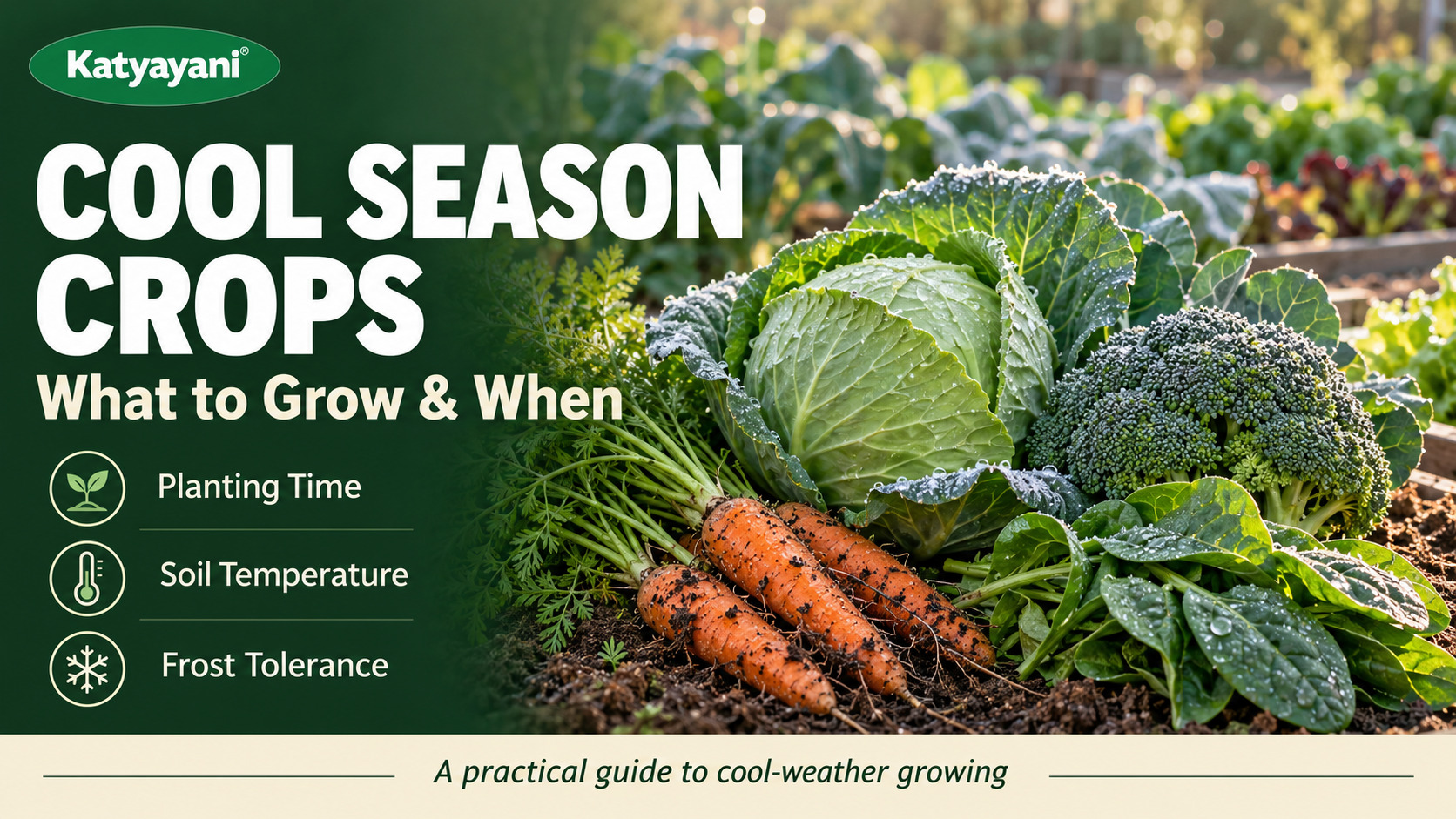
Cool season crops are plants that grow best in cool weather, roughly 15 to 24 degrees C, and tolerate light to hard frost. Examples are spinach, lettuce, peas, cabbage, cauliflower, carrot, radish and onion. They are sown in autumn or early spring, and in India mainly from October to December (rabi). Most bolt when days lengthen or heat arrives.
What are cool season crops?
Cool season crops are plants that grow, set leaves, roots or heads best in cool weather and tolerate frost better than summer crops. They are the crops of autumn, winter and early spring. The UF/IFAS Gardening Solutions list names mustard greens, spinach, lettuce, kale, collards, cabbage, cauliflower, broccoli, carrots, celery and radishes, and adds beets, Brussels sprouts, endive, English peas, fennel, garlic, Swiss chard, turnips, kohlrabi, leeks, onions and shallots.
Two ideas matter. First, the seed germinates in cool soil, which warm-season crops cannot do. Second, the plant puts on its useful growth before long, hot days arrive. Plant them too late and they run to seed.
In agriculture the term is used in two ways. In gardening it means vegetables such as spinach and cabbage. In field farming, the rabi crops (wheat, chana, mustard, peas) are also cool-season crops, sown in October to December and harvested in summer. This guide covers both.
Which vegetables are cool season crops? (full list by group)
| Group | Cool-season vegetables | Notes |
|---|---|---|
| Leafy greens | Spinach, lettuce, kale, collards, mustard greens, Swiss chard, arugula, endive | Fast to harvest; most bolt in heat |
| Cabbage family (brassicas) | Cabbage, cauliflower, broccoli, Brussels sprouts, kohlrabi, turnip | Usually transplanted; heavy feeders |
| Root crops | Carrot, radish, beet, turnip, parsnip, rutabaga | Sown where they grow; do not transplant well |
| Legumes | Peas (English or garden peas), broad beans | Sprout in cool soil; rot in cold, wet soil |
| Onion family | Onion, garlic, leek, shallot, green onion | Very cold-tolerant seed; sprout at 32 F per UC |
| Others | Celery, fennel, strawberries | Celery needs cool nights for good germination |
Some of these, such as Swiss chard and carrot, are only half-hardy, so "cool-season" is a range, not a single line.
At what temperature do cool season crops grow best?
The best data comes from soil, not air. The UC Master Gardener tables, based on the California Master Gardener Handbook, give a minimum, an optimum range and a maximum soil temperature for germination. UC's table is in Fahrenheit; the Celsius column is my conversion.
| Crop | Minimum soil (F) | Optimum range (F) | Maximum (F) | Optimum range (C, my conversion) |
|---|---|---|---|---|
| Spinach | 32 | 65-75 | 75 | 18-24 |
| Lettuce | 32 | 60-75 | 85 | 16-24 |
| Peas | 40 | 65-75 | 85 | 18-24 |
| Cabbage | 40 | 60-85 | 95 | 16-29 |
| Broccoli | 40 | 60-85 | 95 | 16-29 |
| Cauliflower | 40 | 65-85 | 95 | 18-29 |
| Carrots | 40 | 65-85 | 95 | 18-29 |
| Radishes | 40 | 65-85 | 95 | 18-29 |
| Beets | 40 | 65-85 | 95 | 18-29 |
| Onions | 32 | 65-85 | 95 | 18-29 |
| Garlic | 32 | 65-85 | 95 | 18-29 |
UC adds that seed may still germinate outside these ranges, but success is better inside them, and that a probe thermometer is the accurate way to test soil. So the practical answer: most cool season crops grow well when soil is between 16 and 29 degrees C, and the leafy ones prefer the cooler end.
How fast does seed come up at different temperatures?
UC also publishes average days to emergence. The same crop can take two months or two days depending on soil temperature.
| Crop | 50 F (10 C) | 59 F (15 C) | 68 F (20 C) | 77 F (25 C) | 86 F (30 C) | 95 F (35 C) |
|---|---|---|---|---|---|---|
| Spinach | 11.7 days | 6.9 | 5.7 | 5.1 | 6.4 | no germination |
| Lettuce | 7.0 | 3.9 | 2.6 | 2.2 | 2.6 | no germination |
| Peas | 13.5 | 9.4 | 7.5 | 6.2 | 5.9 | not tested |
| Radishes | 11.2 | 6.3 | 4.2 | 3.5 | 3.0 | not tested |
| Carrots | 17.3 | 10.1 | 6.9 | 6.2 | 6.0 | 8.6 |
Spinach took 62.6 days to emerge at 32 F and 22.5 days at 41 F in the same data, and did not germinate at 95 F. That is the reason a spinach bed sown in warm soil in September fails while the same seed sown in a cool October bed comes up evenly.
What is the difference between cool season and warm season crops?
| Feature | Cool season crops | Warm season crops |
|---|---|---|
| Germination soil (UC minimum) | 32-40 F for spinach, lettuce, peas, brassicas, roots | 50 F for tomato; 60 F for cucumber, squash, okra, beans |
| Frost | Hardy or semi-hardy; survive light to hard frost | Tender; damaged or destroyed by a light frost (Iowa State) |
| Typical season | Autumn, winter, early spring. Rabi in India | Late spring and summer. Kharif and zaid in India |
| Examples | Spinach, cabbage, carrot, peas, onion | Tomato, okra, cucumber, squash, snap beans, corn |
| Main failure | Bolting in heat or long days | Poor germination and growth in cold |
So, are tomatoes cool season? No. UC lists tomato at a 50 F minimum and an optimum of 65-85 F, and warns that at 41 F the seed does not germinate at all. Peas, on the other hand, are cool-season: they germinate from 40 F and prefer 65-75 F. For the monsoon side of the calendar, see our guide to rainy season vegetables.
Which cool season crops tolerate frost?
Gardeners split vegetables into hardy, semi-hardy and tender. Iowa State Extension uses these thresholds:
| Frost class | What it survives | Vegetables Iowa State lists |
|---|---|---|
| Hardy | Mid to low 20s F (about -4 to -7 C, my conversion) | Brussels sprouts, broccoli, cabbage, cauliflower, kale, rutabaga, turnip |
| Semi-hardy | Upper 20s F (about -2 to -3 C) | Beet, carrot, leaf lettuce, green onion, kohlrabi, radish, spinach, Swiss chard |
| Tender | Light frost damages or kills them | Green beans, corn, cucumber, okra, summer squash |
Other extension sources draw the lines slightly differently (for example, Maryland puts hardy at about 25-28 F). Use the tables as a guide and watch your local forecast. In India, true frost is a concern mainly in north India and hill areas in December and January; our guide to protecting crops from frost and cold waves covers covers, irrigation and timing.
When should you plant cool season crops?
Work backwards from the first frost or the first hot weather, depending on where you live.
- Cool climates (US, UK, Europe): plant in early spring so the crop matures before summer heat, and again in late summer for an autumn harvest. Iowa State advises working backwards from the average first frost date; in Iowa that falls between 30 September and 15 October.
- Plains of India: the main window is October to December, with some crops going in from September. Katyayani's own sowing guide for pots, 15 winter vegetables to grow in pots, treats October as the key month, and field rabi crops follow the same window.
- Hills: many cool-season vegetables can be sown across a longer window, because summer is cool. TNAU lists carrot as grown year-round above 1,500 m in the hills with assured irrigation.
What do TNAU crop pages say about sowing time?
These are Tamil Nadu agricultural university windows and should be matched to your own region. They are useful for the relative timing, duration and yield.
| Crop | Plains sowing (TNAU) | Duration | Yield (TNAU) | Source |
|---|---|---|---|---|
| Cauliflower | September to February; seedlings ready in 25 days | About 70 days from transplanting to curd (fertigation schedule) | 15-20 t/ha plains; 20-30 t/ha hills | TNAU cauliflower |
| Cabbage | August to November (plains); hills Jan-Feb, Jul-Aug, Sep-Oct | 120 days plains; 150 days hills | 25-35 t/ha plains; 70-80 t/ha hills | TNAU cabbage |
| Carrot | August (plains); July to February at 1,000-1,500 m | 100-120 days; good colour at 15-20 C | 25-30 t/ha | TNAU carrot |
| Peas | February-March and October-November (plains); flowering and pod set need about 12-15 C | Harvest possible 75 days after sowing | 8-12 t/ha pods | TNAU peas |
| Radish | September (plains); June-July (hills); best roots at about 15 C | 45 days (45-60 in the yield section) | 20-30 t/ha | TNAU radish |
Note that TNAU advises plains carrot sowing in August, a different season from northern plains where carrots are often sown later. This is why a generic "sow in October" rule is only a starting point.
Why do cool season crops bolt, and how do you stop it?
Bolting means the plant sends up a flower stalk early, and the leaves or roots turn bitter or woody. The RHS lists cold spells and changes in day length as the main causes. University of Delaware Extension says bolting in spinach, lettuce and some radishes occurs naturally as days lengthen and is accelerated by high temperatures, and adds that seed exposed to low temperature early in the season can also be induced to bolt (vernalization, per Delaware).
- Sow at the right time so the crop matures before day length and heat build.
- Choose slow-bolting or early-maturing varieties.
- Give afternoon shade in warm spells.
- Keep watering even; harvest leafy crops early instead of waiting for full size.
- Do not start spinach and lettuce when soil is above their germination maximum (see the UC table).
How do you grow cool season vegetables well?
- Test the soil, not just the air. A probe thermometer at sowing depth tells you whether it is time (UC).
- Prepare the bed with compost and a balanced base. Brassicas are heavy feeders; our winter kitchen garden feeding schedule gives a compost-plus-liquid-feed plan, and a soil check helps; see how to read your soil health card.
- Raise cabbage-family transplants in a clean nursery. For nursery and seedling beds, a Trichoderma-based bio-fungicide such as Trichoderma viride powder is a common choice to reduce damping-off. Follow the label dose.
- Sow in succession. UF/IFAS notes many cool-season crops can be sown several times in a season for a longer harvest.
- Mulch lightly. Mulch keeps soil cool and moist; see our guide to the benefits of mulching.
- Protect from cold nights. Use covers on frosty nights and remove them when the temperature rises above 32 F (Iowa State).
- Watch the usual pests. Cabbage and cauliflower attract aphids and diamondback moth; start with the cabbage diamondback moth insecticides and aphid insecticides collections only when scouting shows pests. For bacterial black rot, see fungicides for cabbage black rot. Cabbage that is slow to grow may need the cabbage vegetative growth fertilizer range.
Which field crops are cool season crops in India?
The field-crop meaning of cool season is the rabi season. According to the SGT University summary on Google, rabi crops are sown from October to December and harvested from April to June. Wheat, chana, mustard, peas, barley and potato are the best-known examples. For crop-wise planning, see our guides on wheat sowing time and seed rate, mustard sowing and fertilizer schedule, and biofertilizers for chana and other rabi crops. Secondary sources give different germination temperatures for rabi sowing (Tradologie says cool temperatures of 10-15 C during germination and early growth; Mahindra says 20-25 C at sowing), so check your state agricultural university advice.
Can you grow cool season crops in pots and what about flowers?
Yes. Leafy greens, radish, carrot (in deep pots), peas and herbs suit containers; see winter vegetables to grow in pots for variety and pot-size choices. Cool-season flowers such as marigold, petunia and chrysanthemum are covered in winter flowers in pots.
Conclusion
Cool season crops are defined by what they tolerate: cold soil for germination, light to hard frost, and a short window before heat and long days push them to seed. Use soil temperature (about 16-29 C for most), the hardy and semi-hardy lists, and your local sowing calendar. In India that usually means October to December. Start with a few quick crops like spinach and radish, sow in succession, and keep notes on dates so next year you can plan to the week.
Why trust this guide
Written by Team Katyayani, Editorial Team at Katyayani Organics. Cross-checked against published research and university extension programs.

Leave a Comment