 13 min read
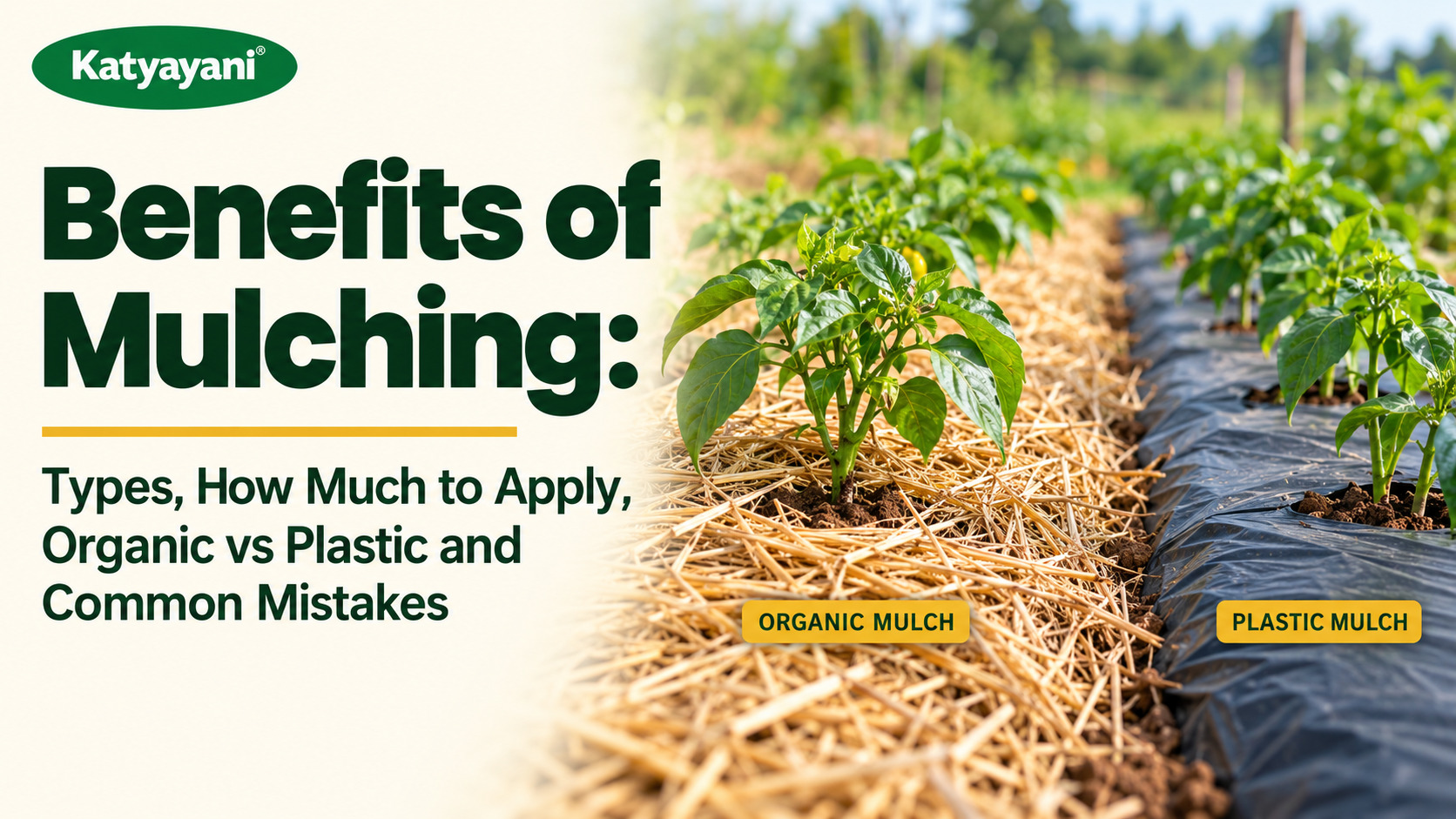
Mulching means covering the soil surface with a protective layer such as straw, leaves, wood chips, compost or plastic film. It conserves soil moisture, suppresses weeds, moderates soil temperature, reduces erosion and, with organic mulch, adds organic matter as it decomposes. Typical depth is about 5 to 10 cm, less for fine materials.
What is mulching?
Mulching is spreading a protective layer over the soil surface, usually permeable, using organic or inorganic material, in loose pieces or sheets. Virginia Cooperative Extension explains that a forest does this naturally when leaves fall and form a natural mulch; applying mulch copies that process.
Organic mulches are made from plant material: straw, leaves, bark, wood chips, grass clippings, compost, and living mulches (cover crops). Inorganic mulches include plastic film, landscape fabric (geotextile), stone and gravel. Newspaper and cardboard are used as sheet mulch under organic cover.
What are the benefits of mulching?
Virginia Tech lists these primary benefits of mulch. The right-hand column adds what it means in practice.
| Benefit | What mulch does | In practice |
|---|---|---|
| Moisture retention | Conserves soil moisture, reducing evaporation and the need for watering | Fewer irrigations in summer; helpful with drip |
| Weed prevention | Blocks light that weed seed needs to germinate | Less hand weeding and less herbicide |
| Insulation | Keeps soil warmer in winter and cooler in summer; delays freezing; reduces winter soil heaving | Protects roots from heat stress and cold snaps |
| Erosion control | Reduces soil loss from wind and stormwater runoff | Protects topsoil on slopes and bare beds |
| Soil health | Improves soil structure, aeration and drainage; reduces compaction from foot traffic and heavy rain | Looser, crumbly surface soil |
| Fertility | Organic mulch adds nutrients as it decomposes | Slow feeding, adds organic matter |
| Plant health | Promotes a healthy soil microbe population that helps roots take up water and nutrients and reduces root rot and soilborne disease | Healthier root zone |
| Protection | Shields trunks, stems and surface roots from mower and trimmer damage | Mostly landscape benefit |
| Appearance | Tidy look | Curb appeal |
| Financial | Reduces need for fertiliser, pesticides and machinery | Lower running cost over time |
The USDA's People's Garden page and Virginia Tech agree on the core idea: mulch helps conserve and extend available water, protects the soil from erosion, reduces competition from weeds and moderates temperature extremes (USDA).
What do Indian field studies show?
Field studies in India report real gains, but they are specific to a crop, soil and season, so treat the numbers as examples and not as averages.
- Tomato, three planting systems and three mulch types: black polythene, transparent polythene and paddy straw saved 17, 11.3 and 15.4% water compared with the unmulched control. The best combination, raised bed planting with paddy straw mulch, saved about 49% water with 55% higher yield over the absolute control. Paddy straw gave the best yield alone, and the lowest dry weed biomass was under black polythene (ICAR record).
- Tomato and brinjal in Bihar: black polyethylene mulch gave 38.6% and 44.6% higher yield than no mulch. With drip plus black mulch, yields reached 54.4 t/ha for tomato and 44.45 t/ha for brinjal, with 34% water saving (ICAR journal article).
- Chilli: one study found weed fresh weight of 41.49 g without mulch, and suggested black or silver-black plastic mulch as an alternative to conventional weeding.
What are the disadvantages of mulching?
Drawbacks matter as much as benefits, and they are what most short articles leave out. Virginia Tech says incorrect mulching is becoming the number one cause of death of trees and shrubs in the US.
| Drawback | Why it happens | How to avoid it |
|---|---|---|
| Too thick or piled against stems ("mulch volcano") | Cuts oxygen, keeps bark wet, invites insects and disease, increases runoff | Keep to 5-10 cm and 7.5-10 cm clear of the trunk |
| Nitrogen lock-up | Fresh wood chips can temporarily tie up soil nitrogen; mixing undecomposed mulch into soil changes the carbon-to-nitrogen balance | Age wood chips 3-12 months; keep mulch on the surface |
| Weed seed and pathogens in the mulch | Poorly composted material carries weed seeds and disease; home compost that stays anaerobic smells of vinegar and slows growth | Use properly composted material |
| Rodents and fire | Straw is attractive to rodents and extremely flammable | Keep it thin and away from structures |
| Herbicide residue | Straw or grass clippings from treated crops or lawns can carry persistent herbicide | Use chemical-free material for vegetables |
| Plastic blocks water and air | Impermeable film stops water and air entering the soil; becomes brittle with age and a rising plastic concern | Use only in beds with drip underneath and remove the film after use |
| Slows rain infiltration | A mulch layer slows water entry | Do not mulch dry soil; water first |
What are the types of mulch?
Organic mulches
| Mulch | Strength | Watch-out (Virginia Tech) |
|---|---|---|
| Straw (wheat) | Inexpensive; suppresses weeds, conserves moisture, improves soil as it rots | Decomposes quickly, attracts rodents, flammable; buy straw not hay; avoid herbicide-treated straw |
| Bark and wood chips | Resist compaction; chips decompose slowly and rarely wash away; often free from municipalities | May carry tree seeds; fresh or black walnut chips can be toxic; age chips 3-12 months |
| Leaves | Cheap; composted leaves are a good amendment | Decompose quickly; whole leaves mat and block water; walnut leaves are toxic |
| Pine needles | Decompose quickly, resist compaction, easy to apply | Do not change soil pH unless used as an amendment |
| Newspaper and cardboard (sheet mulch) | 3-4 layers of newspaper or one layer of cardboard suppresses weeds; can be tilled in | Soak first; use no tape, glue, wax or colour print |
| Living mulch and cover crops | Protect soil, add organic matter; legumes add nitrogen | Left in place 6 months to a year, then incorporated |
| Not recommended | Cocoa, rice, peanut and cottonseed hulls; sawdust and peat moss; fresh grass clippings | Hulls blow away and can be high in phosphorus (cocoa hulls are toxic to some pets); sawdust and peat mat and repel water |
In Indian farms, crop residues such as paddy straw are the most common organic mulch, and the tomato study above found paddy straw both saved water and gave the highest yield. For straw in the field, our guide on parali management with a bio-decomposer explains why returning residue to the field beats burning it.
Inorganic mulches
| Mulch | Use | Note |
|---|---|---|
| Plastic sheeting | Weed control and moisture in vegetable beds with drip under the film | Cheap but brittle with age; blocks water and air, so not for landscape plants |
| Clear plastic | Warms soil before spring planting | Does not stop weeds on its own |
| Black plastic | Shades out weed seed; used before planting or as row cover | Lowest weed biomass in the tomato study |
| White plastic | Absorbs less heat; temporary row cover | |
| Red plastic | Reflects light to lower leaves and can enhance growth | |
| Landscape fabric (geotextile) | Lets air and water through, blocks weeds; best with a thin cover of mulch | Clogs with sediment over time; weeds can root through |
| Stone and gravel | Paths, rock gardens, flower beds | Can heat soil and plants (dark or light rock), move down into soil; limestone gravel is unsuitable for acid-loving plants |
Organic vs inorganic mulch: which should you choose?
| Situation | Better choice | Reason |
|---|---|---|
| Vegetable beds without drip | Organic (straw, dry leaves, compost) | Water enters the soil and the mulch feeds it |
| Vegetable beds with drip | Plastic film or organic | Film saves water and weeds; keep drip lines under the film |
| Fruit trees and shrubs | Organic wood chips or bark | Permeable and long lasting; keep clear of trunk |
| Pathways | Wood chips, bark, gravel | Durable underfoot |
| Pots and terrace garden | Thin layer of coir, dry leaves or compost | Lowers evaporation; see our terrace soil guide |
| Short-term crop in a polyhouse | Black plastic | Weed control and clean fruit |
Virginia Tech's summary: organic mulches add nutrients and humus as they decompose, improving soil tilth and moisture-holding capacity, and must be replenished. Inorganic mulches stay in place longer, but do not add organic matter. Weed growth is also more likely in organic mulch than in inorganic mulch.
How much mulch should you apply? (depth and distance)
Virginia Tech gives these depths. The centimetre column is my conversion at 2.54 cm per inch.
| Plant or material | Depth | Spread | Notes |
|---|---|---|---|
| Coarse material (bark chunks, wood chips) | 2 to 4 inches (5 to 10 cm) | Settled depth; replenish as it rots | |
| Fine or double-shredded mulch | 1 to 2 inches (2.5 to 5 cm) | Allows less oxygen, so apply less | |
| Trees and shrubs | 2 to 3 inches (5 to 7.5 cm) | Extend 2 to 6 feet (0.6 to 1.8 m) from the trunk or to the dripline | Never pile against the trunk |
| Small annuals and perennials | 1 to 2 inches (2.5 to 5 cm) | Extend 3 to 12 inches (7.5 to 30 cm) from the crown | Never cover the crown |
| Maximum | 4 inches (10 cm) | Do not let it build up beyond this | |
| Gap from trunk or stem | 3 to 4 inches (7.5 to 10 cm) at trees; at least 1 inch (2.5 cm) from perennial crowns | Keeps bark dry and avoids smothering |
If mulch is too thin, light reaches the soil and weeds germinate. The thicker the layer and the smaller the particles, the greater the chance of weed growth in the mulch itself, according to Virginia Tech.
When and how should you mulch?
- Clear weeds first. Remove weeds and debris. Dig out or kill perennial weeds (dandelion, nutsedge, bermudagrass) before mulching, or the mulch will help them grow.
- Water the soil. Apply organic mulch when the soil already has good moisture, because mulch slows rain entry. Water thoroughly before laying it on dry ground.
- Time it. Virginia Tech says spread mulch before summer annual weeds germinate, which is usually before soil warms above about 50 F (10 C). For vegetables, apply organic mulch after plants are well established (4 to 6 inches tall).
- For plastic film: spread it on fully prepared, well-moistened ground before planting, bury the edges, cut slits for seeds or transplants and add a few extra slits so water can infiltrate. Put drip lines under the film.
- For sheet mulch: soak newspaper or cardboard in water first so it does not turn hydrophobic, weigh it down, then cover with 1 to 2 inches of organic mulch.
- When planting through mulch, pull the mulch back, plant, then return it. Do not mix undecomposed mulch into the soil.
What is the healthiest mulch?
There is no single healthiest mulch. The best one is clean, chemical-free and properly composted or aged, and suited to the site. For vegetables, Virginia Tech says to be sure the materials are chemical-free, especially grass clippings and straw. A good fit for many Indian growers is dry crop residue or leaf compost; if you compost your own mulch material, a decomposing culture like decomposing culture activator helps speed breakdown, and finished compost or manure from our manures and soil fertilizer range works as a feeding mulch. Check that compost has heated enough to kill weed seed and pathogens.
How does mulching help in different seasons?
- Summer: reduces evaporation and keeps roots cooler. It is part of the water plan for kitchen garden feeding and watering.
- Winter: Virginia Tech says winter mulches protect plants from severe cold and soil heaving; apply in mid-to-late fall once soil has cooled. For north India, see frost and cold wave protection.
- Cool-season crops: a light mulch keeps soil cool for spinach, lettuce and brassicas. See cool season crops.
- Rotation and cover crops: living mulch and green manure belong in a crop rotation plan.
- Natural farming: mulching (acchadana) is one of the practices promoted in natural farming; see the National Mission on Natural Farming guide.
Is there a subsidy for plastic mulch in India?
Plastic mulching has been included in horticulture mission cost norms. A search summary of the NHB cost-norms document lists plastic mulching at about Rs 32,000 per hectare (Rs 36,800 in hilly areas), with 50% assistance and a per-beneficiary area limit that varies. State schedules differ (West Bengal lists plastic, jute or other biodegradable mulching at Rs 40,000 per hectare, 50% of cost, up to 2 hectares). Confirm the current MIDH/NHM norm, film thickness specification and your state's approved list with the district horticulture office. For related protected cultivation schemes, see our polyhouse and shade net subsidy guide.
What are the common mulching mistakes?
| Mistake (Virginia Tech) | Fix |
|---|---|
| Mulch too thick or thin, or "volcano" against the trunk | 2-4 inches (5-10 cm); 1-2 inches for fine mulch; show the root flare |
| Mulch too close to stems or over plant crowns | Keep 1 inch (2.5 cm) clear of perennial crowns; apply in fall before leaves die back or in spring after shoots appear |
| Mixing soil and mulch at planting | Pull back mulch, plant, then return it |
| Mulch bed too small | Extend to the dripline or beyond, and widen as the plant grows |
| Uncomposted mulch | Use properly composted or aged material |
| Impervious material (plastic, carpet) under mulch | Use permeable landscape fabric or just mulch; roots need oxygen |
| Using the wrong plant: limestone gravel around acid-loving plants | Choose another mulch |
Excess moisture under thick mulch can also add to container problems; if leaves yellow or roots turn soft, see our guide on root rot in containers.
Conclusion
Mulch is one of the cheapest ways to save water, suppress weeds and protect soil, but only when it is the right material in the right amount. Use 5 to 10 cm of clean organic mulch for most beds, thin it for fine material, keep it off stems and trunks, and choose plastic only with drip underneath. Water first, mulch second, and replenish as it breaks down.
Why trust this guide
Written by Team Katyayani, Editorial Team at Katyayani Organics. Cross-checked against published research and university extension programs.

Leave a Comment