 12 min read
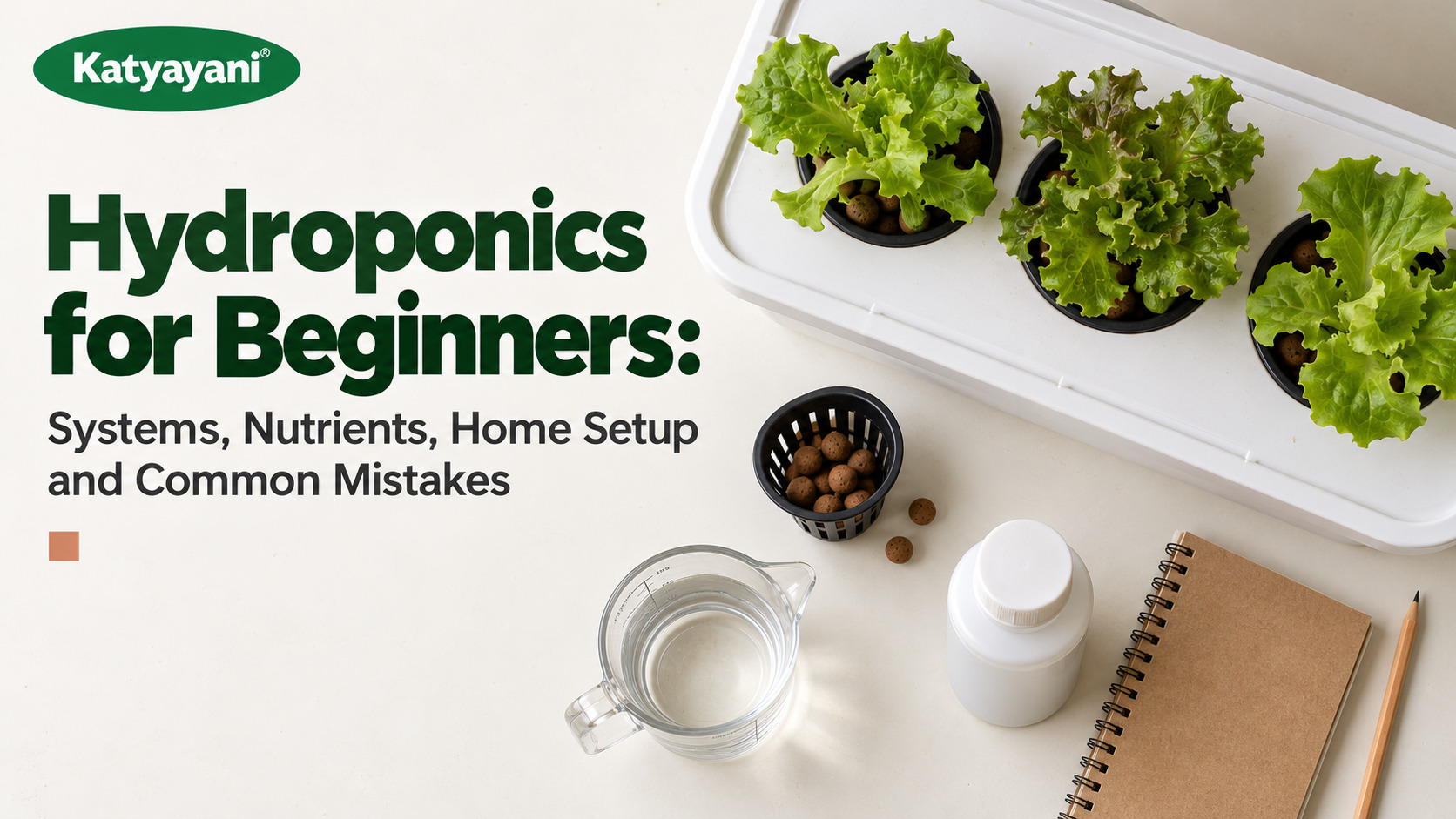
Hydroponics is growing plants without soil by feeding their roots a water-based nutrient solution. Beginners should start with the Kratky method or deep water culture and grow lettuce or herbs. Keep nutrient pH at about 5.5 to 6.5 and EC near 1.2 to 1.8 dS/m, use a darkened reservoir, and check the solution weekly.
What is hydroponics?
Hydroponics is growing plants without soil. The nutrients that roots would normally find in soil are dissolved in water, and the roots take them up directly from that solution or from an inert medium wetted by it. Wikipedia describes it as a type of horticulture and a subset of hydroculture that uses water-based mineral nutrient solutions.
The idea is old. Julius von Sachs and Wilhelm Knop developed soilless cultivation in the 1859-1875 period, and William Gericke introduced the word "hydroponics" in 1937. A famous 1938 bulletin by Hoagland and Arnon claimed hydroponic yields were no better than good soil yields, which is a useful reminder: hydroponics is a different way to deliver water and nutrients, not a magic yield multiplier.
For a home grower the appeal is practical. You can grow leafy greens and herbs on a balcony or in a spare room, with no garden soil, fewer soil-borne problems and much less water. The cost is that you now have to supply everything the soil used to buffer: nutrients, pH, oxygen and cleanliness.
How does hydroponics work?
- Roots are held in a net pot with an inert medium (or bare in the solution).
- Water carries dissolved nutrients (nitrogen, phosphorus, potassium, calcium, magnesium, sulphur and micronutrients) to the roots.
- Oxygen reaches the roots from an air stone, a flowing film, or an air gap that forms as the water level drops.
- pH and EC are kept in range. pH decides whether nutrients are available; EC (electrical conductivity) shows how strong the solution is.
- Light feeds the plant. Indoor setups need good sunlight or grow lights. One Indian guide suggests 4 to 6 hours of sunlight a day for a home system, or LED lights.
What are the types of hydroponic systems?
Wikipedia groups systems by how the solution reaches the roots. These are the ones a beginner will meet.
| System | How it works | Needs pump or power? | Beginner verdict |
|---|---|---|---|
| Kratky (non-circulating) | Net pot sits in a tank or dark bottle of nutrient solution. As plants drink, the level drops and a moist air space forms for oxygen | No pump, no electricity (Kratky 2009) | Easiest. Best for lettuce, leafy greens and short crops |
| Wick / passive sub-irrigation | Porous medium wicks solution to roots by capillary action | No pump | Simple, but weaker for large or thirsty plants |
| Deep water culture (DWC) | Roots hang in oxygenated solution, usually with an air stone | Air pump | Bootstrap Farmer: dead simple, most forgiving |
| Nutrient film technique (NFT) | Shallow stream of solution flows past bare roots in a channel | Water pump | Good for leafy greens at scale; little buffer if the pump fails |
| Ebb and flow (flood and drain) | Tray is flooded on a timer, then drained | Water pump, air pump, timer | Grows nearly any crop but has more parts |
| Drip | Solution dripped onto a medium around each plant | Pump, often a timer | Used for tomato, pepper and cucumber (Wikipedia: often run-to-waste) |
| Aeroponics | Roots hang in air and are misted | High-pressure pump | Bootstrap Farmer: the most sensitive; not for beginners |
Which is the easiest hydroponic system for beginners? Kratky for a first leafy-green experiment, and DWC for a slightly larger first system. Bootstrap Farmer's advice is to stick with systems that have the fewest pumps and timers, and to choose "the one you have the time and patience for".
How does the Kratky method work, and how long does lettuce take?
The Kratky method was developed by Bernard Kratky at the University of Hawaii's Beaumont Agricultural Research Center. In his 2009 paper, lettuce is seeded in a tapered plastic net pot filled with growing medium and set in a darkened 4-litre bottle filled with nutrient solution, with the lower 3 cm of the pot immersed. The medium stays moist by capillary action. As the plant grows, the solution level falls and leaves an expanding moist air space where "oxygen roots" form. All the solution is added before planting, and no extra labour is needed until harvest.
- Harvest time: leaf and semi-head lettuce cultivars are usually harvested about 6 to 7 weeks after seeding.
- Head size and solution: growers typically aim for 150 to 250 g heads using about 3 to 6 litres of solution per plant. A model system fills the tank with 4 to 8 litres per plant before planting.
- Water efficiency: less than 20 litres per kg of lettuce is common, and as low as 11 litres per kg has been recorded.
- One rule: never top up the solution so that it covers the oxygen roots. Kratky warns that raising the level can make the plant "drown". The level may stay the same or fall, but should not rise.
The paper is about lettuce and similar short-term crops, so do not expect Kratky to carry tomatoes to harvest in a bottle.
What do plants need in a hydroponic nutrient solution?
Plants need the same macro and micro nutrients as in soil, but in a dissolved, balanced form. Most beginners buy a ready-made two-part mix. Bootstrap Farmer recommends starting with a reputable brand's basic one- or two-part fertiliser, noting that some concentrates cannot be stored together. Keep Part A and Part B separate until they are diluted.
Katyayani's Hydroponic Nutrients LEAFY-400 is a two-part mix (Leafy-A and Leafy-B) for leafy greens, salads and microgreens. The product page gives the dose as 5 ml each of Leafy-A and Leafy-B per litre of water, with pH adjusted to 5.5 to 6.5, and states it is only for hydroponics, not for field or soil use. For fruiting vegetables, see the hydroponic nutrients collection, which includes a mix for tomatoes and veggies.
What pH and EC should you aim for?
| Parameter | Target | Source |
|---|---|---|
| pH | 5.5 to 6.0 for leafy greens | Cornell leafy greens guide (search summary) |
| pH | 5.5 to 6.5 | Katyayani Leafy-400 product page |
| EC at germination (NFT lettuce) | 1.2 dS/m | UF/IFAS EDIS AE610 |
| EC during production (NFT lettuce) | 1.5 to 1.8 dS/m | UF/IFAS EDIS AE610 |
| EC in a 24-variety trial | Growth was higher at 1.3 and 2.0 dS/m than at 2.9 and 3.9; higher levels likely caused osmotic stress | Purdue Extension HO-309-W |
| Air temperature in a lettuce trial | 24 C day and 19 C night | UF/IFAS EDIS AE610 (growth chamber) |
So the plain advice is: start with the label dose, adjust pH into the 5.5 to 6.5 band, and buy a basic pen EC meter. UF/IFAS and Purdue both suggest a gentle EC is safer than a strong one for lettuce. Why does pH matter? Because iron and other micronutrients become unavailable outside the right band, in the same way described in our guide on soil pH and nutrient lock. Wikipedia adds that hydroponic solutions change pH and oxygen faster than soil, and that iron can precipitate out, so chelated iron is often used.
What can you grow in hydroponics as a beginner?
- Lettuce and leafy greens: the best first crop and the subject of most research, including Kratky's and the UF/IFAS and Purdue trials.
- Herbs: basil and mint are repeatedly recommended in Indian beginner guides.
- Spinach and other greens: also recommended for a first setup by the same guides. A Google-sourced summary found no harvest-day tables for them, so check your seed pack and local trial.
- Microgreens: the Leafy-400 label names them as suitable.
- Later, fruiting crops: tomato, pepper and cucumber are the usual commercial hydroponic crops (Wikipedia) but need larger systems, support and more nutrient management.
If you also keep pots or a terrace, our guides on winter vegetables in pots and terrace garden soil mix help you decide what to grow in soil and what to grow in water.
What do you need for a home hydroponic setup?
| Item | Why | Beginner tip |
|---|---|---|
| Container or tray | Holds the solution | Opaque or darkened to stop algae; food-safe material (Bootstrap Farmer warns not everything at a hardware store is rated for potable water) |
| Net pots and medium | Hold the plant and keep roots moist | Rockwool is the most widely used medium (Wikipedia); coco coir needs thorough washing (Wikipedia says up to six months of washing in commercial settings) so buy washed coir; clay pebbles are reusable |
| Nutrient mix | Complete feed | Use a ready two-part mix first |
| pH pen or drops and EC meter | Keep the solution in range | Test every few days at first |
| Air pump and air stone (DWC) | Oxygen for roots | Keep a spare; stones need cleaning and eventually fail (Bootstrap Farmer) |
| Light | Photosynthesis | Sunny window, balcony, or LED lights |
| Reservoir thermometer | Warm solution holds less oxygen | Wikipedia notes hydroponic water holds only about 8 mg of air per kg |
On cost, Indian retailer and lifestyle guides put a small DIY home system at around Rs 5,000, with bought and assembled systems costing several times more. These are rough, non-independent figures, so compare quotes. For a Kratky bottle trial, the cost is mainly nutrients and a few net pots.
How do you start hydroponics at home? Step by step
- Pick one crop and one system. Lettuce in a Kratky tank or a small DWC bucket.
- Start seeds in a medium such as rockwool cubes or coir in a net pot. Keep it moist and warm until it sprouts, and use a weaker solution at this stage (UF/IFAS puts lettuce germination EC at 1.2 dS/m).
- Mix the nutrient solution with clean water at the label dose. For Leafy-400, 5 ml of each part per litre.
- Adjust pH into range and check EC.
- Set the plant so the lower part of the net pot touches the solution (Kratky) or the roots hang in oxygenated water (DWC).
- Keep the reservoir dark and covered to prevent algae.
- Check every day or two: level, colour of roots, leaf colour, smell of the water.
- Top up with plain water or fresh solution as the system requires, but remember Kratky's rule about not raising the level over the oxygen roots.
- Flush and clean the system between crops, and weekly in recirculating systems; Bootstrap Farmer recommends a weekly flush with clean water and hydrogen peroxide.
- Harvest leaf lettuce at the stage you like. Kratky's typical window is 6 to 7 weeks from seeding.
What are the disadvantages of hydroponics?
- Power and pump dependence. Wikipedia notes NFT has little buffering against flow interruptions such as power outages.
- Low oxygen in the water. Hydroponic water holds about 8 mg of air per kg, so aeration matters.
- Energy use. Pumps, filtration and lights can use a lot of electricity.
- Fast problems. Solution pH and oxygen change faster than soil, and disease can spread through shared water.
- Some plants do not suit it. Some species become waterlogged in hydroponic systems.
- Upfront cost and learning curve. Even Bootstrap Farmer calls good systems "an investment".
- Mixed yield claims. Some studies show 20 to 30% yield increases and up to 90% less water than conventional farming (Wikipedia), but a 1938 bulletin found no yield advantage over good soil. Treat claims with care.
What mistakes do beginners make?
| Mistake | Why it hurts | Fix |
|---|---|---|
| Using a cheap pump or no spare air stone | One failure kills the crop | Buy a reliable pump and keep spares (Bootstrap Farmer) |
| Building a complex system first | More parts means more failure points | Start with Kratky or DWC |
| Letting light into the reservoir | Algae competes for nutrients | Use a dark or covered container |
| Raising the Kratky level over the oxygen roots | Plant drowns (Kratky) | Only let the level stay or fall |
| Mixing concentrates together | Some nutrients form precipitates | Keep Part A and B apart until diluted |
| Overstrong solution | Osmotic stress (Purdue) | Stay near EC 1.3-2.0 for lettuce |
| Skipping cleaning | Slime and disease | Weekly flush and clean between crops |
| Using salt-loaded coco coir | Salt damage | Buy washed coir or flush it (Bootstrap Farmer) |
If you see yellow or pale leaves, our nutrient deficiency chart helps you read the pattern, and if roots turn brown and slimy, the diagnosis steps in root rot in containers apply to water culture too: reduce temperature, improve oxygen and clean the system.
Is hydroponics a business option too?
For home growing it is a hobby with a small payback. For larger farms, the economics are different: costs, revenue, crop choice and market risk matter more than technique. Our separate guide on vertical farming and hydroponics business models covers that. If you plan a covered structure to protect crops, also read greenhouse farming in India.
Conclusion
Start small and boring: one crop (lettuce or basil), one forgiving system (Kratky or DWC), a dark covered reservoir, a ready two-part nutrient mix at label strength, pH between 5.5 and 6.5 and a gentle EC. Write down what you do each week. When that first batch works, scale to more pots or a simple NFT bench. If something fails, check oxygen, pH, light on the reservoir and cleanliness before adding more nutrients.
Why trust this guide
Written by Team Katyayani, Editorial Team at Katyayani Organics. Cross-checked against published research and university extension programs.

Leave a Comment