 12 min read
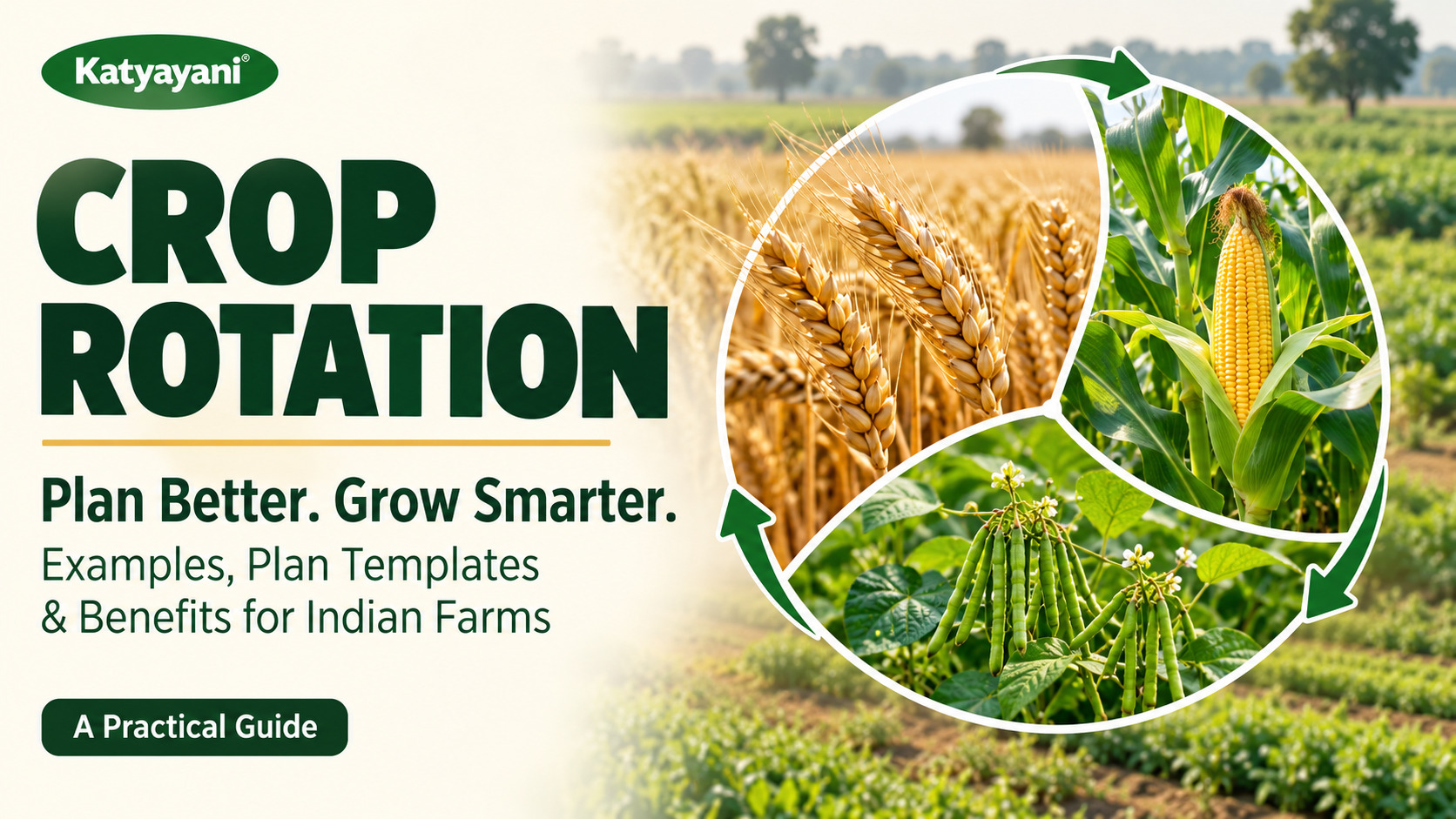
Crop rotation is growing different crops one after another on the same land instead of repeating one crop. A legume such as chana or moong is followed by a cereal such as wheat or rice, so soil nitrogen is restored and pest and disease cycles break. The simplest order is legume, then leafy or fruiting crop, then root crop, then back to legume.
What is crop rotation?
Crop rotation is the practice of growing a planned series of different crops on the same field across seasons or years. Rodale Institute gives a simple example: after corn, which uses a lot of nitrogen, a farmer might plant beans, which return nitrogen to the soil. Britannica describes it as the successive cultivation of different crops in a specified order on the same fields, in contrast to a one-crop system or haphazard succession.
It is different from intercropping, where two crops grow together in the same season, and from fallowing, where land is left unplanted. In practice a good plan uses all three tools: rotation across years, intercrops within a season, and green manure or fallow where needed.
Why is crop rotation important? Benefits explained
Different crops draw different nutrients and host different pests. When one crop is repeated, the same nutrients get mined and the same pests and diseases get a permanent home. Rodale puts it plainly: monocultures push growers towards ever higher chemical fertiliser and pesticide use to hold yield. The benefits of rotation fall into five groups.
| Benefit | How it works | Evidence |
|---|---|---|
| Better soil nutrition | Legumes add nitrogen; deep-rooted crops bring up nutrients; residue adds organic matter | A preceding pulse may contribute 18-70 kg N/ha to the next crop (ICAR review quoted in a search summary, VERIFY) |
| Fewer soil diseases | Starves pathogens of their host. Clubroot and onion white rot are examples (RHS) | In Penn State fields, tomato early-blight defoliation was 3% in year 1, 30% in year 2, 74% in year 3 and 70% in year 4 of repeat planting (Cornell) |
| Fewer pests | Breaks the life cycle of insects and nematodes that specialise on one crop | Wikipedia: rotation interrupts pest life cycles and habitat |
| Weed control | Different crops and tillage patterns stop one weed from dominating | TNAU: wheat followed by wet rice helps against Phalaris minor |
| Erosion and soil carbon | Cover and rest crops protect the surface | Wikipedia cites 0.41 t soil organic carbon per hectare a year in Brazil with no-till plus intensive rotation, and up to 43% less runoff with a rye cover crop after potato (the entry flags some claims for citations) |
There is also a business benefit. Britannica notes that well-planned rotations let labour, power and equipment be used more efficiently and reduce weather and market risk.
Repeat planting shows up faster than most growers expect. In a second Penn State trial cited by Cornell, muskmelon Alternaria blight appeared 5 days earlier in year 2 than in year 1, and 21 days earlier by year 5 (first seen 18 July instead of 8 August).
What are the basic rules of crop rotation?
TNAU's organic farming section lists about twenty rules. The ones that matter most to a working farmer or gardener are these, each with TNAU's own example.
| Rule | TNAU example | Why it works |
|---|---|---|
| Legume then non-legume, and the reverse | Green gram followed by wheat or maize | Legumes add nitrogen; cereals use it |
| Deep-rooted then shallow-rooted | Cotton, castor or pigeonpea followed by potato, lentil or green gram | Different soil layers are used in turn |
| Heavily fertilised then light feeder | Maize followed by black gram or gourds | Uses leftover nutrients, saves input cost |
| Exhaustive then restorative | Sugarcane or napier followed by groundnut, cowpea or green gram | Gives the soil a recovery crop |
| Green manure then grain crop | Dhaincha followed by rice; green gram or cowpea followed by wheat or maize | Adds organic matter and nitrogen |
| Wet-soil crop then dry-soil crop | Rice followed by Bengal gram, lathyrus, pulses or oilseeds | Reduces build-up of hard-to-control weeds seen in continuous wet rice |
| Dicot then monocot | Potato, mustard, groundnut or pulses followed by rice, wheat, sugarcane or jowar | Breaks pest and disease cycles that run in one plant group |
| Susceptible crop then break or trap crop | Sugarcane then marigold for nematodes; jowar then castor for Striga | Lowers soil-borne pest load |
| Ratoon then deep-rooted restorative | Sugarcane or jowar ratoon followed by pigeonpea, lucerne or cowpea | Repairs soil after a long-duration crop |
| Same microbe family: use a common host | Rhizobium group lists: peas, lentil, lathyrus share one; beans, green gram, black gram share another; cowpea, pigeonpea, soybean, Bengal gram share another | Helps you pick the right culture for each legume |
TNAU's closing line is worth keeping: rotating crop varieties and cultural practices, in addition to rotational cropping, gives more and surer benefits than rotating crops or land alone.
What are examples of crop rotation in India?
These sequences combine the rules above with common Indian cropping. Pick the one that matches your season and irrigation. Where a number is shown it is from a named source.
| Region and system | Rotation | Why it makes sense |
|---|---|---|
| Indo-Gangetic plains, irrigated | Rice, wheat, then moong (summer) | Mung bean in the short gap between wheat and rice. A long-term study reported rice yield up 10-14% when mung bean was in the rotation (search summary, VERIFY) |
| Rice fallows | Rice, then chana, lentil or lathyrus | Wet-soil crop followed by dry-soil pulse (TNAU rule). ICAR review notes barriers: seed, irrigation, labour and inputs |
| Cotton belts | Cotton, then wheat or gram | TNAU: leaf-shedding crop followed by a non-leaf-shedding crop, and deep-rooted followed by shallow-rooted |
| Sugarcane areas | Sugarcane, then marigold or groundnut/cowpea | TNAU: nematode trap crop (marigold) and restorative crops after sugarcane |
| Mustard and potato areas | Mustard or potato, then wheat or rice | Dicot followed by monocot |
| Kitchen garden | See the 3 and 4 year plan below | Moves families so no bed gets the same group in successive years |
Why not stay with rice and wheat? Estimates of the rice-wheat area in India range widely, from 9.2 million hectares in a 2020 paper cited in Frontiers to 10.5 million in an ICAR Indian Farming article (a 2025 paper quotes 26 million). Whichever you use, papers agree that continuous cultivation has led to stagnation or decline in productivity in parts of the plains. A PAU Ludhiana study in Frontiers in Agronomy (2025) reported that a legume-integrated system gave 68.97% higher rice-equivalent yield (199.88 q/ha) than rice-wheat (118.29 q/ha), based on a search summary (VERIFY with the paper).
For pigeonpea in the rice-wheat belt, ICAR, ICRISAT and partners have worked on early-duration varieties that fit the pigeonpea-wheat rotation (bulletin).
What is the best order for crop rotation in a vegetable garden?
The RHS uses four groups: brassicas (cabbage family, kale, radish, turnip), legumes (peas and beans), onions (onion, garlic, shallot, leek), and the potato family (potato, tomato), plus a root group (beetroot, carrot, celery, parsnip, parsley and similar). Cucurbits, salads and sweetcorn can go wherever convenient as long as they are not grown too often in one spot. RHS gives these two plans.
Three-year plan (RHS)
| Bed | Year 1 | Year 2 | Year 3 |
|---|---|---|---|
| A | Potatoes | Legumes, onions and roots | Brassicas |
| B | Legumes, onions and roots | Brassicas | Potatoes |
| C | Brassicas | Potatoes | Legumes, onions and roots |
Four-year plan (RHS)
| Bed | Year 1 | Year 2 | Year 3 | Year 4 |
|---|---|---|---|---|
| A | Legumes | Brassicas | Potatoes | Onions and roots |
| B | Brassicas | Potatoes | Onions and roots | Legumes |
| C | Potatoes | Onions and roots | Legumes | Brassicas |
| D | Onions and roots | Legumes | Brassicas | Potatoes |
So the short answer to "what is the best order" is: legumes first (they add nitrogen), then the hungry leafy brassicas, then potato or tomato family, then roots and onions, and back to legumes. For India you can swap in tomato, brinjal and chilli for the potato-family bed and add a cucurbit bed. Cornell warns that eggplant Verticillium wilt needs a 4-5 year gap and that tomato, potato and pepper should be avoided in that gap, so keep the whole potato family together as one group.
Most plans fail through lack of records, not lack of ideas. Draw the beds, label each with the crop and date, and photograph them. Our winter kitchen garden feeding schedule and pot growing guide show season planning that fits into this.
How many years should you wait before planting the same crop again?
This is the question competitor pages skip. Cornell and Penn State publish minimum gaps for specific vegetable diseases. They are written for US conditions, so use them as a minimum and expect longer gaps where a disease is already heavy.
| Crop | Disease | Minimum gap (years) | Note |
|---|---|---|---|
| Cabbage family, radish, turnip | Clubroot | 7 | Avoid turnip and radish too; raise pH to 6.8 or above |
| Cabbage family | Black rot | 2-3 | Avoid turnip |
| Cabbage family | Blackleg | 3-4 | Avoid turnip |
| Peas | Root rots | 3-4 | |
| Peas | Fusarium wilt | 4-5 | |
| Tomato | Fusarium wilt | 3 | |
| Tomato | Early blight | 2 | Avoid potato |
| Eggplant | Verticillium wilt | 4-5 | Avoid tomato, potato, pepper, strawberry, brambles |
| Potato | Verticillium wilt | 3-4 | Without tomato, eggplant, pepper |
| Muskmelon and watermelon | Fusarium wilt | 4+ | Each has its own Fusarium wilt |
| Onion | Leaf blights | 1-2 | |
| Spinach | Downy mildew and white rust | 2 | |
| Carrot | Leaf blights | 2-3 |
A pH note: the clubroot rule of raising pH to 6.8 or above connects to nutrient availability too. See our guide on soil pH and nutrient lock before liming, and test first through your soil health card.
What is a four-crop rotation?
The best-known four-crop rotation is the Norfolk four-course system: wheat, turnips, barley and clover. Charles Townshend (1674-1738) popularised it in 18th-century Britain, and it is regarded as a key step in the British Agricultural Revolution, according to Wikipedia. Wheat and barley are cereals, turnips are a cleaning root crop that also feeds livestock, and clover is the legume that rebuilds nitrogen. Older systems left land fallow: the two-field system planted half the land each year, and the medieval three-field system planted two-thirds. Britannica notes that most modern rotations stay within eight years or less and recommends a legume about once in every four years.
How does a legume in the rotation help the next crop?
Legumes host Rhizobium bacteria in root nodules that fix atmospheric nitrogen. Wikipedia notes the amount available depends on the legume, how effective the rhizobia are and soil conditions. TNAU also lists which legumes share the same Rhizobium group, which matters when you choose a culture. Where a legume is new to a field, seed treatment with a matching culture helps nodulation; a product such as Rhizobium bio-fertilizer is meant for this, and our guide on Rhizobium, PSB and KMB for chana explains timing and seed treatment. For wilt-prone pulses, seed treatment to prevent chana wilt works alongside rotation, since an ICRISAT pigeonpea study found one-year non-host breaks lowered wilt incidence in the next crop.
How do you handle crop residue between crops in a rotation?
Residue is part of the rotation. Burning wastes the organic matter you are trying to build. Between rice and wheat the gap is short, and our guide on parali management with a bio-decomposer compares options. A culture such as the decomposing culture activator is used to speed breakdown of straw so the next crop can be sown on time; follow the label for dose. If soil-borne disease is the concern, Trichoderma viride powder is a common soil and seed treatment alongside rotation, not a substitute for it.
What are the limits and challenges of crop rotation?
- Soil type, climate, irrigation, weather, markets and labour limit which crops you can rotate (Wikipedia).
- Row crops such as vegetables are often the most profitable but deplete nutrients and soil structure, so a rotation can mean growing a lower-income crop for a season.
- Poor planning can still cause nutrient imbalances or pathogen build-up, and effects may take years to appear.
- Small farms often cannot afford long cover-crop periods.
- In rice fallows, an ICAR review lists lack of quality seed, irrigation, labour and inputs as the main hurdles for pulses.
- If you plan organic certification, note that the US organic regulations specifically require a rotation that maintains soil organic matter, controls pests, manages nutrients and protects against erosion (USDA AMS). For Indian certification routes, see NPOP vs PGS.
Conclusion
Crop rotation is cheap to start and slow to pay back, so begin with one change: put a legume where a cereal or heavy feeder has been, or move your vegetable families one bed forward. Use the TNAU rules to pick the next crop, the Cornell gaps to avoid disease, and a written map so that next year you know what grew where. Combine it with soil testing, residue management and the right bio-inputs rather than treating it as a stand-alone fix.
Why trust this guide
Written by Team Katyayani, Editorial Team at Katyayani Organics. Cross-checked against published research and university extension programs.


Leave a Comment